Trump hails ‘fantastic trade deals’ with Xi, says US and China agree Iran must not get nuclear weapon
Trump also announced that Xi will travel to the United States around Sept. 24 in a visit that, he promised, will be "reciprocal."

Donald Trump meeting with Xi Jinping on the sidelines of his visit to Zhongnanhai Garden in Beijing

President Donald Trump closed his two-day visit to Beijing on Friday, asserting that he reached "fantastic trade agreements" with his Chinese counterpart, Xi Jinping, and revealing a common position between the two powers regarding the Iranian nuclear program and the war in the Middle East.
"We've made some fantastic trade deals, great for both countries," the Republican leader said after touring the gardens of Zhongnanhai, the Chinese government's central complex next to the Forbidden City, where Xi had welcomed him with a handshake to begin the second and final day of the summit.
Trump did not offer details on the content of the pacts reached, but did address other issues, including the good relationship he has with Xi Jinping, whom he has known for more than a decade.
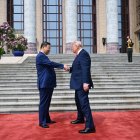
Trump said he recognizes Xi as "a man I respect greatly" and who he claimed has become "a really good friend" after nearly 12 years of dealing.
"We've settled a lot of different problems that other people wouldn't have been able to settle," Trump said, stressing that the bilateral relationship "is a very strong one." The tone contrasts with the president's usual rhetoric toward Beijing during his campaigns, when China figured among the main targets of his trade criticism.
In a Truth Social post earlier in the day, Trump sharply questioned former President Joe Biden, claiming that, because of the Democrat's administration, China's president had called the U.S. a nation "in decline." According to Trump himself, that perspective changed since he came to the White House 16 months ago.
Common position on Iran
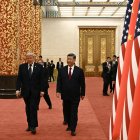
The most striking announcement came when addressing the Middle East issue, where Trump, sitting next to Xi, asserted that Beijing shares Washington's sentiment that Tehran cannot have a nuclear weapon.
"We feel very similar about [how] we want [the war] to end. We don’t want [Iran] to have a nuclear weapon," Trump said before insisting: "They cannot have a nuclear weapon."
The president also commented that they want to reopen the sea lanes, alluding to the Strait of Hormuz, and called the regime in Tehran "a little bit crazy." "We want the strait open. ... We want [Iran] to get it ended because it's a crazy thing there," he sentenced.
His words coincided with a Chinese Foreign Ministry statement issued the same Friday, which called for "a comprehensive and lasting ceasefire as soon as possible" in the Middle East and demanded that "the sea lanes should be reopened as soon as possible in response to the international community's calls."
The message, however, is significant: China, a major buyer of Iranian oil and a historic ally of Tehran, partially visibly aligned itself with Washington on regional security and geopolitical issues.
Trump also announced that Xi will travel to the United States around Sept. 24 in a visit that, he promised, will be "reciprocal."
"We're going to lay it on the line," he said, assuring that the Chinese visitors will come away "very impressed." The president closed by thanking Xi and his team: "It's been really a great couple of days."
LATEST