Iran's girls poisoned by the regime
The time sequence is not coincidental. The first poisonings occurred after the outbreak of protests over the death of Mahsa Amini.

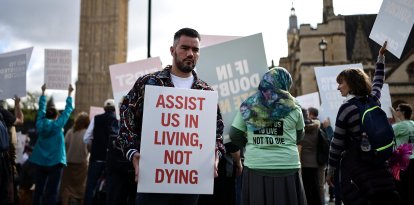
A protester holds an image of Mahsa Amini.
On November 30, 2022, in the holy city of Qom, eighteen female students began to faint, to vomit, to lose mobility in their limbs. It was the first episode in what would become an unprecedented wave of chemical attacks against Iranian students. In the months that followed, the pattern was repeated in dozens of cities: the smell of rotten oranges or cleaning products, followed by nausea, palpitations, dizziness, numbness and respiratory crises.
According to Iranian sources and the EFE news agency, about 1,000 female students were poisoned in about 50 female schools during the first week of March 2023. By the time the UN experts published their statement, the attacks had already reached ninety-one schools spread over twenty provinces of the country.
Then Interior Minister Ahmad Vahidi, the same official in charge of the investigation, publicly ruled out that the attacks were intentional and attributed ninety percent of the cases to the "stress and anxiety" of the girls themselves. State media went further, suggesting that the students were faking the symptoms to avoid exams.
The deputy education minister even admitted that the attacks were "intentional" to close girls' schools, but a few hours later retracted his words, saying he had been "misinterpreted". The health minister spoke of "some kind of moderate poison." Contradictions piled up as ambulances were overcrowded.
Doctors were forbidden to document the actual cause. "Doctors were instructed not to attribute the deaths of the affected girls to the gas attacks and instead had to cite other medical conditions as the cause" . Amnesty International, in its April 2023 report, concluded that millions of Iranian schoolgirls were at risk, that the government had systematically concealed toxicology reports, and that the state response represented a flagrant violation of the right to education, health and protection of minors. Humanium notes that international experts identified nitrogen gas as the likely poisoning agent in many cases, although the regime's refusal to provide samples and the ban on foreign correspondents visiting hospitalized girls prevented full independent verification.
The temporal sequence is not coincidental. The first poisonings occurred after the outbreak of protests over the death of Mahsa Amini. The same female students who had removed their veils in their schoolyards, chanted "Woman, Life, Freedom" and made sleeve cuts in front of portraits of former supreme leader Ali Khamenei were being hospitalized en masse. The contrast pointed out by the UN experts was brutal: the same state that took months to investigate coordinated attacks against hundreds of girls was able to deploy its security forces within hours to arrest peaceful demonstrators. Impunity was a message.
Groups of parents gathered congregate in front of the schools shouting "Death to the child-killing government." The "Women, Life, Liberty" movement had returned to the streets driven by the desperation of mothers and fathers who couldn't even figure out what had been done to their daughters.
The poisonings were the ayatollah tyranny's response to protests over the murder of Mahsa Amini, perpetrated by the Islamic Republic's Morality Police. On September 13, 2022, Mahsa Amini, a 22-year-old Kurdish woman, was arrested by the "morality police" on charges of not wearing the veil properly. Eyewitnesses claimed that the police forced her into a van, hit her on the head and took her to a detention center for an "educational class". Three days later, on September 16, Mahsa Amini died in hospital. She was 22 years old.
The protests that followed were the most massive in decades. They spread from Saqqez to Tehran, Isfahan, Mashhad, Tabriz and dozens of other cities. The "Women, Life, Freedom" movement went viral and the world, for a moment, peered inside the criminal regime.
The ayatollahs' response was methodical and fierce. Security forces fired live ammunition, metal pellets and tear gas at protesters. The protests left hundreds of demonstrators dead (including nearly 100 minors), nearly 22,000 arrested and dozens of people who lost one or both eyes from direct hits to the head from pellets.
While the girls were being poisoned in their classrooms, the regime was fine-tuning another tool: the gallows. It documenteddozens of death sentences in connection with the protests by mid-2023. "The Iranian authorities have intensified their use of the death penalty as a tool of political repression," according to Amnesty International.
The first execution occurred on December 8, 2022: Mohsen Shekari, 23, was hanged for protesting. Four days later, Majidreza Rahnavard was publicly hanged. According to Iran Human Rights, Iran executed 834 people in 2023, using capital punishment against protesters but also political dissidents.
The two journalists who revealed Mahsa Amini's case to the world (Nilufar Hamedi and Elahe Mohammadi) were convicted for "propaganda against the system". Hamedi published the photograph of Amini intubated in the hospital; Mohammadi covered her funeral. That was enough to destroy their lives. Women who appeared in videos dancing in the street without veils were forcedto apologize on state television. Relatives of the dead protesters were threatened not to speak out. Mahsa Amini's grave was damaged at least twice. His uncle was arrested by security forces days before the first anniversary of his death.
His lawyer was summoned for questioning. "Anyone who participates in the "Women, Life, Freedom" movement, whether by participating in protests or publicly showing support - for example on social media - risks arrest, detention, ill-treatment, torture and prosecution for serious crimes that can lead to the imposition of the death penalty." - International Independent Investigation Mission to Iran, September 2023.
On February 28, 2026, during the first strikes of Operation Epic Fury, an explosion partially destroyed a building in Minab. The Iranian regime immediately presented it as a girls' school bombed by the U.S. and Israel, and the propaganda machine did the rest. The casualty figures published by Iran's own state media varied astonishingly within hours. The Minab investigation is still open. It is not clear who fired the shots or how many were killed. There are documents showing that the property was historically an Islamic Revolutionary Guard facility and it is possible that the tragedy was due to outdated intelligence information.
But Operation Epic Fury, long awaited by millions of Iranians who have been under the criminal oppression of the ayatollahs for decades, was ordered by Trump so that the atrocities perpetrated by this criminal regime will not happen again. Empathy activated solely as anti-Western propaganda is not empathy, it is opportunism disguised as outrage. Those who were silent for years while the regime poisoned girls and hanged dissidents did not discover the Iranian horror. They discovered that it is now useful to them.
LATEST