Trump threatens Spain with severe tariffs if it does not increase its defense spending: 'I am very unhappy'
"I think what Spain did is a very bad thing for NATO," the U.S. leader lashed out.
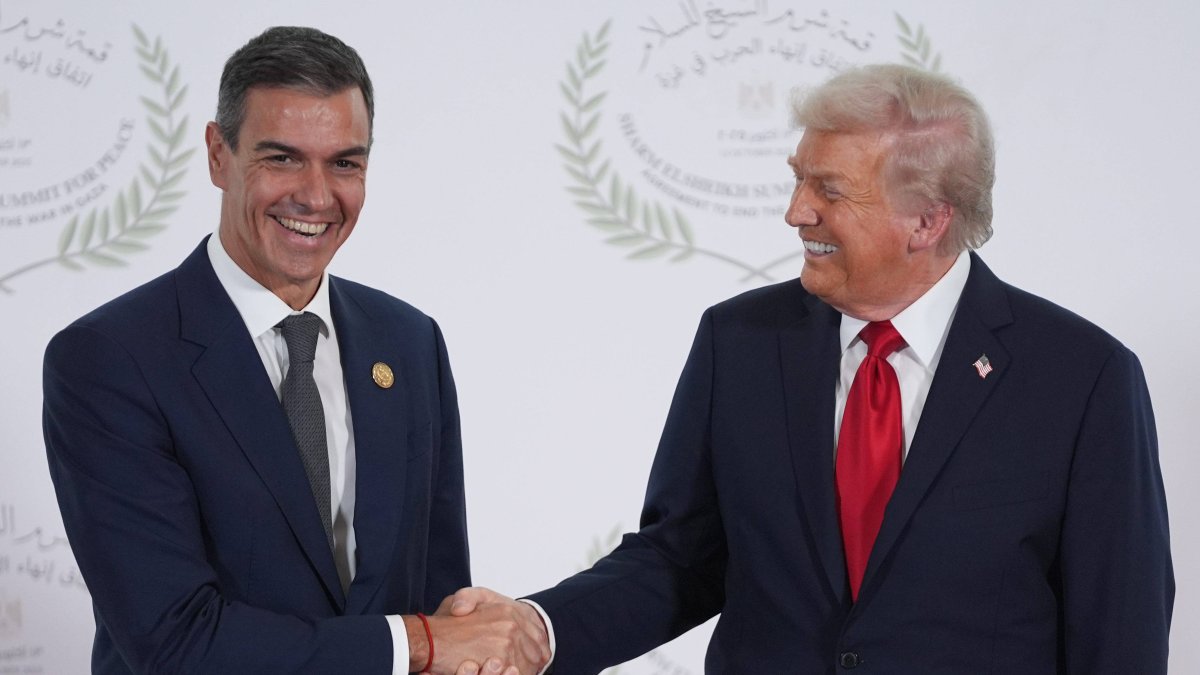
Donald Trump greets Spanish Prime Minister Pedro Sanchez.

President Donald Trump again expressed his displeasure and weariness with Spain, a country that, for the moment, has not joined its NATO allies in the increased defense spending, an explicit request from Washington to its European allies since the Republican returned to the White House.
In fact, before the press, Trump clearly threatened the Spanish government, led by leftist President Pedro Sánchez. If Spain does not increase its defense spending to levels similar to those of NATO allies, Washington will impose severe tariffs.
"I'm very unhappy with Spain. They're the only country that didn't raise up their number to 5 percent. Every other country in NATO raised up to 5 percent," Trump told reporters at the White House. “I think what Spain did is a very bad thing for NATO.”
🚨 Trump avanza aranceles a España por no elevar su gasto en defensa al 5% del PIB, acusando al Gobierno de Pedro Sánchez de «hacer algo muy incorrecto para la OTAN» y de «beneficiarse de la protección sin pagar su parte». El presidente estadounidense dijo estar «muy descontento»… pic.twitter.com/UF8a2jKiAP
— David Alandete (@alandete) October 14, 2025
The Republican leader added that he was "thinking about giving them [Spain] trade punishment through tariffs because of what they did."
While on several occasions Trump pressed Spain to increase its defense spending, these statements were undoubtedly the most forceful on the issue to date. They came just a day after Trump and Sanchez shook hands in Sharm el-Sheikh, Egypt, as part of the Hamas-Israel peace deal.
World
NATO seals a historic increase in its military spending: "5% of GDP without exception"
Diane Hernández

World
Trump before the Israeli parliament: 'Now I can say it, the hostages are back'
Santiago Ospital
The U.S. president's remarks come amid a months-long campaign for European countries to increase their spending and reduce their military dependence on the United States. The White House pressure, in fact, worked. At the NATO summit in The Hague in June, the allies finally agreed on a new defense spending target of 5% of GDP —3.5% earmarked for direct military spending and 1.5% for defense-related areas such as military mobility. Trump welcomed the move.
Pedro Sánchez, however, asked his European counterparts for an exception, arguing that Spain does not need to spend as much on defense as other nations. Currently, Spain has the lowest military spending of all NATO member countries: in 2024, just 1.3% of its GDP was spent on defense.
This has put Trump in a bad light on more than one occasion. "I think it's unbelievably disrespectful," the president said Tuesday. "And I think they should be punished for that. Yes, I do."
Last week, Trump had also been blunt, calling Spain a "laggard" and suggesting the country could be expelled from NATO (technically unlikely).
In April, amid the pressures, Pedro Sánchez promised to increase Spain's defense spending to 2% of GDP by the end of 2025, a figure that would bring the country "up to speed" with the previous NATO target. However, that figure is still well below the new 5% requirement, although most European countries have until 2035 to reach that level of spending.
LATEST