ANALYSIS
'Cuba is not a medical power': Dismantling one of the dictatorship's myths with Dr. Tony Guedes
The Cuban family doctor, exiled in Spain, wrote the book Del Dicho al Hecho. La Leyenda de la Sanidad en Cuba to put an end to the idea that the regime in Havana has been managing health services well for decades and to make it clear that "the island's healthcare has been a debacle since 1959."
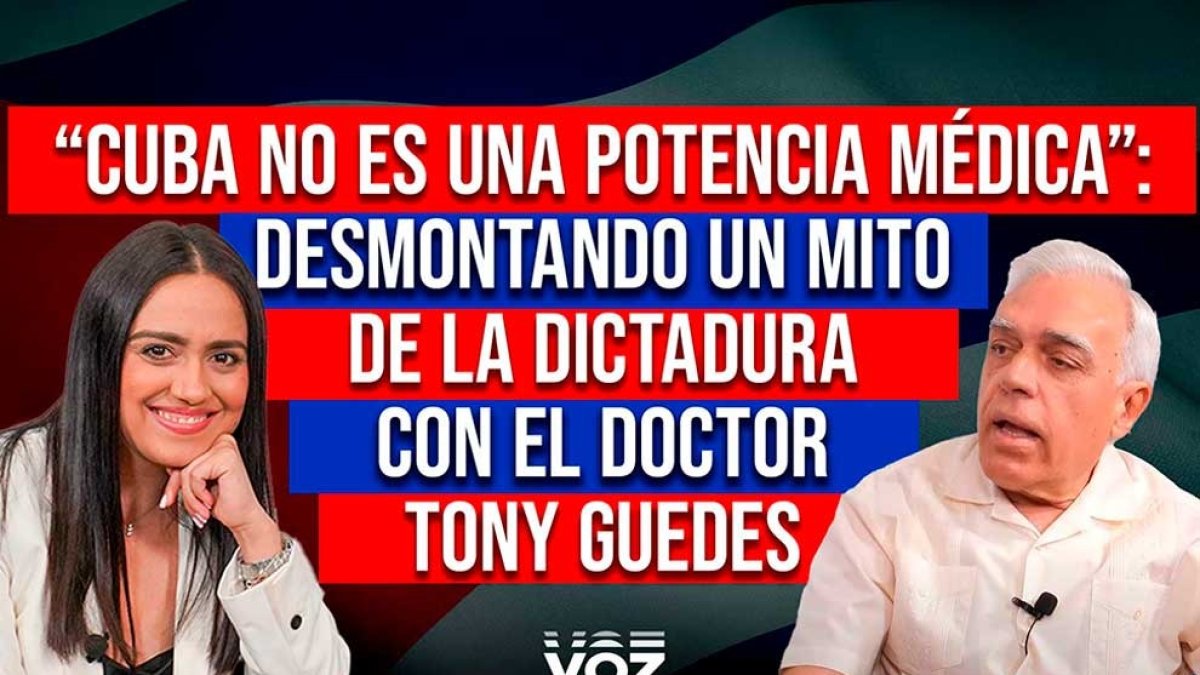
Entrevista al Dr. Tony Guedes sobre sanidad en Cuba

In recent days, several investigations have come to light on the worn-out Cuban health system, one of the bastions that the regime in Havana has always sold to the world as its "great conquest." Among these publications is the book Del Dicho al Hecho. La Leyenda de la Sanidad en Cuba (Spanish for: From What's Said to What's Done: The Myth of Healthcare in Cuba).
VOZ spoke to author Antonio "Tony" Guedes Sánchez to dismantle one of the great myths that the Cuban dictatorship has been dragging along for more than 60 years. The family doctor, born on the island and now living in exile in Spain, affirms it with data and examples in the interview: "Cuba is not a medical power."
The idea of the investigative text, according to Guedes, is to demonstrate from the regime's own official data "its contradictions, its lies, its fallacies and that Cuba after 1959 was not a middle power as it has sold, not only to Cubans, but to the world in general, and especially Latin Americans."
The author explains that the mantra of Cuba and its "glorious" health care has been bought by international, Pan-American and world health organizations. "They have bought it and repeat it without any objective verification. I believe there is more to it than that and that is why I devoted years to research," he said.
Study in three parts
Del Dicho al Hecho is divided into three chapters to review the medical history since the creation of the Republic of Cuba in 1902. The first part goes up to 1952, the second part from 1959 to 2008 and the third ends in 2024, the year of the book's publication.
According to Guedes' explanation, it is "academic-style research, 150 pages, but it is easy to read even for those who are not interested in medicine."
This study of Cuba's healthcare system is based mainly on the reports from international organizations, such as those issued by the World Health Organization (WHO) and the Statistical Yearbooks of Latin America, Statistical Yearbooks of Cuba (of the State Statistics Committee of the Cuban Ministry of Education). It also includes the official figures that have been published in recent decades by the regime.
Foreign support and the sale of "medical slave labor"
The Cuban family doctor said that an important part that sustains the myth of the success of public healthcare in the communist country is the help it has historically received from abroad. In the early years of Fidel Castro's government (1970s-80s, until the beginning of the '90s with the disappearance of the USSR), Cuba received millions of dollars in support from Russia. In the 2000s, Venezuela came to take the place of the collapsed Soviet Union, and subsequently, the island has managed to survive with the intervention of other powers and communist countries such as China, or aid from leftist governments such as those of Argentina, Bolivia, Brazil and more.
Dr. Tony Guedes adds that the training of doctors for other countries has also helped in the fabrication of the idea of Cuban healthcare seen as a victory of "The Revolution."
To this is added what the regime has called "the export of Cuban medical services," which Guedes assures, "has a background beyond solidarity and internationalism."
"There are multiple objectives," the Cuban doctor pointed out. The first of them "is ideological, to sell image; the second is intelligence penetration" because "these doctors either because they feel it or, even if they don't feel it, they are committed to steal information for Iran, Russia or China."
Guedes says there is also an economic objective. "The government keeps 80% of the salary," he claimed. "Those doctors in many places have their passports taken away," he added. All this happens in violation of the agreements of the International Labor Organization.
He said that in the communist country, "Doctors have been used in recent decades as a source of economic income, as if it were the export of a sack of sugar or tobacco to generate money."

"A silenced Cuba"
About his book, Dr. Guedes has indicated that he is satisfied because he wrote it "based on objective data," while exposing that "international organizations are very penetrated by the regime."
The former president of the Cuban Liberal Union, a political party founded in 1990, tries to expose in his book the realities of what he calls "a silenced Cuba."
"In any case it was not a power, but a very important country in health before 1959, if we compare it with Central America, the Caribbean in general with Latin American countries and even, not to mention Asia and Africa at that time, even with some countries, Portugal, Italy, Spain and in some parameters with Germany in the '50s. But today, this is not the reality, and the island has lived in a medical debacle since Castro's triumph."
Guedes continued:
The real power has never been, of course, the last few years. It is such an obvious thing. Anyone who visits Cuba, anyone who talks, who goes to a doctor there, who is honest, who is sincere, has to recognize it.
"I don't intend to tear down the wall altogether, but to help remove a brick so it collapses over time"
On communism and the totalitarian regime that the island lives today, which is going through one of the worst crises in its history, he reflects: "I do not intend to tear down the wall altogether, but to push it, to help remove a brick so that it collapses over time."
The book is available on Amazon in all formats: e-book, Kindle and print.
"Is Cuba still hurting?" we concluded with the questions. The doctor doesn't have to think about it: "It always hurts. I am Cuban to the bone, that is to say, to the marrow. What am I? I am Cuban."
LATEST