Artemis II successfully returns to Earth: NASA completes historic manned mission around the Moon
The astronauts will be transferred to the USS John P. Murtha, where they will receive medical evaluations before returning to Houston.


NASA's Artemis II mission completed Friday with a successful splashdown in the Pacific Ocean, marking a decisive step in the U.S. return to manned deep space exploration.
The Orion capsule, with four astronauts aboard, completed its descent and landed off the coast of San Diego at 8:07 p.m. EDT, ending an approximately 10-day journey around the moon.
Controlled return from deep space
The spacecraft's return was a complex technical operation that confirmed the U.S. ability to bring back a crew from beyond Earth orbit, something that had not occurred since the era of the Apollo missions.
During re-entry, Orion suffered extreme temperatures and speeds in excess of 30 times the speed of sound before deploying its parachutes and descending in a controlled manner over the Pacific. Following the water impact, joint teams from NASA and the U.S. Navy began the recovery process.
Society
'Chills': Artemis II astronauts say lunar flyby still gives them the shivers
Virginia Martínez
The astronauts will be transferred to the USS John P. Murtha, where they will receive medical evaluations before returning to Houston for post-mission analysis.
A key mission for return to the Moon
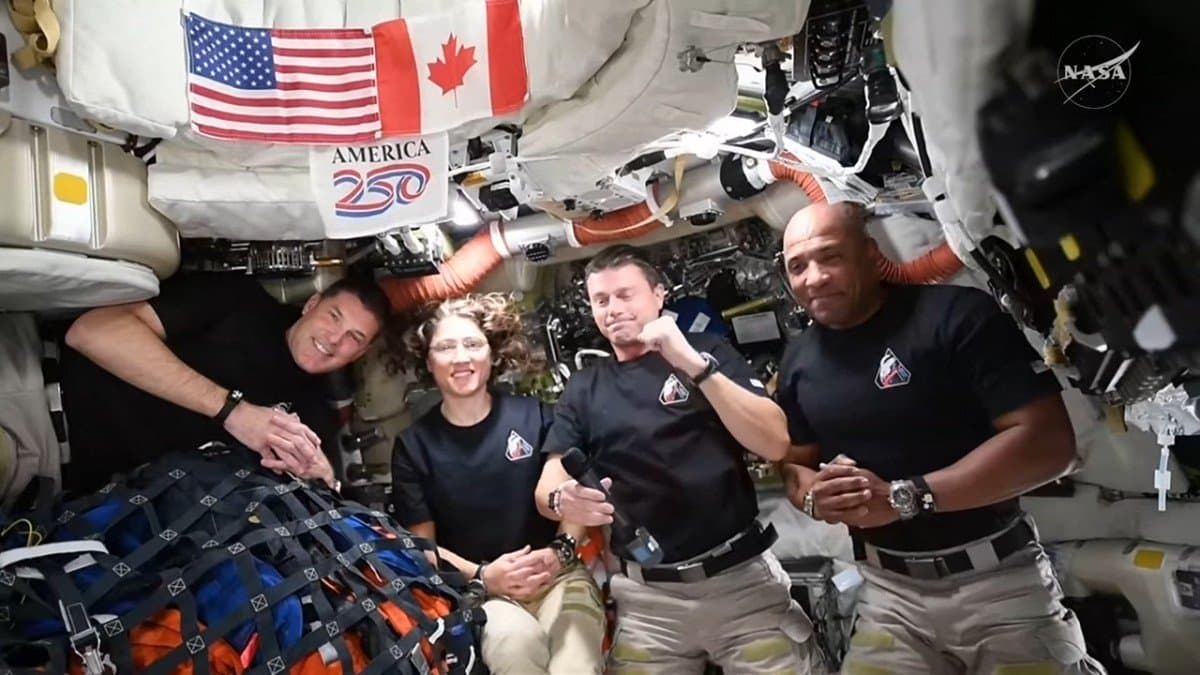
Artemis II is the first manned mission of the Artemis program and represents an essential intermediate step before future lunar landings. The crew - consisting of Reid Wiseman, Victor Glover, Christina Koch and Canadian Jeremy Hansen - orbited the Moon and returned to Earth, traveling nearly 700,000 miles.
The main objective was to test the Orion spacecraft's systems in real-world deep space conditions, from navigation to life support, laying the groundwork for future missions that will seek to establish a sustained human presence on the lunar surface.
NASA has underscored the importance of the human component in this type of exploration. Direct observation by astronauts will allow detecting details and variations that complement the data collected by automated instruments.

United States reaffirms its space leadership
The success of the mission reinforces the role of the United States as a leader in space exploration in a context of increasing global competition. Artemis II validates key technologies and also sends a clear signal about the country's ability to undertake complex missions beyond Earth orbit.
With this achievement, NASA moves toward its next big goal: to once again bring astronauts to the surface of the Moon and, eventually, pave the way for manned missions to Mars.
Society
Artemis II completes historic lunar flyby and heads home after 40-minute communication blackout
Emmanuel Alejandro Rondón
Society
Trump contacts Artemis II astronauts and invites them to the White House: 'You have made history and made America proud'
Emmanuel Alejandro Rondón
🛠 Do you think there is an error in this article?
Recommendations








LATEST