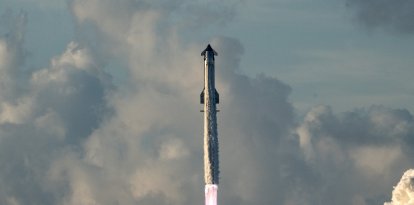
The Artemis II mission begins the final phase of its approach to the Moon
At this stage the mission is about 63,000 kilometers from the Moon and about 374,000 kilometers from Earth, a NASA official said during a direct broadcast of the event.

Photo provided by an Artemis II crew member and provided by NASA.

Astronauts on the Artemis II mission began the final phase of its approach to the Moon Monday, reaching the tipping point where lunar gravity exerts a stronger pull on the spacecraft than Earth's gravity, AFP reported.
The Orion spacecraft will use lunar gravity to propel itself in a flyby that will take the crew a record distance, surpassing any point in space reached by humans to date.
The mission, launched Wednesday, entered what NASA calls the lunar sphere of influence Monday around 04H42 GMT and will soon conduct the first lunar flyby since 1972.
At this stage the mission is about 63,000 kilometers from the moon and about 374,000 kilometers from Earth, a NASA official said during a direct broadcast of the event.
The U.S. space agency on Sunday released an image taken by the crew showing the moon and its East Basin.
"This mission marks the first time the entire Basin has been seen by human eyes," NASA said. It is a huge bull's-eye-like crater that has been photographed before by orbiting cameras.
Who is on the spacecraft?
"Thank you to you and the entire team on the ground for perpetuating the Apollo legacy with Artemis. Bon voyage and safe return," wished them the Apollo program astronaut Charles Duke, now 90 years old.
The American is one of the last men to venture up to the star, in 1972. Since then, no human being has approached it.
Revised flyby plans
NASA said the Artemis crew has completed a test to make sure the flight manual is working and also revised its science observation plan to identify and photograph various geographic features on the lunar surface.
The astronauts had started the day with a meal that included scrambled eggs and coffee, NASA said, and had awakened to the song "Pink Pony Club," Chappell Roan's pop hit.
"Morale aboard is high," Commander Reid Wiseman told the Mission Control center in Houston at the start of the crew's day.
The astronauts have been trained in geology so they can photograph and describe lunar features, including ancient lava flows and impact craters.
They will see the Moon from a unique vantage point compared to the Apollo missions of the 1960s and 1970s.
The Apollo flights flew about 70 miles above the lunar surface, but the Artemis II crew will be just over 4,000 miles at their closest approach, allowing them to see the entire, circular surface of the Moon, including the regions near both poles.

Technology
Artemis II advances to the Moon with historic records and a broken toilet
Diane Hernández
Never seen before
Artemis II astronauts have already observed entirely new perspectives.
"Last night we had our first view of the far side of the Moon, and it was absolutely spectacular," Koch said during a live interview from space.
The mission is part of a long-term plan for sustained returns to the Moon, with the goal of establishing a permanent base to serve as a platform for future exploration.
During the flyby of the satellite, "we're going to learn an awful lot about the spacecraft," NASA Director Jared Isaacman stressed Sunday on CNN.
"That's what we're most interested in in terms of data," he added, recalling that the Orion capsule had not carried a human being until now.
NASA is aiming for a moon landing in 2028, that is, before the end of Donald Trump's Donald Trump term in office.
LATEST