NASA unveils its new Roman Space Telescope, which will produce an ‘atlas of the universe’
The device will now be moved to Florida for launch into space in early September.
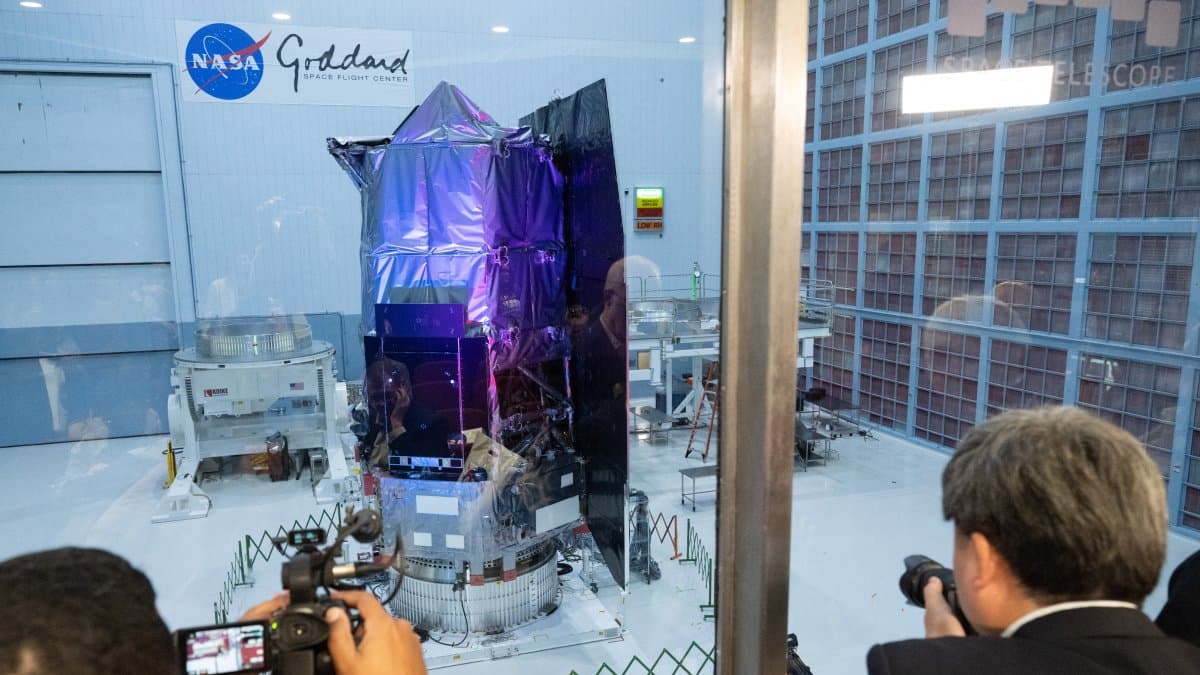

(AFP) NASA unveiled its new Roman Space Telescope, designed to explore vast areas of the universe in search of exoplanets, but also answers to the great physical mysteries posed by dark matter and dark energy.
This state-of-the-art telescope "will offer Earth a new atlas of the universe," NASA Director Jared Isaacman rejoiced Tuesday from the U.S. space agency's Goddard Center in eastern Maryland, where its assembly was completed.
The silver device, about 40 feet tall, will now be moved to Florida for launch into space in early September aboard a SpaceX rocket.
Developed over more than a decade at a cost of more than $4 billion, it is named in honor of one of America's greatest astronomers, Nancy Grace Roman, nicknamed the “Mother of Hubble” in reference to another NASA flagship telescope.
More than 35 years after the latter's commissioning, which revealed to us, among other things, that our universe is expanding faster than we thought, the Roman Space Telescope will be tasked with answering the questions that remain unanswered.
With its wide field of view, more than 100 times greater than Hubble's, it will sweep vast areas of the sky from a vantage point millions of miles from Earth.
"It will send us 11 terabytes of data a day, which means that in the first year alone it will have provided us with more data than the Hubble telescope will have collected in its entire lifetime," Mark Melton, systems engineer at Roman, tells AFP.
Thanks to this wide-angle lens, NASA expects to "discover tens of thousands of new planets" or even "thousands of supernovae," explains Nicky Fox, head of the agency's science activities.
Roman also intends to study the invisible: dark matter and dark energy, whose origin is unknown, but which are believed to account for 95% of our universe.
"If Roman ever wins the Nobel Prize, it will probably be for something we haven't even thought of yet," smiles Mark Melton.
🛠 Do you think there is an error in this article?
Recommendations






LATEST