ANALYSIS
Aleksander Ceferin and Gianni Infantino: From alliance to enmity
The relationship between the heads of UEFA and FIFA has been gradually fracturing since they took office a decade ago. The plan to sell off part of the commercial rights to the World Cup and the Club World Cup has ultimately shattered it.
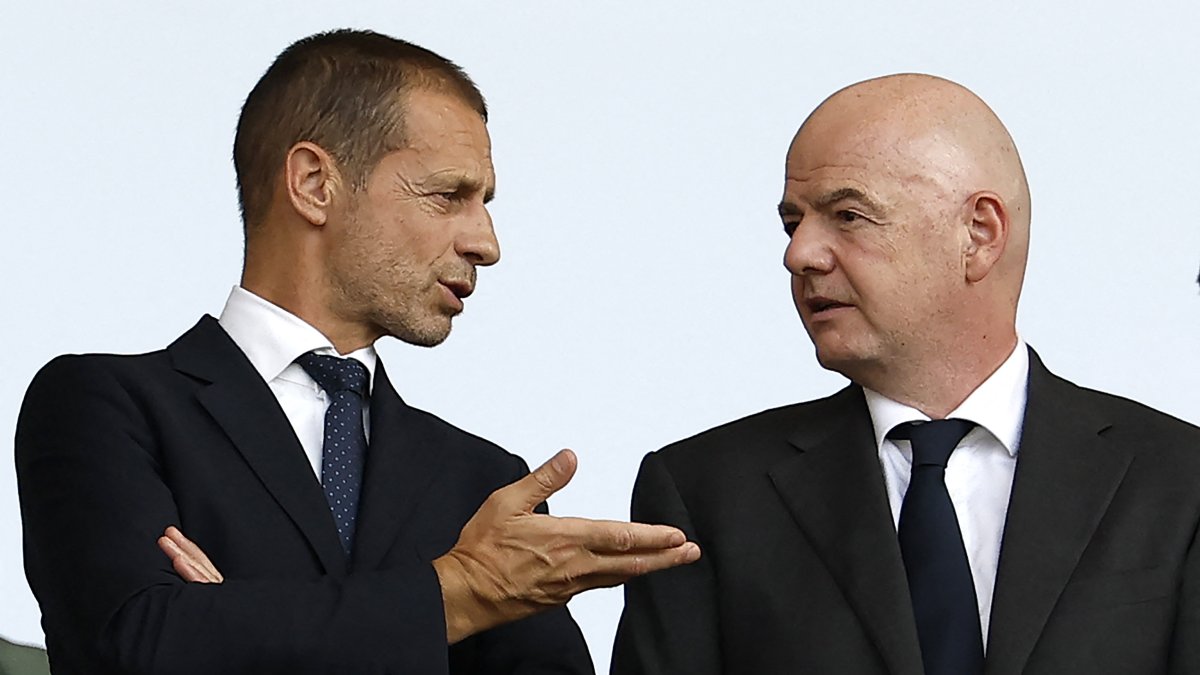
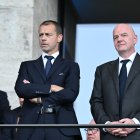
Aleksander Ceferin (left) talks with Gianni Infantino (right)

The conflict in soccer sparked by the failed sale of the commercial rights to the World Cup and the Club World Cup to private entities cannot be understood without discussing the opposing sides. The president of the International Federation of Association Football (FIFA), Gianni Infantino, saw how much of the sport he governs mounted fierce opposition to his thwarted project, citing the lack of transparency in the process and the negative impact it would have on soccer. Among all those organizations and figures who rejected what remained a mere prototype, there is one person who did not shy away and launched the boldest challenge against Infantino, despite their past as allies: Aleksander Ceferin.
The president of the Union of European Football Associations (UEFA) warned Infantino that, if he went through with the sale, none of the 55 European national associations would ever again compete in a FIFA tournament, including the World Cup. This is a very serious threat, given that UEFA includes historic powerhouses such as France, England, Germany, Portugal, Italy and Spain. Given this scenario, one might wonder who Ceferin is and what motivated him to transform himself from a strategic partner into Infantino's main nemesis.
Who is Aleksander Ceferin?
Born in Ljubljana, Slovenia, in 1967, Ceferin is a lawyer who has been involved in the world of sports for many years. After working as a representative for athletes and sports organizations—he also served on the board of directors of NK Olimpija Ljubljana, one of the top teams in the Slovenian soccer league—he took a major step forward in his professional career in 2011, when he was named president of the Slovenian Football Association. At the same time, he held certain responsibilities within UEFA, specifically on its Legal Committee.
Five years later, his big promotion came. Following a vote held at the European confederation's headquarters in Nyon, Switzerland, Ceferin, with the slogan "Football First," became the new UEFA president after securing a resounding electoral victory over his opponent. The Slovenian, who emerged as a consensus figure backed by Europe's small and medium-sized federations, faced the difficult task of restoring UEFA's trust and image, damaged by a corruption scandal some time ago.
One of the first to comment on Ceferin's victory was Infantino, who had been FIFA president for only a few months and who did not hesitate to highlight the virtues of UEFA's new leader. "He has very good ideas. He's a new face to many, but he's very competent, and I look forward to working with him, since he's also part of the new FIFA," said Infantino.
From collaboration to rivalry
Ceferin was reelected UEFA president on two other occasions: in 2019 and 2023. In neither instance were elections held because no other candidates ran. And in both cases, he received congratulations from Infantino. However, the rapport they initially displayed gradually deteriorated over time due to certain events that ultimately fractured a relationship that is essential for the good of soccer.
First, they had a clash rooted in economic considerations. While Infantino sought to monetize soccer in other markets (such as the United States and Asia) and increase his influence over the schedule, Ceferin responded by defending the interests of European clubs and national teams, which are the source of a large portion of soccer's revenue.
Then came the World Cup and a proposed change by the FIFA president that ultimately became a turning point between the two leaders. Infantino pushed the idea of holding the premier national team tournament every two years instead of every four. Ceferin described the proposal as "destructive" to the well-being of soccer players and openly threatened a European boycott of the World Cup if FIFA moved forward with this initiative. Ultimately, Infantino's goal remained merely a proposal.
A new model for the Club World Cup, launched by Infantino, also emerged. The FIFA president promoted a mega-project for the competition by expanding it to 32 teams to compete directly with the commercial appeal of the UEFA Champions League. Ceferin viewed this idea as a direct attack on the premier competition organized by the European confederation and expressed his absolute opposition to it moving forward, citing the overloaded schedule for players and how detrimental it would be to the interests of a tournament as prestigious as the UEFA Champions League.
Finally, Infantino proposed a plan to sell a portion of the commercial rights to the World Cup and the Club World Cup. Accused of having done so in secret, without consulting the parties responsible for making such decisions, and of looking only to his own personal interests, the FIFA president was met with the strongest possible responses. One of these responses came from UEFA, led by Ceferin, who did not hesitate to challenge Infantino and warn him against sabotage that would have been destructive to soccer.
LATEST