Florida races toward the future: DeSantis announces electric air taxi and autonomous vehicle tests
The state is preparing to test eVTOL aircraft before the end of 2026 and is expanding its commitment to driverless cars. The SunTrax center, in the heart of Florida, will play a key role in testing new transportation technology.
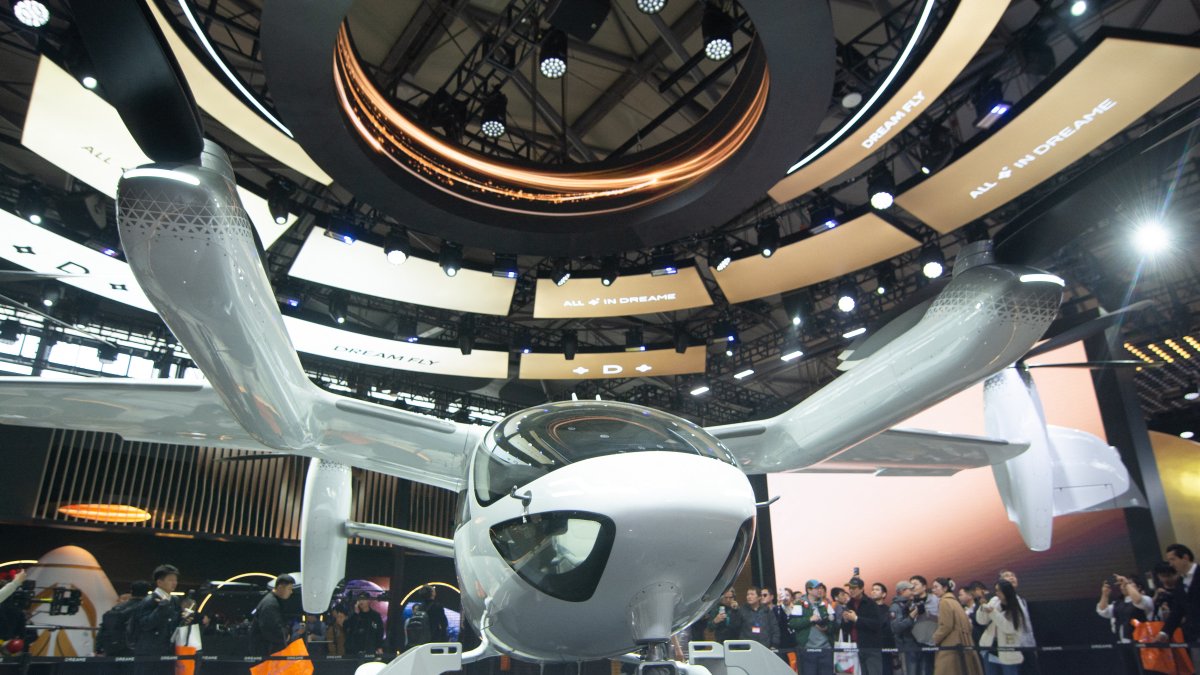
A flying taxi at a technology fair (File photo)

Florida aims to become one of the nation's leading laboratories for advanced mobility. Republican Governor Ron DeSantis announced that the state is preparing to expand testing of electric air taxis and autonomous vehicles, as part of a strategy aimed at incorporating new technologies into the transportation system.
DeSantis presented the updates on Monday during an event at SunTrax, a facility of the Florida Department of Transportation (FDOT) facility located in Auburndale in Polk County. The governor announced that testing of new electric vertical takeoff and landing (eVTOL) aircraft is scheduled to begin before the end of 2026.
The project is not starting from scratch. For months, the FDOT has been developing a specific platform at SunTrax for what is known as Advanced Air Mobility (AAM), a concept that aims to use next-generation aircraft to transport people and goods in urban, suburban and rural environments.
SunTrax: Florida's testing ground for air taxis
SunTrax began as a research center for technologies related to roads, connected vehicles, and autonomous systems, but Florida has expanded its infrastructure to also turn it into a testing ground for advanced aviation.
The FDOT operates SunTrax Air there, a center dedicated to researching, testing and validating technology related to advanced air mobility, including the infrastructure needed for future commercial operations with eVTOL aircraft.
The facility will allow researchers to study not only the behavior of the aircraft but also operational procedures, navigation, and integration with the airspace and ground facilities necessary for their operation.
In July, FDOT also announced a partnership with Eve Air Mobility, a company affiliated with Brazilian manufacturer Embraer, to advance the development of this ecosystem. The agreement calls for using SunTrax Air to study the infrastructure and procedures needed to safely integrate these aircraft into the state's transportation network.

Society
Florida will give parents control over the use of artificial intelligence in public classrooms
Diane Hernández
What are eVTOLs?
EVTOL aircraft—short for electric Vertical Take-Off and Landing—use electric propulsion systems and can take off and land vertically.
This feature allows them to operate from facilities known as vertiports, without requiring the long runways used by traditional airplanes.
Florida believes these aircraft could be used in the future not only as air taxis for passengers but also for cargo transport, medical emergencies and disaster response.
One of the corridors that authorities have identified as particularly attractive is the one between Tampa and Orlando, two of the state's major metropolitan areas connected by the congested Interstate 4. The long-term goal is to develop a network that can also extend to other regions, including the Space Coast.
Florida has already laid the legal groundwork
This year, DeSantis signed HB 1093, which took effect on July 1, 2026, and expanded the state's framework for developing and funding infrastructure related to advanced air mobility, including vertiports.
The state's strategy aims to create the conditions for manufacturers and operators to conduct tests in Florida prior to a potential commercial expansion.
The FDOT stated that it aims to position the state at the forefront of advanced air mobility development and notes that its investments seek to prepare the infrastructure for future commercial services.
Autonomous vehicles also making progress
The technological push isn't limited to the skies.
SunTrax also serves as a testing ground for autonomous vehicles and connected transportation systems, allowing for the evaluation of vehicles in scenarios that replicate various driving conditions.
At the same time, several companies are expanding their operations in Florida.
Waymo, owned by Alphabet, announced on July 8 that it is preparing to begin fully autonomous operations in Tampa, along with Denver, Las Vegas and San Diego. In the initial phase, the cars will operate without a human specialist behind the wheel and will be available to company employees before eventually opening to the public.
The company had begun preparing for its launch in Tampa since late 2025, when it transported vehicles to the city to gather data and adapt its autonomous driving system to local conditions.
Tesla also currently offers its Robotaxi service in select areas of Florida, including Miami, Orlando and Tampa, according to information available on its official support page.

Just The News
Federal appeals court revives Florida law restricting minors from attending certain drag shows
Just The News
When will air taxis be available?
DeSantis's announcement does not mean that Florida residents can immediately book a flying taxi.
The initial stages will be dedicated to testing, technology validation and infrastructure development, while manufacturers and authorities work on issues related to safety, certifications, airspace control and regulation.
The FDOT maintains that these tests will allow for the collection of information necessary to prepare for future commercial operations in advanced air mobility.
The Federal Aviation Administration (FAA) has also launched pilot programs to integrate this type of aircraft into the country, with applications including passenger transport, cargo, medical services and automated operations. Florida is among the states involved in this national effort.
With the expansion of SunTrax, new investments in vertiports and the arrival of autonomous driving companies, Florida aims to position itself as one of the first states where electric air taxis and driverless vehicles become a regular part of the transportation system.
However, the transition from current testing to widespread use will depend on this technology meeting the regulatory and safety requirements necessary before they can operate commercially on a large scale.
LATEST