The coach who overcame Argentine soccer's greatest dichotomy: Why Scaloni surpassed the legacy and debate between Menotti and Bilardo
Scaloni's achievements represent one of the finest bodies of work ever produced by any head coach, given what he has accomplished over the past eight years and the series of obstacles he has managed to overcome.
Shortly after winning the World Cups in '78 and '86, the Argentine soccer ecosystem found itself, from one moment to the next, immersed in a dichotomy and a war of paradigms that was as practical as it was ideological, to the point in which it was reflected evenly in form and substance. It was the equivalent of Spain winning this second World Cup thanks to a style of soccer entirely at odds with what was displayed in South Africa, with a head coach who sparked both admiration and animosity and defended tooth and nail a mantra and ethos contrary to that of 2010.
We are talking about César Luis Menotti and Carlos Salvador Bilardo, the two heads of a dual leadership in soccer that has shaped both the collective imagination of an entire country and its very philosophical essence. These are two stances as profoundly complex and valuable as they are opposed, which for quite some time sparked a major division that spilled over both onto the soccer field and into the newsrooms of the country's most prestigious sports media outlets. Menottism versus Bilardism: the idea of lyrical soccer versus the most rock-solid pragmatism; Achilles and Odysseus; jazz versus industrial rock.
Although until recently the rise of a figure capable of burying this two-headed monster seemed unthinkable, the disaster that was the 2018 World Cup in Russia for Argentina was destructive enough to plunge the Albiceleste into a sporting crisis that forced the Argentine Football Association to take the urgent measure of immediately firing Jorge Sampaoli. Although there were candidates of unquestionable renown at the time, such as Diego Simeone or Mauricio Pochettino, the chosen one would be a figure who had not yet coached in the First Division and whose experience on the bench was limited to serving as an opponent analyst during the Sampaoli era and a brief stint as coach of the U-20 national team: Lionel Scaloni.
Turning defeat into triumph and the construction of an unparalleled era
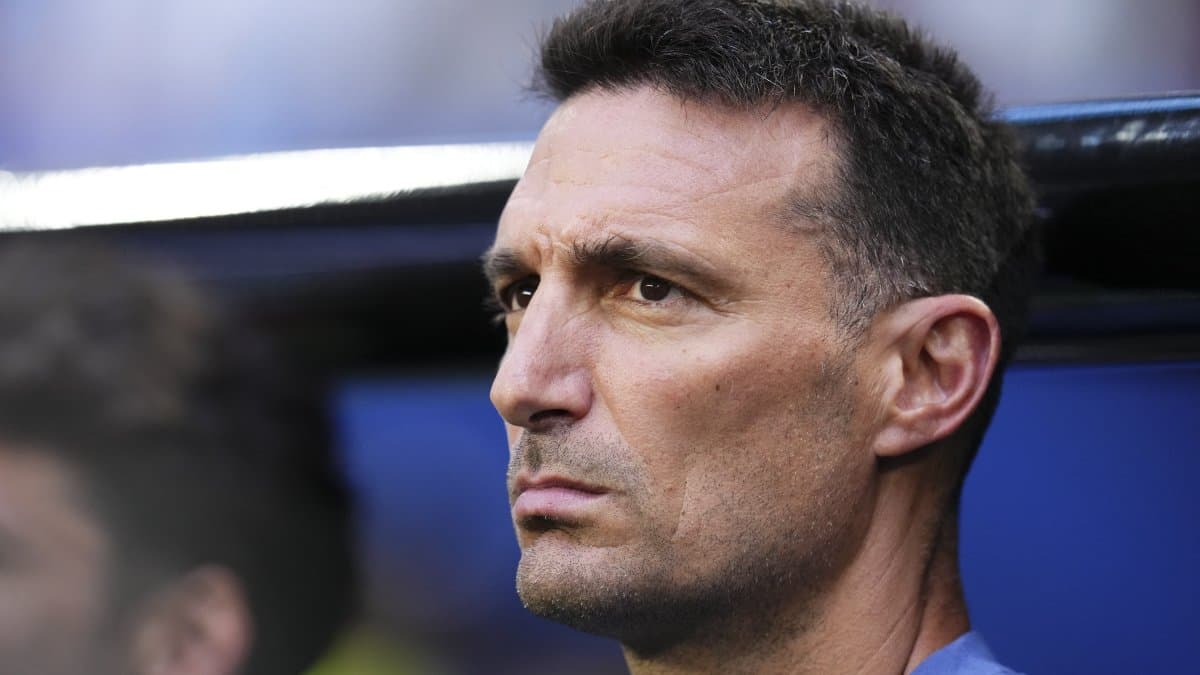
The former player for teams such as Deportivo La Coruña and West Ham United would take the helm of one of the most challenging coaching positions at the most complex moment in the team's modern history, following the pathetic performance and lackluster play displayed in Russia, a self-esteem decimated after the Copa América finals against Chile, and a "golden generation" that had run its course but which no one seemed willing to let go of. The Argentina that Scaloni inherited was considerably more challenging and formidable than the teams Menotti and Bilardo inherited in their respective eras. After all, while "El Flaco's" team was preceded by the disappointment of '74 and a lack of media pressure, "El Narigón's" team was preceded by Spain '82—a tournament with more shadows than highlights, but with plenty of reasons for short-term optimism.
Scaloni's achievements represent one of the finest bodies of work ever produced by any head coach, considering what has been accomplished over the past eight years and the series of obstacles he managed to overcome. Because it wasn't just about finding a system that could maximize the players' quality and finally provide Lionel Messi a space where he could feel comfortable and fully unleash his endless talents, but also to bring about a difficult generational shift by instilling confidence in a group of players who are now stars but who, at the time, did not seem to be so in the eyes of fans and critics alike.
Scaloni's approach was marked by courage and a sense of soccer that seemed to have been forgotten since 2014. While he didn't win the 2019 Copa América, the performance in the semifinals against Brazil displayed a level of play and character not seen in the previous four years—and which Argentina had not shown against its classic rival in an official match since that night when Juan Román Riquelme shone at the Monumental stadium in the Núñez neighborhood. That match was the beginning of it all. The turning point from which the Albiceleste would go on to achieve an impressive streak of 36 consecutive matches without a loss, during which it claimed its first title since 1993 against none other than Neymar's Brazil and a Finalissima in which it would dismantle the European champion in one of the greatest performances ever delivered by Argentina in its more-than-successful history.
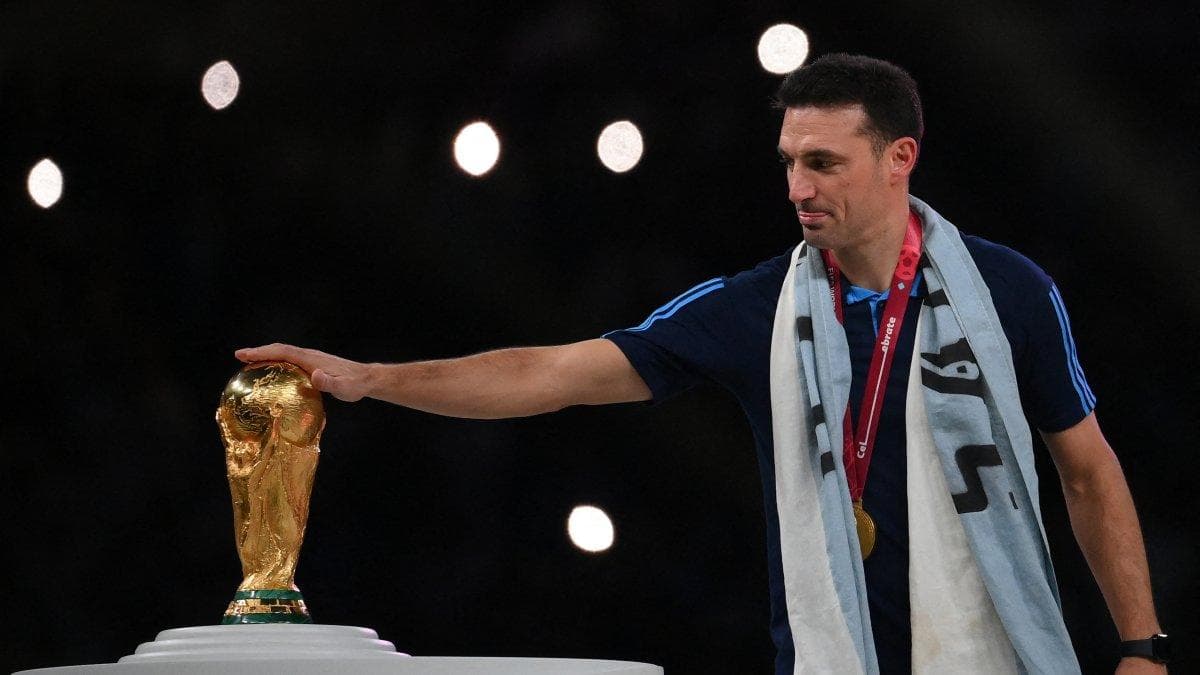
Argentina's coach Lionel Scaloni touches the World Cup trophy.AFP
The streak would come to an end following the loss to Saudi Arabia at the World Cup in Qatar, where Argentina would ultimately lift the trophy and achieve absolute glory, in what was the definitive crowning achievement of a project and a series of decisions that elevated Scaloni to the footballing pantheon and placed him among those who were right from the beginning. And, while it might have seemed that the unquestionable greatness achieved along the way was the result of chance, Scaloni knew how to sustain it and give it continuity, which allowed him not only to achieve a formidable qualifying campaign but also to win another Copa América in which his team maintained superiority from start to finish.
While all of this would have been more than enough to warrant a well-deserved break after such success, Argentina would go on to reach another World Cup final, where everything it demonstrated on the field in 2022 was mirrored emotionally and psychologically. It pulled off a series of wins in matches which seemed doomed only to rise again at the last moment, as if it were the "Real Madrid of national teams" or the main character in a story where the underdog remembers, just before giving up, that it is invincible.
The big picture shows that Scaloni has achieved an unbeatable 78.8% win rate in the 104 matches he has coached so far. Focusing solely on his record, he stands as the most successful coach in the history of the Argentine national team with four titles, clearly surpassing Menotti and Bilardo, who each won only one World Cup. And if what happened at Italy '90 is considered an emotional triumph, it stands on par with the events of the recently concluded World Cup—even in statistical and numerical terms.
Scaloni transcended the dichotomy
Menotti's legacy extends not only to a style and a way of viewing soccer, but primarily to having secured the first of the Albiceleste's three World Cup titles and having professionalized Argentine soccer, which until then had been mired in amateurism. Bilardo's legacy revolves around both a World Cup victory and the introduction of a results-oriented pragmatism that took sufficient hold to become the defining hallmark of Argentine soccer years later, evident primarily the many clubs that went on to win Copa Libertadores titles.
Scaloni's legacy boils down to the restoration of diminished greatness—the resurrection of what many considered a soccer "corpse" that was in a situation not unlike other mammoth national teams, such as Germany or Brazil, who have been suffering for some time. He rescued the Albiceleste from a widespread crisis to restore the glory that had been buried in the final years of the last century.
In light of this fact, continuing the debate between "Menottism" and "Bilardism" is an exercise that is more absurd than significant. Although it is still too early to determine whether Scaloni should be considered a completely separate third way in terms of model and worldview (he incorporates clear elements of both), the question of who has been the greatest and most influential head coach for the Argentine national team is meaningless in the face of an overwhelming reality forged over the last eight years—one that neither "El Flaco" nor "El Narigón" managed to match, even under less dramatic circumstances.
In a country that for decades wavered between a drive for the lyrical and ruthless calculation, Scaloni demonstrated that true mastery lies in intelligent harmony—that rare ability to unite beauty and effectiveness without betraying either. Argentina's current head coach has not only bridged the gap between two irreconcilable philosophies; he has transcended the dichotomy itself.
Where Menotti embodied the foundational lyricism and Bilardo the raw realism of survival, Scaloni represents something deeper and, perhaps, more valuable: the calm fusion of a soccer-loving nation that has finally come to recognize itself once again in a mirror, the rebuilding from the ashes of disappointments and lost finals of a national team that seemed doomed to nostalgia. His true triumph lies not solely in the titles—however monumental they may be—but in having restored to Argentina something it had lost: the conviction that its greatness is not a memory of the past, but a living possibility in the present.
🛠 Do you think there is an error in this article?
Recommendations


LATEST