ANALYSIS
Government Shutdown Imminent: Republican Proposal Fails in the Senate
Despite three Democrats voting in favor, the legislation to keep the government open failed in the upper chamber.
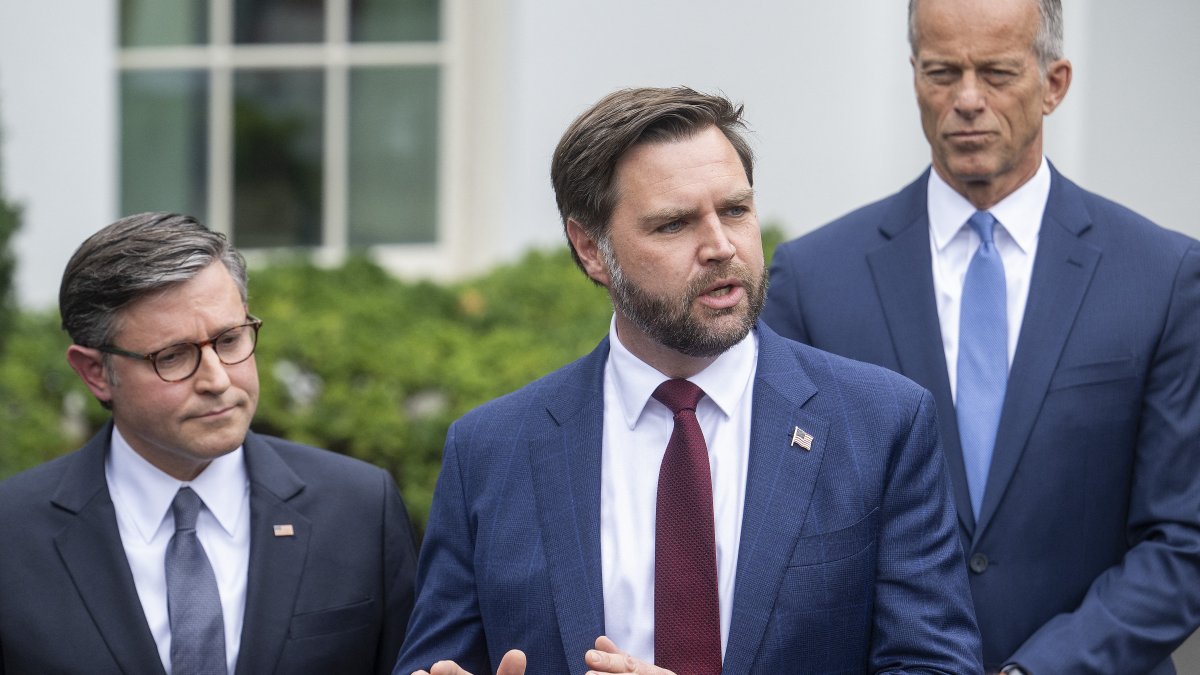
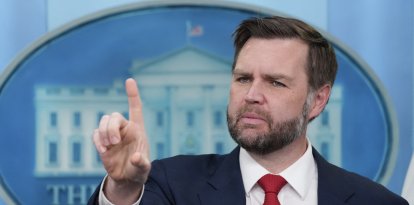
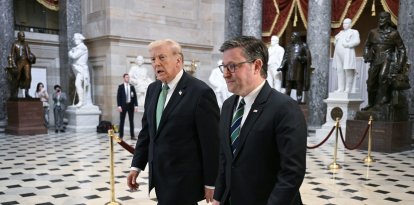
Vance and Republican congressional leaders/Jim Watson.

A government shutdown is imminent. The Republican proposal, already approved by the House of Representatives, failed to clear the Senate, where it needed at least 60 votes. As a result, the government will shut down for the first time since january of 2019—also under President Donald Trump.
Democrats attempted to pass their own proposal Tuesday afternoon, but it was rejected by a vote of 53 against. Moments later, the Senate moved to vote on the Republican plan.
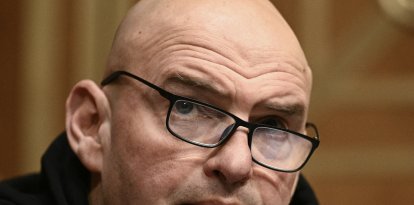
Although three Democrats—John Fetterman (D-PA), Catherine Cortez Masto (D-NV) and Angus King (I-ME)—voted in favor, the bill fell five votes short of passage.
“This administration doesn’t care about Nevadans, but I do. That’s why I cannot support an expensive shutdown that would hurt Nevada families and give even more power to this reckless administration,” Cortez Masto wrote on X.
The shutdown is now set to take effect at the start of Wednesday, October 1.
"The Democrat caucus here in town in the Senate has chosen to shut down the government over a clean nonpartisan funding bill. That's right. A clean nonpartisan funding bill. We didn't ask Democrats to swallow any new Republican policies. We didn't add partisan riders. We simply asked Democrats to extend existing funding levels to allow the Senate to continue the bipartisan appropriations work that we started. And Senate Democrats said no. Why? Because far left interest groups and far left Democrat members wanted to show down with the president. And so Senate Democrats have sacrificed the American people to Democrats, partisan interests", said John Thune, the Republican Senate Majority Leader.
“Democrats may have chosen to shut down the government tonight, but we can reopen it tomorrow. All it takes is a handful of Democrats to join Republicans to pass the clean, non-partisan funding bill that's in front of us,” he added.
">.@LeaderJohnThune: The Democrat caucus in the Senate has chosen to shut down the government over a clean, nonpartisan funding bill... Why? Because far-left interest groups and far-left Democrat members wanted a showdown with the President. pic.twitter.com/kqItABWMQ6
— Rapid Response 47 (@RapidResponse47) September 30, 2025
“It is unclear how long Democrats will maintain their untenable position”
Russell Vought, director of the Office of Management and Budget (OMB), issued a memorandum to federal agencies after the Senate vote. The document instructed agencies to begin preparations for an “orderly shutdown.”
“It is unclear how long Democrats will maintain their untenable posture, making the duration of the shutdown difficult to predict,” Vought wrote.
“Regardless, employees should report to work for their next regularly scheduled tour of duty to undertake orderly shutdown activities. We will issue another memorandum indicating the government functions should resume once the President has signed a bill providing for appropriations,” he added.
What Was Each Party Demanding to Avert the Shutdown?
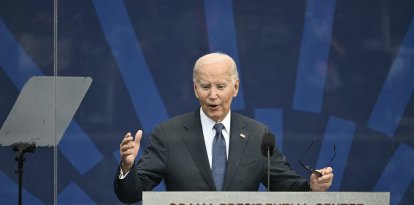
To secure Democratic votes, Republicans were expected to make concessions on health care, particularly regarding subsidies for health insurance. These subsidies were originally approved under the Affordable Care Act (Obamacare) and later expanded through the American Rescue Plan and the Inflation Reduction Act—both funded under President Joe Biden.
According to Politico, both Trump and Vance signaled they were open to discussing the subsidies—but only once the government is kept open.
In 2024, the House Budget Committee estimated that these subsidies carried a fiscal cost of roughly $125 billion.
On the Republican side, the leadership proposed a “clean” package, without additional clauses, which maintained current spending levels until November.
What is the government shutdown?
The logic comes from the National Constitution, specifically Article 1, Section 9: "No Money shall be drawn from the Treasury but in Consequence of Appropriations made by Law, and a regular Statement and Account of the Receipts and expenditures of all public Money shall be published from time to time."
Once closure is reached, certain agencies directly cease to function. They may be all, some, or particular ones. Employees cannot work, and their pay is withheld until lawmakers reach an agreement.
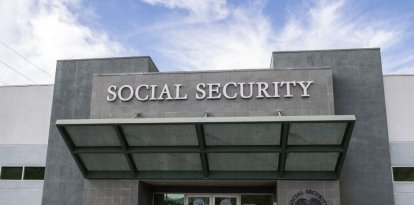
The government budget has two major types of spending: mandatory and discretionary. Specifically, the shutdown only affects the discretionary part of the budget but not mandatory spending, which includes Social Security, Medicare, Medicaid and interest payments on the debt. These expenditures would not be affected by an eventual shutdown.
The discretionary leg includes federal agencies, national parks, regulatory agencies such as the EPA, and administrative services.
In turn, essential activities such as homeland security, military on duty, air traffic control or emergency medical services continue to operate, despite the fact that their employees must work without pay until Congress approves the funds.
The United States was completely unaware of this scenario until well into the 20th century, when the first government shutdown took place in 1980. Jimmy Carter was the first president to be in charge during this situation, which on that occasion lasted just over 24 hours. The shutdown was repeated in 1982 (twice), 1983, 1984 (twice), 1986, 1987, 1990, 1995 (twice), 2013, 2018, and 2019.
The last one, coincidentally the longest, was 2019. It took 35 days before everything returned to normal operation. It is estimated that 800,000 public employees did not receive their money during that period of time.
One of the most remembered scenes of that shutdown occurred when Donald Trump, then president, had to receive the Clemson University soccer team, who had recently been crowned in the College Football National Championship. Since the employees were unable to work, including in the kitchen, the president bought food from McDonald's, Wendy's, and Burger King.
LATEST