Maximum tension in Washington after secret meeting on Middle East bombing plans
Trump seriously considers ordering a new air offensive if diplomatic avenues fail to achieve a definitive and immediate breakthrough.
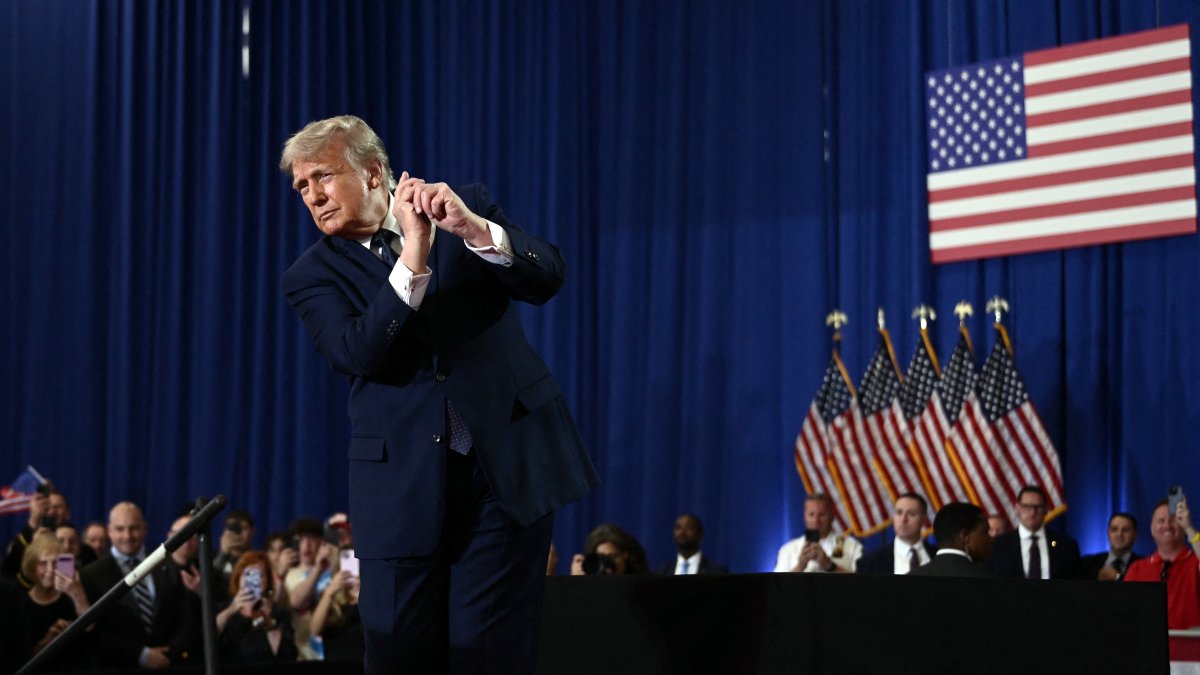
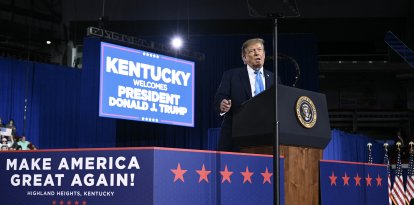
President Trump after his speech at Rockland Community College in Suffern, N.Y., this May 22.

President Donald Trump headed a high-priority meeting with his national security team in the Oval Office to assess the reactivation of military operations against Iran.
Government sources confirmed to Axios that the president seriously considers ordering a new air offensive if diplomatic channels do not achieve a definitive and immediate breakthrough. The intelligence summit coincides with the effort of international mediators in Tehran to avoid a full-scale war escalation.
The urgency of the scenario caused a drastic modification in the agenda of the chief executive. After an engagement in New York, Trump canceled his planned stay at his Bedminster club and announced that he would not travel to the wedding of his eldest son, Donald Trump Jr. in the Bahamas.
The president justified his stay in Washington by appealing to the responsibility of his office and the safeguarding of the nation's stability, focusing all the attention of the White House on monitoring the crisis in the Middle East.
West Wing dilemma and deal paralysis.
The closed-door meeting was attended by key figures in the presidential security circle, including Vice President JD Vance, Defense Secretary Pete Hegseth, CIA Director John Ratcliffe and White House Chief of Staff Susie Wiles.
The deliberations focused on updating the strategic scenarios available to U.S. forces in the event of a total collapse of the negotiations.
The imminence of armed action has had a direct impact on federal law enforcement. CBS confirmed that several members of the U.S. military and intelligence community canceled their plans for Memorial Day weekend in anticipation of possible strategic bombings.
This internal mobilization reflects the state of combat readiness and seriousness with which the Pentagon assumes the breakdown of the ceasefire.
Parallel to the meeting in Washington, delegations from Pakistan and Qatar arrived in Iranian territory in a last-minute attempt to bring the two countries closer together.
U.S. intelligence authorities are closely following the planned meetings between the international mediators and the top commanders of the Islamic Revolutionary Guard Corps (IRGC), who retain real control over defense decisions in the Tehran regime.
The doctrine of the decisive strike versus Tehran's evasiveness.
Despite the open channels of communication, the signals emitted by Trump point to an exhaustion of strategic patience. According to people close to the president, the president manifested in recent days his frustration at the Iranian counterpart's unwillingness.
Although he initially gave a temporary margin to diplomacy after communicating with Israeli Prime Minister Benjamin Netanyahu, the persistence of the stalemate reactivated the preparations for a deployment of coercive force.
The strategy that the president is considering is oriented towards the execution of a forceful and large-scale military action.
Sources with knowledge of the deliberations indicate that Trump contemplates the possibility of a final operation of a resolute nature, designed to inflict severe damage to the enemy infrastructure, declare the strategic victory of the United States and put a definitive end to the conflict under Washington's conditions.
For their part, Iran's Foreign Ministry and spokesmen linked to the Revolutionary Guard stated that negotiations are continuing, but admitted that a final agreement is not close.
Tehran's propaganda apparatus insisted that the current focus must be the immediate cessation of hostilities before proceeding with any other thematic agenda. This restrictive stance is perceived in conservative circles in Washington as a stalling maneuver to buy time in the face of military and economic pressure.
The outcome of the crisis in the coming hours will determine the course of U.S. foreign policy in the region.
While the president has already postponed the use of force on previous occasions by betting on negotiated solutions, the current logistical deployment in the capital indicates that the room for maneuver for the Tehran regime has been reduced to a minimum.
LATEST