The White House responds to Maduro's leaked letter: 'He repeated a lot of lies, therthere are no changes in the position towards Venezuela'
Press Secretary Karoline Leavitt dismissed the message and assured that the Venezuelan dictator is trying to make up the reality.

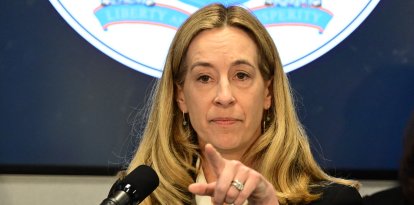
White House Press Secretary Karoline Leavitt.

The White House responded on Monday to a letter sent by Venezuelan dictator Nicolas Maduro to President Donald Trump, in which he called for dialogue and rejected accusations of drug trafficking against him. Press Secretary Karoline Leavitt dismissed the message and assured that the Chavista leader is trying to make up the reality.
"Frankly, I think there were a lot of lies that were repeated by Maduro in that letter, and the administration's position on Venezuela has not changed," Leavitt said. The official reiterated that the U.S. government considers the Chavista regime illegitimate and warned that President Trump is willing to use "all means necessary" to curb drug trafficking from Venezuela to the United States.
Maduro's letter and its dissemination
The letter, dated September 6, was published by Venezuela's illegitimate Vice President Delcy Rodriguez, assuring that it had been previously delivered to a South American mediator to reach President Trump. In it, Maduro called the accusations of drug trafficking "fake news" and warned that, in his opinion, they sought to "justify an escalation to armed conflict that would inflict catastrophic damage across the entire continent."
The Venezuelan dictator also affirmed his willingness for a "direct and frank conversation" with U.S. special envoy Richard Grenell, in order to "overcome the media noise" and advance in what he described as a "historic and peaceful" relationship between both nations. He even praised Trump's efforts to end wars and called for promoting dialogue as a way to ensure peace on the continent.

World
Military, diplomatic, and intelligence officials say US military deployment in the Caribbean seeks to oust Maduro from power
Emmanuel Alejandro Rondón
Context of increased tensions
Despite this, Maduro insisted that Venezuela is a "territory free of drug production" and denied that his country has a relevant role in the narcotics network that affects the region.
LATEST