Dictators at home, tycoons in the West: The secret life of the Iranian leadership
In Iran's nepotistic system it is common to appoint relatives within the vast bureaucracy of state organizations such as banks, councils, foundations, energy companies, think tanks and universities.
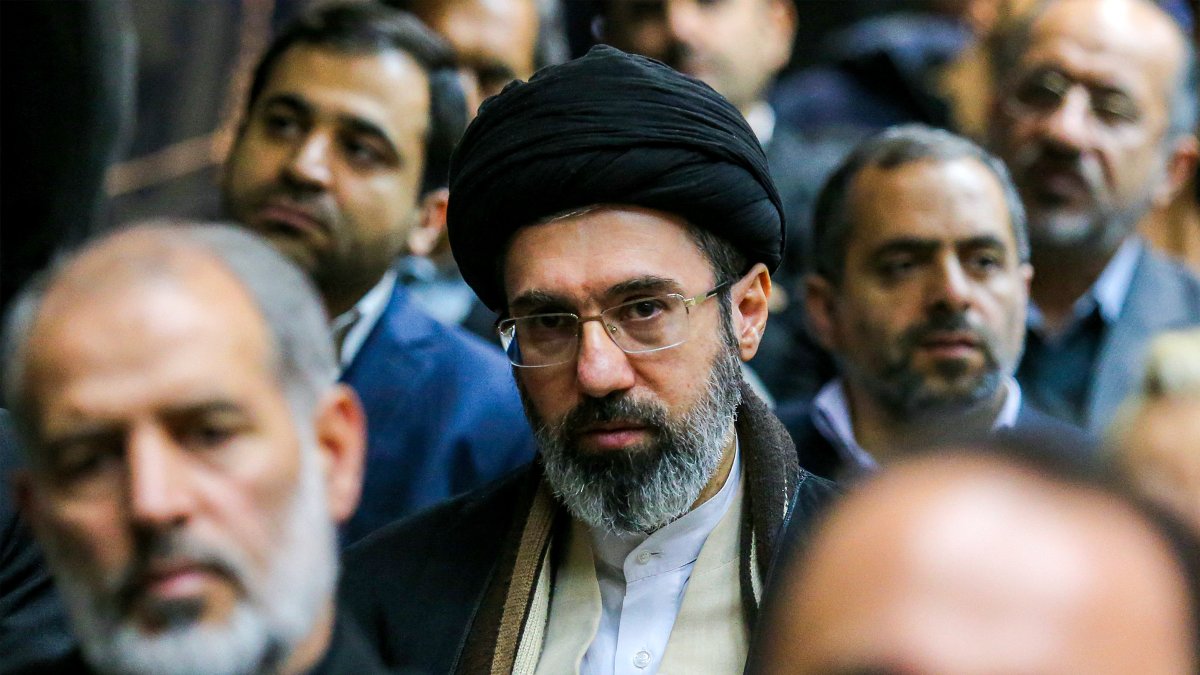
Iranian supreme leader Mojtaba Khamenei (C), son of former supreme leader Ayatollah Ali Khamenei.
Any dictatorship inevitably derives forms of corruption. The Iranian Revolution of 1979 formally abolished the monarchy, but failed to eradicate nepotism, which is the world's oldest form of tribal corruption. The ideological framework of theocracy perpetuated nepotistic relationships, presenting them under justifications aligned with the regime's values. Iranian nepotism persisted and grew, suggesting that beyond formal "republican" institutions, power resides in informal networks.
The tribalism of the Islamic Republic divides society along binary lines: those loyal to the regime and the marginalized. Positions of power are reserved for those who have demonstrated loyalty. A study revealed that the dynamics of post-revolutionary politics in Iran have been heavily influenced by informal politics. Being a descendant of clerics, for example, implies prestige. Analysis of family ties among the Islamic Republic's ruling elites offers clear signs of the circle of the privileged, composed of such ties, revolutionary credentials and clerical lineage representing the main avenues of access to the Iranian government apparatus and its associated advantages. Nepotistic favoritism also extends to practices such as benefiting from a quota system to attend universities and obtaining state scholarships to study abroad.
In Iran's nepotistic system, it is common to appoint relatives within the vast bureaucracy of state organizations such as banks, boards, foundations, energy companies, think tanks and universities. As a result, regime families accumulate assets and connections that influence Iranian politics, creating a network of family alliances that consolidates power.
A prominent example is the prominent Larijani family, which exemplifies the practice of marriages between clerical elites. The recently eliminated Ali Larijani, former Majlis chairman, was the son-in-law of Ayatollah Morteza Motahhari, former chairman of the Revolutionary Council. His brother, Sadeq Larijani, former president of the Supreme Court and head of the Convenience Council, is married to a member of the family of Ayatollah Vahid Khorasani, a highly influential Shiite figure. Another brother, Bagher Larijani, former rector of Tehran University of Medical Sciences, is the son-in-law of Ayatollah Hasan Hasanzadeh-Amoli, a distinguished Islamic philosopher. In addition, his sister married Ayatollah Mostafa Mohaqqeq-Damad, former head of the General State Inspectorate.
This interconnectedness extends to political appointments. During his tenure as head of the Judiciary, Ayatollah Sadeq Larijani kept another brother, Mohammad-Javad Larijani, in power as deputy minister of international affairs and director of the Human Rights Bureau, demonstrating the importance of family ties for career advancement. This pattern is not unique to the Larijani family. The family of Ayatollah Khomeini, for example, has established marriage ties with at least eighteen different families, while the family of Ayatollah Khamenei has forged kinship ties with at least nine families. These alliances demonstrate how marriage between relatives functions both as a tool for maintaining influence and as a mechanism for perpetuating nepotism within formal government structures.
The children of these families leverage the influence and power of their parents or relatives to gain economic or political advantage. This practice has become so widespread that the Iranian public has coined the term "aghazadeh" to describe them.
World
Ali Khamenei: the leader of a theocracy forged in blood and religious fanaticism
Luis Francisco Orozco
The term "aghazadeh" was initially used to target the sons of the late former president, Ali Akbar Hashemi Rafsanjani, who was once featured in Forbes magazine as a "millionaire mullah" with colossal personal wealth. Another case is the son of the former Iranian ambassador to Venezuela, Sasha Sobhani, who shamelessly flaunts his extreme wealth to his millions of followers on Instagram.
Long before the latest Iranian social crises that resulted in massive demonstrations and protests, the unrest against the aghazadehs was already evident. Stories about corruption in the political classes popularized the Iranian drama series "Aghazadeh," which was a hit with audiences as it addressed popular discontent over the blatant corruption of the children of the powerful.
The series told the story of Nima Bahri, an aghazadeh who shops at Christie's auction house, flies to Dubai on a private jet and aspires to be Gordon Gekko from the movie "Wall Street." Bahri has so much money that he is forced to launder it. One of the ways he does this is by auctioning off counterfeit paintings, a nod to real life, referencing a 2018 Tehran auction.
While senior Iranian leaders build their narrative by criticizing the West, it is an open secret that they send their own children to live, study and enrich themselves in Europe and the United States. A classic example of this double standard was the viralization of a photograph of the granddaughter of the leader of the Islamic Revolution, Ayatollah Ruhollah Khomeini, flaunting a designer handbag worth thousands of dollars in Europe.
However, the clerical lineage is not the only one that exhibits this impunity. Another paradigmatic case of aghazadeh is that of designer Anashid Hoseini. Shortly before the outbreak of the massive protests over the death of Mahsa Amini, Hoseini sparked public outrage by posing on social media sporting a handbag that cost more than what an average Iranian worker earns in an entire year. Her subsequent wedding to Amir Mohsen Moradian (son of Iran's ambassador to Denmark) sparked a national scandal for its obscene cost.

Politics
Trump sanctions key Iranian figures amid assessments of possible military action
Sabrina Martin
The citizenry's weariness with the frivolity of these 'sons of power' is such that Instagram accounts such as Rich Kids of Tehran went viral by devoting themselves exclusively to highlighting the privileges of the young wealthy elite. Faced with the evidence that much of this new generation does not even live in the country their parents rule, popular outrage erupted online with the hashtag #Where_is_your_kid?, a massive campaign that ridiculed the regime's politicians for imposing austerity and religion at home, while their heirs enjoy a life of luxury abroad.
For example, Mohammad Hossein Shamkhani and his brother Hassan live in Dubai and run a shipping empire that circumvents U.S. sanctions. Their father, Ali Shamkhani, is the former security chief of the Islamic Republic and a senior advisor to former supreme leader Ali Khamenei. Just before the latest protests erupted, Shamkhani was facing a political firestorm over the leak of a video of his daughter's wedding, in which she wore a provocative dress, prompting accusations of hypocrisy against a regime that murders women who do not follow oppressive dress codes.
According to a former Iranian minister, 5,000 aghazadeh live in the United States, Iran's greatest enemy, the "Great Satan." Now, in the midst of the U.S. beheading of the Iranian top brass, the true size of the family fortune controlling the state has come to light. Iran's new supreme leader reportedly owns a dozen properties in the British capital worth millions of dollars, through a complex network of shell companies. The late Ali Khamenei accommodated several relatives in Britain and France, while the family of the founder of the Islamic revolution, Ayatollah Ruhollah Khomeini, settled in Canada.
These properties represent only a small fraction of the financial empire controlled by the son of Ali Khamenei, which was uncovered by an exhaustive investigation by Bloomberg indicating that Khamenei is involved in transactions funneling funds stemming from the sale of Iranian oil to Western markets. The funds have circulated through bank accounts in the United Kingdom, Switzerland, Liechtenstein and the United Arab Emirates.
The portfolio also includes a villa in Dubai, luxury hotels in Frankfurt and the Balearic Islands, and bank accounts in Switzerland. The revelation is surprising given the extent of Western sanctions against Iran for decades. Mojtaba Khamenei himself has been the direct target of sanctions by the U.S. Treasury Department.

This web, designed to hoard a wealth of millions, functions as a layered system devised to ensure absolute anonymity and circumvent international sanctions. The financial architecture is based on the creation of successive shell companies in jurisdictions of guaranteed opacity. This design makes it possible to fragment the ownership of assets through law firms in Europe, managing to transform funds from the sale of Iranian oil into luxury assets in the heart of the continent without triggering alerts from financial regulators. In the current context, with military pressure from the United States, the European network becomes vital to ensure the financial survival of the Iranian leadership.
The real power of these elites is not limited to their foreign accounts, but lies in the absolute control of the country's most strategic economic entities. This financial force, designed to act as armor for the regime, is concentrated in three fundamental pillars. The first is Setad (EIKO - The Execution of Imam Khomeini's Order), a gigantic parastatal conglomerate that controls assets valued at tens of billions of dollars, monopolizing key sectors such as energy, telecommunications and banking. The second pillar is the Astan Quds Razavi Foundation; based in the city of Mashhad, this foundation manages vast tracts of land, industrial enterprises and religious infrastructure projects. Its total fiscal and legal opacity makes it a tool of incalculable political and territorial influence, rather than a simple source of verifiable wealth.
Finally, there is the Islamic Revolutionary Guard Corps (IRGC). Far from being solely a military force, it operates as Iran's largest economic holding company, ensuring that the multibillion-dollar profits from civil engineering, construction and oil trading continue to flow uninterrupted to those who hold central power. Taken together, this network ensures that, even in times of international sanctions or domestic crisis, resources always remain under the tight strategic control of the top.
This survival system is designed to mobilize assets in London, Madrid or Dubai to maintain the loyalty of the Revolutionary Guard Corps. While the Iranian elite keeps large amounts of its wealth abroad, more than half of the Iranian population lives in poverty. But the "aghazadeh" exposed this life of luxury, corruption and hypocrisy, and this is also one of the causes of the inexorable fall of the regime.
LATEST