Military, diplomatic, and intelligence officials say US military deployment in the Caribbean seeks to oust Maduro from power
The Chavista regime has tried, unsuccessfully, to rebuild bridges of negotiation with Washington.

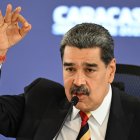
Pete Hegseth and Nicolas Maduro in a file image

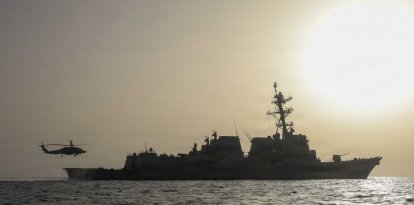
The Trump Administration's military escalation in the Caribbean Sea—with amphibious groupings, Arleigh Burke—class destroyers, P-8 surveillance aircraft and the transfer of the fearful F-35 stealth fighters to Puerto Rico-is not, according to military, diplomatic and intelligence officials, simply an operation against regional drug trafficking networks. According to a report in The New York Times, the campaign is carefully designed to put sustained pressure on Venezuelan dictator Nicolas Maduro, accused of drug trafficking in the country, creating conditions that could lead to his removal from power.
President Trump's recent strike orders against four drug boats in the Caribbean—at least three of them coming from Venezuela—have been presented by the White House as part of an offensive against the flow of fentanyl/cocaine into the United States and "narco-terrorist" organizations, such as the Cártel de los Soles—led by Maduro himself, his second in command, Diosdado Cabello; and different Venezuelan generals. President Trump assured that his government has "evidence" about the cargo and the course of the ships, but the authorities have not yet made public conclusive evidence to calm the critics, fueling legal and political doubts about the proportionality of the actions of the War Department.
In a report published Saturday, The New York Times cited different military and intelligence sources who claim that the Trump Administration is building a case to depose Maduro.
“The massive naval flotilla off the coast of Venezuela and the movement of fifth-generation F-35 fighters to Puerto Rico has little to do with actual drug interdiction — they represent operational overkill,” said Admiral James G. Stavridis, former head of the Pentagon's Southern Command. “Rather, they are a clear signal to Nicolás Maduro that this administration is growing serious about accomplishing either regime or behavioral change from Caracas. Gunboat diplomacy is back, and it may well work."
In previous reporting, different Trump Administration officials spoke under anonymity about operations in the Caribbean, calling into question the extent of it and raising the possibility that the U.S. is indeed seeking regime change in Venezuela.
"This is 105% about narco-terrorism, but if Maduro winds up no longer in power, no one will be crying," a Trump administration official told Axios.
"The president has asked for a menu of options. And ultimately, this is the president's decision about what to do next, but Maduro should be s***ting bricks," another said. Some officials even mentioned that the dictator could leave the country in a "body bag" if Cuban intelligence agents left him to his fate.
World
Varios asesores de Trump ponen el futuro de Maduro en entredicho: “Podría salir en una bolsa de cadáveres”
Emmanuel Alejandro Rondón
Some analysts also believe that the operations in the Caribbean are just a warning to prepare for escalation.
“Attacks on alleged drug boats so far are being read in the region as warning shots that portend the possibility of a further escalation,” Elizabeth Dickinson, a senior analyst with the International Crisis Group in Bogota, told the NYT.
Some U.S. policymakers believe the deployment will continue.
“Given the large number of U.S. military assets that have been deployed to the Caribbean, it is clear that the administration intends to continue such operations,” said Sen. Jack Reed of Rhode Island, the top Democrat on the Armed Services Committee.
Messages from the Trump Administration have been mixed. While the War Department focuses on narcoterrorism, the State Department is targeting the Venezuelan Cartel of the Suns and the dictator Maduro, an ally of the regional drug cartels.
“Narco-terrorists are enemies of the United States—actively bringing death to our shores,” Defense Secretary Pete Hegseth wrote after the second attack on a Venezuelan narco-boat, adding, “We will track them, kill them, and dismantle their networks throughout our hemisphere—at the times and places of our choosing.”
“We’re not going to have a cartel, operating or masquerading as a government, operating in our own hemisphere,” Secretary of State Marco Rubio said this week, adding that Maduro was indicted in the United States and is "a fugitive of American justice."
Prior to the attacks in the Caribbean, President Trump secretly authorized the Pentagon to prepare and, if necessary, use lethal force against selected "narcoterrorists," which opens the door to operations with a broader military framework than traditional police interdiction at sea. In addition, according to the NYT, a draft bill is circulating in the White House and on Capitol Hill right now that would give the president sweeping powers in his war against drug cartels and "any nation he says has harbored or aided them."
That draft, according to sources cited by the NYT, would have had the intervention in its drafting of representatives close to the Trump Administration; among the names that have emerged is that of Representative Cory Mills (R-Florida).
Such a draft may be in response to the criticism that has been raised against attacks in international waters. Some legal experts argue that lethal operations against suspected smugglers, without sufficient public evidence, may violate international law and the Constitution. Some Democratic lawmakers have seized the moment to take some swipes at the White House and have demanded explanations of the legal basis and chain of command for such actions. However, the White House insists that it has given all the necessary information to Congress and, at least publicly, messages from officials suggest that the deployment will continue.
Now, the question is whether the extremely costly force deployed by the US will merely send a message to the cartels by intersecting drug shipments or whether it will instead seek a much greater geopolitical success: the overthrow of Maduro, who heads one of the region's most problematic regimes on humanitarian, political and criminal issues.
LATEST