ANALYSIS
Democrats who once opposed gerrymandering now support it against Trump: 'We have to take up arms'
Prominent Democratic Party figures such as Nancy Pelosi favored redrawing electoral maps to counter the Texas initiative. Their voters are not so sure, according to a recent YouGov poll.
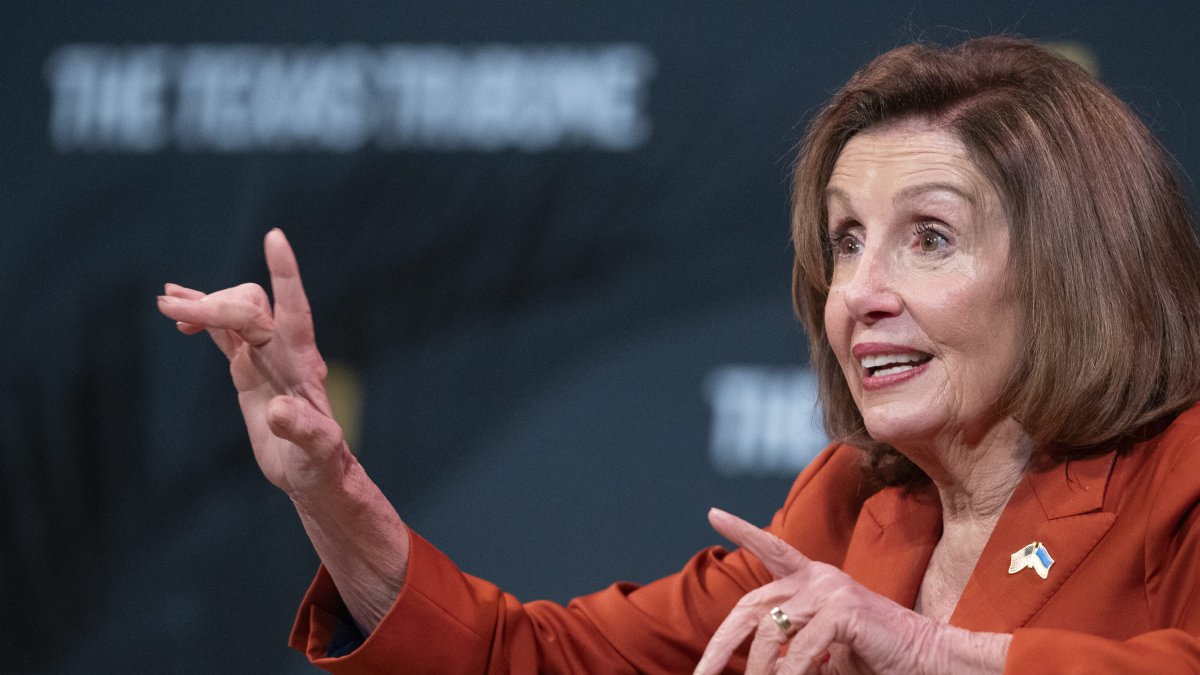
Nancy Pelosi, former Speaker of the House

"Politicians should not be choosing their voters by this political gerrymandering," opined Nancy Pelosi in 2021. For the then speaker of the House, partisan redistricting "distorts our democracy." Four years later, however, she publicly supports California redrawing its districts to gain five Democratic seats.
The veteran politician symbolizes the turnaround by several figures in a party that once campaigned on taking away legislators' ability to draw electoral maps. Who draws them varies from state to state, but there are two major groups of mapmakers: either state Legislatures or commissions made up of citizens or politicians from both parties.
Shortly after Pelosi uttered that criticism of partisan redistricting, her party passed a bill in the House that imposed commissions as the only option: "The bill requires states to establish independent redistricting commissions to carry out congressional redistricting."
It would not be the first time she has changed her position. Ten years earlier, Pelosi appears to have donated $10,000 to a campaign to eliminate California's citizen redistricting commission, returning the function to the Legislature. According to an article at the time in the LA Times, several Democrats, including Adam Schiff, also contributed funds.
Pelosi justified her latest pivot by pointing toward the Texas GOP's attempt to redraw the electoral maps, which could add five Republican seats in Congress. "We will not let him [Trump] pave over our free and fair elections, starting with what he’s trying to do in Texas," she argued at a news conference. "This isn’t two wrongs, this is self defense for our democracy."

Politics
Gerrymandering: Texas reopens old political war over congressional redistricting
Israel Duro
A Democratic PAC against gerrymandering, unless...
Pelosi will participate next week in an event of a Democratic organization designed to oppose gerrymandering. Opposed because, according to its website, it "poses a critical threat to our democracy." However, the National Democratic Redistricting Committee (NDRC) now supports Democratic initiatives to redraw electoral maps in response to Texas.
According to an reports collected by Politico, in addition to Pelosi, attending the event as a "special guest" will be former President Barack Obama, who in 2021 said, "Gerrymandering is a sneaky way for politicians to consolidate as much power as they can."
"We do not oppose — on a temporary basis — responsible responsive actions to ensure that the foundations of our democracy are not permanently eroded," NDRC Chairman Eric H. Holder, Jr said in a statement. In other words: the Democratic organization born to oppose gerrymandering is now for retaliatory gerrymandering against Texas.
"Progressives and Democrats are uncomfortable with the acquisition and the use of power in ways that Republicans are not. And that time has got to be over," Holder asserted in an interview with The New York Times titled "Eric Holder explains why he changed his mind on gerrymandering."
"What’s driving Democrats is, I think, a legitimate response. I mean, it’s like the Germans have invaded France. Are you going to just say, ‘Well, we’re against war and we’re for the resolution of disputes in a peaceful way’?" he added. "Sometimes you have to take up arms. And when confronted with this authoritarian, anti-democracy effort, we have to take up arms."
Democratic voters, however, don't seem to agree.
"Americans see gerrymandering as unfair"
Thirty-nine percent of Democratic voters oppose their party redrawing electoral maps to counter potential gerrymandering in Texas, according to a survey by YouGov. Forty percent are in favor.
On the Republican side, support for retaliatory electoral maps is even lower: 48% oppose the GOP responding to California with changes in another state while 33% are in favor.
"Americans see gerrymandering as unfair, even when other states are doing it," claim the researchers behind the poll.
Beyond partisan affiliations, 51% of the population opposes their state drawing new maps in response to the Texas initiative. Fifty-five percent feel the same way in response to the California proposal. In addition, 75% of Americans think partisan gerrymandering is a "major problem."
Democratic track record of gerrymandering
The same Democratic Party that now opposes gerrymandering was accused of engaging in gerrymandering on several occasions. Eric Holder himself criticized his co-religionists in New Jersey and Illinois for just that.
The latter state is one that Republicans often target to accuse Democrats of hypocrisy. Blue Rep. Mike Quigley acknowledged to Politico that he was "aware that our maps in Illinois are gerrymandered."
He also said that "in an ideal world, these maps are drawn by nonpartisan commissions, and they represent what the Constitution said we should do... We’re not there yet. ... So you can’t be a Boy Scout in a situation like this — you have to be as tough as they are."
Illinois is listed with the worst grade in the District Redistricting Bulletin, compiled by the nonpartisan Gerrymandering Project. Those that also get an "F" for favoring Democrats are New Mexico and Nevada. While Mississippi gets a "C," and Pennsylvania a "B."
"All of these states are looking around at each other like The Good, the Bad and the Ugly thinking who's going to fire first," the organization's president, Professor Sam Wang, told ABC News. "There is no sheriff in town saying this is not helping everyone."
"Gerrymander is partisanship maximized above all of the other things," he also argued, adding that "states like Florida and Texas have the worst examples of gerrymandering."
A study by Breitbart contrasting Trump's presidential performance with the number of seats won by Republicans adds to the list: Connecticut, New Mexico, California, New YorkMaryland, New Jersey, Oregon and Massachusetts. In the latter, for example, the president won more than 36% of the vote but his party has no seats in Washington.
Other Democrats who could redraw their districts
The Democratic Party's track record not only contains instances of partisan redistricting in the past, but could also point to new ones in the near future: in addition to California, states such as Illinois and New York threatened to revise their own maps if Texas delivers on the promised redistricting.

Politics
The electoral redistricting war: these are the seven states that could go the way of Texas
Emmanuel Alejandro Rondón
LATEST