Interview
'It's not amnesty': Gabe Evans defends the Dignity Act
In an interview with VOZ, the young Colorado congressman also discussed the benefits of the "Big Beautiful Bill" for working and middle-class families.
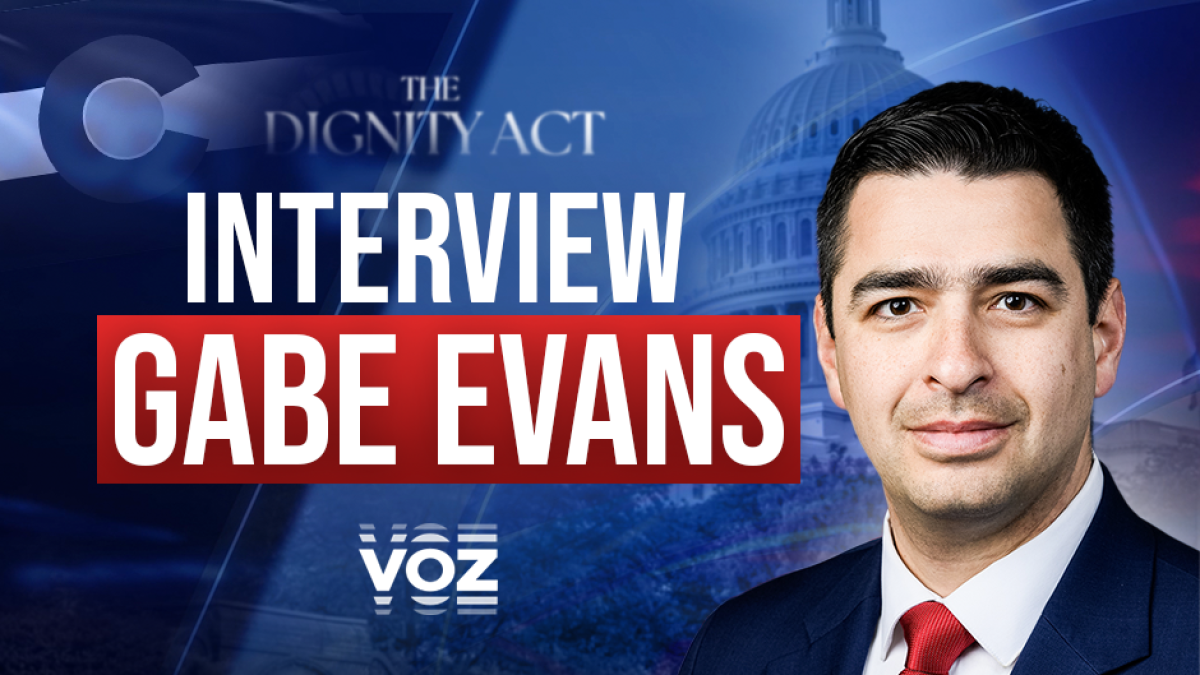
Gabe Evans

Gabe Evans was one of the surprises of the 2024 election. After winning a close election for the eighth congressional district of Colorado, he became one of the youngest members of the House of Representatives. Before coming to Washington, D.C., he spent time with the Arvada Police Department and then twelve years in the Army, including a tour of duty in Afghanistan. He was honorably discharged in 2019, when he decided to leap into politics.
As the grandson of a Mexican immigrant who served in the U.S. Army during World War II, he is proud of his Hispanic roots. In fact, the district he represents has a 38.5% Hispanic population.
In an interview with VOZ, Evans explained the keys to the Dignity Act, a bill that seeks to combine border security with a path to legal status for undocumented immigrants who do not have a criminal record, have been in the country for five years and pay a fine to finance the process.
In addition, he discussed the benefits of the "Big Beautiful Bill" and the keys to retaining the majority in the House of Representatives heading into 2026.
"The Dignity Act recognizes the problem"
The Colorado congressman explained that after the Trump administration successfully controlled the immigration crisis inherited by the Biden-Harris administration, it was time to move to a second phase. One that reforms the system to allow illegals who meet certain conditions to have a pathway into the system. In short, it seeks to fix an immigration system that has been "deficient for the past four decades."
Stressing the importance of the national motto, "out of many, one," he assured that the country needs people who want to make an honest living and raise a family.
"How do we have some sort of pathway forward for people that wanna work hard? They wanna pay their taxes. They're doing the right thing. They're not taking federal welfare. How do we build the pathway forward for them? And so that's what the Dignity Act does," he said.
"If you've been in the United States before January 2021, you're not taking federal welfare, you're not committing crimes or causing other problems, and you apply for this program and you're able to pay, pass the the background check, then every year for seven years, you pay a $1,000 fee. You get a work permit, as long as you then continue to work hard, not take welfare, not get into trouble, contribute to the American society. And then after seven years, then you get a green card," he added.
"We have to separate the good guys from the bad guys"
The Dignity Act was recently introduced by Congresswomen Maria Elvira Salazar (R-FL) and Veronica Escobar (D-TX). It also has the backing of a bipartisan group of congressmen, including Evans.
Soon after, the bill received criticism from much of the MAGA universe. Charlie Kirk, Steve Bannon and Matt Walsh, among others, have made harsh comments on social media.
When asked what the most important point of this project is, the Colorado Republican assured that it starts with recognizing the problem.
"There's more to fixing the immigration system than just securing the border. You know, forty two percent of the agricultural workforce in the United States right now is illegal immigrants. I don't like that statistic, but that's the statistic that we have. That's the problem that we have to solve. And so the Dignity Act plays the hand that we're dealt, not the hand that we wish we had. And it says, this is the problem," he continued.
"It's not an amnesty, it's a strict bill"
He further responded to Republicans who claim it is an amnesty: "We have to have some sort of pathway forward to sort out the good guys from the bad guys. And those folks that do wanna work hard, they have to have accountability because the fact is you are illegally in the United States. So there has to be accountability," Evans continued.
In response to the attacks from Republicans and conservatives on the bill, the congressman assured that having Donald Trump in the White House and a GOP majority in Congress presents a unique opportunity.
"We know this is a problem. We can't sweep this problem under the rug anymore. And so what better time to work on this problem, than with an America first administration and an America first idea, right now in the house and the senate. It's not amnesty. It's not a free handout. It's a very, very tough bill in terms of law enforcement. It's a tough bill to take responsibility for fixing the problems we've had for the last four decades. (...) As Ronald Reagan said, if we agree on eighty percent of things, that makes you an ally for eighty percent, not an enemy for twenty percent," he added.
"The 'Big Beautiful Bill' helps the middle class and the working class"
Evans also spoke about the benefits of the legislation signed by Donald Trump last July 4, especially for the middle and working class, as well as retirees.
"In my district, the tax cuts benefit the bottom eighty five percent of wage earners. So that's things like increasing the child tax credit. This gives tax cuts, to small businesses. This gives, no tax on tips, no tax on overtime. That's millionaires aren't working in tipped professions. This is for working class folks, and it takes care of our seniors. The average retiree in the United States will pay no Social Security tax," the congressman explained.
Regarding his next steps in Congress, he stated that he will work to reduce government bureaucracy and unnecessary regulations that affect businessmen and entrepreneurs.
A message to the Hispanic community
Finally, Evans spoke about the values that represent the Hispanic community in the United States: "My abuelo, Cuauhtémoc Chávez. I I've read, some of his his writings in his journal where he talks about doing what he did to give a better starting point in life for his kids, so that'd be my mom, and then knowing that his grandkids, me, would we would have a better start in life than even my mom did."
"And so that's something that's so important to the Latino community, is passing on that better life, passing on that American dream, passing on that generational wealth. And so that's something that I believe in because that's my story. Yeah. And that's the story that my district is forty percent Latino. That is something that they want to," he concluded.
LATEST