Legislators María Elvira Salazar and Veronica Escobar introduce the bipartisan ‘Dignity Act’ bill
The Dignity Act bill represents an effort to find practical and humane solutions to an immigration system that, according to the legislators, has not been working properly for decades.

President Donald Trump with Congresswoman Maria Elvira Salazar (Archive)

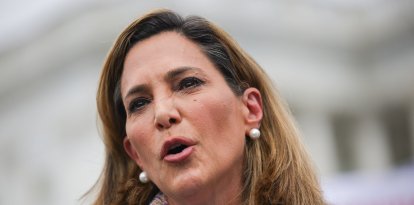
A bipartisan group of lawmakers in the U.S. House of Representatives, led by Representatives Maria Elvira Salazar (R-Fla.) and Veronica Escobar (D-Texas), introduced a renewed version of the Dignity Act.
This bill, initially introduced in 2023, seeks to address comprehensively the challenges of the U.S. immigration system by promoting measures that strengthen border security, provide legal status to certain undocumented immigrants, and slow down the processing of asylum applications.

The goals of the Dignity Act: It is not an amnesty
The Dignity Act proposes a balanced approach that combines strengthened border security with opportunities for some undocumented immigrants to regularize their status.
According to Representative Salazar, the bill does not offer amnesty, but "dignity" for those who have contributed to the U.S. economy. On her Instagram account, Salazar expressed:
“Now that President Trump has finally secured the border, it’s time to fix the rest of the system. America is feeling the impact. Cities are overwhelmed. Workers are needed. The system is broken and inaction has a cost. Millions have lived in the shadows for decades, working, paying taxes, raising families. They don’t want a handout. They want a chance.”
In addition, the bill establishes that undocumented immigrants who meet certain criteria, such as having resided in the country for more than five years and having contributed to the economy, could access legal status after paying a fine for a period of seven years.
However, this pathway does not include the possibility of obtaining citizenship or access to federal programs or health insurance. In that regard, Salazar in an interview with Fox And Friends stressed:
“They did break the law. They are illegals or undocumented. But they have been here for more than five years, contributing to the economy. Those people, someone gave them a job, and they are needed because we need hands in order to continue being the number one economy in the world."
DIGNITY ACT OF 2025: Rep. @MaElviraSalazar to unveil new bipartisan bill for comprehensive immigration reform in the U.S. pic.twitter.com/zEUON4YFl7
— FOX & Friends (@foxandfriends) July 15, 2025
In addition, the lawmaker stressed the flexibility the bill would grant:
“They can go back home for Christmas, they can come back. Continue working, buying homes, paying taxes and contribute to the economy.”

Benefits for dreamers
A key component of the Dignity Act is its focus on beneficiaries of the Deferred Action for Childhood Arrivals (DACA) program, known as Dreamers. The bill proposes a pathway for these young people, brought to the United States as children, to obtain permanent legal status and, eventually, citizenship.
For her part, Representative Escobar, a co-sponsor of the bill, emphasized that this new version of the bill has been adjusted to the "current political environment" and has a greater number of co-sponsors than the original proposal. In statements to ABC, Escobar noted:
"She [Salazar] and I worked for about seven months on a bill that addressed border security but also legal pathways so that our country benefits from immigration. We know that if we solve the immigration challenges that we face, we can have a stronger economy, and we can do that."
Last night, I shared some exciting news on ABC7 Xtra: tomorrow, I'll be introducing my bipartisan immigration reform bill, the Dignity Act, in Congress. pic.twitter.com/k6BpEQ61Ys
— Rep. Veronica Escobar (@RepEscobar) July 14, 2025
The principles of the proposal
On her X account, Salazar highlighted the principles guiding the proposal: “We are the most noble nation on earth and a nation that respects the rule of law. It’s time our immigration system reflected that. The Dignity Act is coming in one day. No amnesty. No excuses. Let’s fix our system once and for all with dignity.”
We are the most noble nation on earth and a nation that respects the rule of law. It’s time our immigration system reflected that.
— Rep. María Elvira Salazar (@RepMariaSalazar) July 14, 2025
The Dignity Act is coming in one day.
No amnesty. No excuses. Let’s fix our system once and for all with dignity. pic.twitter.com/82750vZCUk
The Dignity Act represents a bipartisan effort to find practical and humane solutions to an immigration system that lawmakers say has not been working properly for decades. By combining border security measures with legal pathways for certain immigrants, the bill seeks to strengthen the U.S. economy and reflect the values of fairness and dignity that sponsors believe are fundamental to the nation.
Reaches Congress
The bill, which has won the support of several lawmakers from both parties, has reached Congress and will be debated against the backdrop of a complex political context.
However, the collaboration between Republicans and Democrats, led by Salazar and Escobar, seeks to overcome the traditional divisions on the immigration issue to offer a comprehensive reform that benefits both immigrants who have been working and contributing to the economy for years, as well as the country.
Along those lines, the Dignity Act has the initial backing of Jenniffer González-Colón (R-PR), Hillary Scholten (D-MI), Kathy Manning (D-NC), Mike Lawler (R-NY) and Adriano Espaillat (D-NY).
The Dignity Act in detail
- Offers immediate protected status and a streamlined pathway for Dreamers and TPS beneficiaries.
- Requires program participants to pay restitution, comply with federal and state laws, pass criminal background checks and pay outstanding taxes.
- Establishes a "Redemption" program for those who complete the Dignity program, offering the opportunity to obtain lawful permanent residency.
- Improves border security by creating a task force to detect and destroy smuggling tunnels, electronic verification of 100% of employees, and increased criminal penalties for illegal border crossings.
- Seeks to streamline the asylum system by establishing regional processing centers and reducing the backlog of cases in immigration courts.
LATEST