The Trump Administration asked the Supreme Court to overturn an order limiting raids on illegal immigrants in Los Angeles
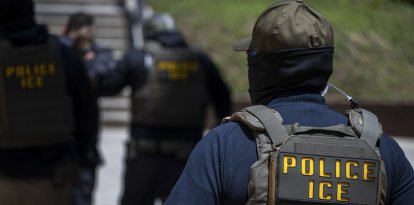
The order, which was issued last month, blocked what critics have called "roving" immigration raids that Immigration and Customs Enforcement (ICE) agents have been executing in Southern California.

ICE agents arresting an undocumented immigrant in Los Angeles.
The Department of Justice (DOJ) on Thursday asked the Supreme Court to overturn Judge Maame Ewusi-Mensah Frimpong's order limiting immigration raids in the Los Angeles area based on general criteria, such as gathering in places where day laborers tend to congregate or speaking Spanish. The order, which was issued last month, blocked what critics have called "roving" immigration raidsthat Immigration and Customs Enforcement (ICE) agents have been executing in Southern California.
In an emergency appeal filed with the Supreme Court, Solicitor General John Sauer defended the use of generalizations such as field of work or language proficiency to execute raids against illegal immigrants. "Needless to say, no one thinks that speaking Spanish or working in construction always creates reasonable suspicion. Nor does anyone suggest those are the only factors federal agents ever consider. But in many situations, such factors — alone or in combination — can heighten the likelihood that someone is unlawfully present in the United States. Immigration and Customs Enforcement (ICE) agents are entitled to rely on these factors when ramping up enforcement of immigration laws in the District," Sauer commented.

Politics
'Speedway Slammer': Indiana to add 1,000 beds for illegal immigrants detained by ICE
Santiago Ospital
Interference with law enforcement efforts
The attorney general also asserted that the Frimpong ruling interfered with the work of law enforcement in an epicenter of ICE operations, also estimating that nearly 2 million people living illegally in the United States reside in the very judicial district to which the decision applied, which encompasses the entire Central District of the state. This includes not only the city of Los Angeles, but also surrounding areas of California such as San Bernardino, San Luis Obispo and Riverside.
Sauer also argued in his emergency appeal that the plaintiffs had no legal standing to bring the case, as they face no immediate risk of being subjected to unconstitutional detention. Likewise, the attorney general explained that Frimpong's ruling represents an incorrect interpretation of the Fourth Amendment to the Constitution, and even contradicts a recent Supreme Court decision limiting the use of injunctive relief of universal scope.
DOJ assured that there are no detention quotas.
Last week, the Ninth Circuit Court of Appeals refused to lift the judge's order and even sharply questioned lawyers for President Donald Trump's administration over whether the mass arrests were in response to a White House-mandated quota to detain 3,000 immigrants per day. In response, DOJ lawyers asserted that no such quota had ever been ordered.
LATEST