Analysis
National security threat: How Iran builds its ‘sleeper cells’ in the US
Michael Balboni, a former national security official in New York, noted that foreign agents often settle in Iranian communities in U.S. cities, where they integrate, get jobs and send intelligence to their handlers until they receive a "go signal" to act.

DHS building (File)

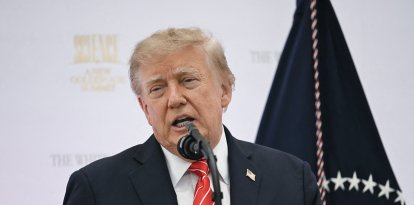
Senior officials in President Donald Trump's administration have issued warnings about the risk of attacks by Iranian "sleeper cells" on U.S. soil, following the bombing of Iranian nuclear facilities last Sunday.
The term "sleeper cell" refers to undercover agents operating undetected in a rival country, blending into society until receiving orders to act.
According to reports from The Telegraph, Iran may have exploited lax immigration policies during the Joe Biden administration to smuggle agents across the southern U.S. border. In that regard, of the more than 1,500 Iranian immigrants intercepted crossing illegally during Biden's tenure, roughly half were released into the country, according to reports the The New York Post.
In addition, The Telegraph also revealed that the total number of border crossings during that period exceeded official figures by 25%, including those who evaded authorities.
Trump points to Biden as responsible
In a comment during his trip to the NATO summit on Tuesday, Trump claimed that Biden “let a lot of super cells in” from Iran, referring to these sleeper cells, and expressed hope that they can be controlled, saying, “But hopefully we’ll take care of them.”
How do these cells work?
Along those lines, Michael Balboni, a former national security official in New York, noted that foreign agents often settle in Iranian communities in U.S. cities, where they integrate, get jobs and send intelligence to their handlers until they receive "a go signal” to act.
For its part, the Department of Justice (DOJ) has documented previous cases of Iranian operations in the U.S.
- In 2023, Farhad Shakeri, an Iranian national, was accused by the DOJ of plotting to assassinate Trump in retaliation for the death of Major Qassim Soleimani in 2020.
Shakeri recruited two men in New York, Carlisle "Pop" Rivera and Jonathon Loadholt, offering them $100,000 to execute an assassination or kidnapping.
- In 2011, Manssor Arbabsiar, an Iranian-American, was sentenced to 25 years in prison for a plot to assassinate the Saudi ambassador to Washington, D.C., offering $1.5 million to an alleged member of a Mexican cartel, who turned out to be an undercover agent.
Iran's M.O.
Experts warn that Iran could resort to other tactics, such as blackmailing Iranian citizens with family members in their country or recruiting disgruntled students at U.S. universities, where anti-Israel protests have created fertile ground for radicalization, according to Michael Rubin, a former Pentagon official and fellow at the American Enterprise Institute.
In addition, the Department of Homeland Security (DHS) issued a bulletin on Sunday warning of possible cyberattacks by "hacktivists" backed by Iran, who could obtain compromising material to extort individuals and force their cooperation.
The DHS statement notes that "the ongoing Iran conflict is causing a heightened threat environment in the United States. Low-level cyber attacks against US networks by pro-Iranian hacktivists are likely, and cyber actors affiliated with the Iranian government may conduct attacks against US networks.”
For his part, Thomas Warrick, a former State Department official and member of the Atlantic Council, stressed that Iran usually seeks a "symmetry" in its retaliation.
That explains why after the attack on its nuclear facilities in Fordow, Natanz and Isfahan with14 “bunker-busting bombs,” Tehran responded with 14 missiles against U.S. bases, an action considered limited to avoid further escalation.
However, despite Iran's threats that any U.S. element is a target, Warrick warned that U.S. nuclear sites could be targets of sleeper cells, and that Iran has previously tried to hire criminal gangs to carry out attacks. “The reality is, Iran isn’t finished yet,” he sentenced.
Trump administration steps up warnings
LATEST