Middle East escalation: Iran attacks US forces in Jordan after American strike on Larak Island
U.S. Central Command rejected Tehran's accusation that it had committed an "act of aggression" and stated that its attack was intended to eliminate an imminent threat to the Strait of Hormuz
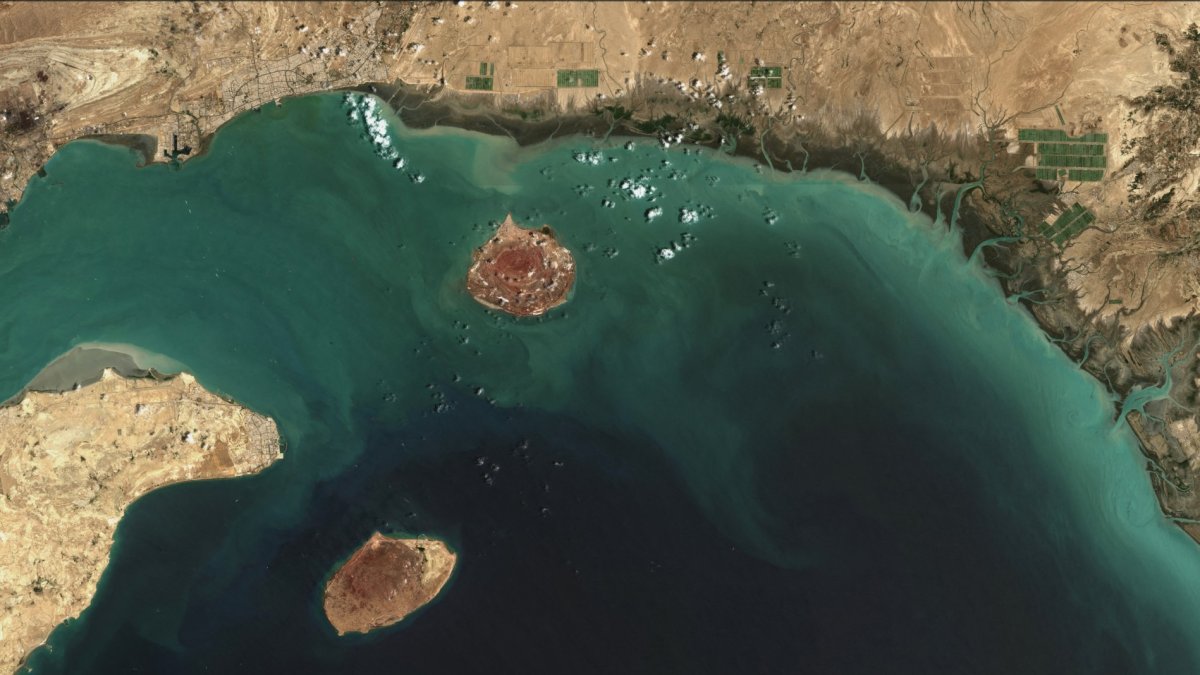
This satellite image shows a panoramic view of the northern part of the Strait of Hormuz

Iran attacked U.S. forces stationed in Jordan on Sunday, hours after Washington bombed two missile launchers on the Iranian island of Larak. According to a source cited by Fox News correspondent Trey Yingst, no significant hits were reported, as nearly all of the projectiles fired by Iran were intercepted.
The escalation stemmed from U.S. intelligence that detected Tehran preparing to launch rockets loaded with sea mines toward the Strait of Hormuz, one of the world's most important trade routes. The plan sought to re-mine those waters after the U.S. Navy had completely cleared them, a fact President Donald Trump confirmed on August 25. At that time, Trump had already warned that any vessel caught planting new explosives would be "immediately and systematically destroyed."
In response to the retaliatory attack, the Jordanian Armed Forces confirmed that they had intercepted eight missiles fired from Iran that entered their airspace. The Islamic Revolutionary Guard Corps (IRGC) also claimed responsibility for a combined attack using ballistic missiles and drones against two U.S. air bases on Jordanian territory, King Hussein Air Base and Al-Azraq Air Base, claiming to have caused "severe damage" to technical and maintenance infrastructure, as well as to areas where fighter jets were stationed.
The U.S. Central Command (CENTCOM) refuted the Iranian account, describing the bombing of Larak as an "act of aggression." The military agency called the accusation "false" and asserted that its forces carried out a "limited, precise action" against IRGC troops who posed a direct threat to the security of the strait. "In essence, Iran created the threat and the U.S. military eliminated it to protect civilian mariners, commercial shipping, and the free flow of global commerce," CENTCOM stated in its release.
From Tehran, Ebrahim Azizi, head of the Iranian parliament's national security committee, warned of further retaliation in a message posted on X: "Undoubtedly, no crime, at any level, goes unanswered; a response that is devastating, more painful, and instructive, which will complete the chain of your failures." IRGC spokesman Hossein Mohebi, for his part, described the U.S. attack as a "strategic and fatal mistake" that, he said, will tip the scales against those who ordered it.
The incident comes amid a broader economic offensive by Washington against the Iranian regime. Treasury Secretary Scott Bessent announced on Sunday that his department will impose new weekly sanctions against Iran, starting with banks that facilitate its access to the international financial system. The official did not rule out completely cutting off any financial institution from the U.S. dollar-based system.
The new round of hostilities has already impacted the markets. Oil prices surged more than 2% in early trading on Monday in Asia, with Brent crude surpassing $90 per barrel, amid growing concerns over a potential prolonged disruption to oil shipments through the Strait of Hormuz.
LATEST