At his inauguration, Abelardo De la Espriella declares all-out war on narcoterrorism, promises to bolster Colombia's security forces
The central theme of the presidential address was the definitive end to negotiations with criminal and guerrilla organizations.
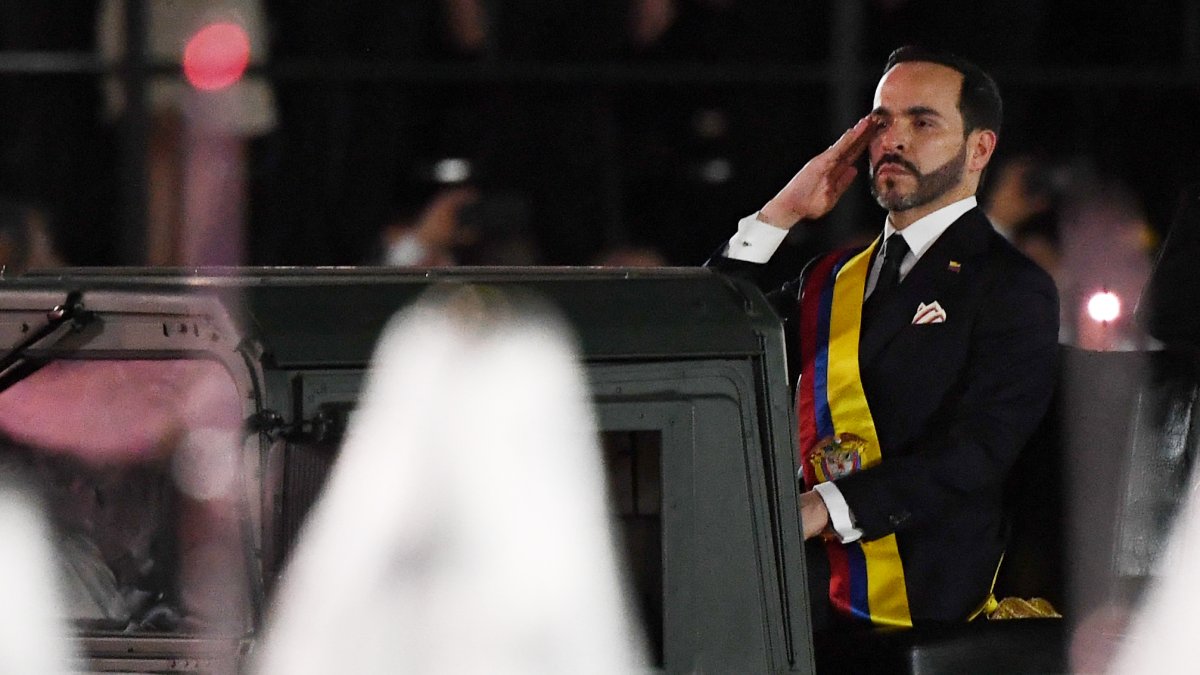
Abelardo De la Espriella during the inauguration ceremony on Friday, Aug. 7.

In Colombia, Abelardo De la Espriella formally assumed the office of head of state and delivered his first official speech from the Pichincha Military Canton in Cali, a location of great historical and symbolic significance for the country's security forces.
From there, the president proclaimed the end of what he described as a long cycle of national resignation and laid the groundwork for a profound transformation in the country's security strategy.
The inauguration ceremony, the main proceedings of which were broadcast to attendees gathered at the USC Arena at the University of Santiago de Cali, served as a platform to outline the new government doctrine.
De la Espriella assured that his administration will focus on restoring fundamental civil rights: "The time has come to restore order, authority and freedom," the president stated categorically, drawing a clear line of demarcation from previous administrations.
End of diplomacy with terrorism
The central theme of the presidential address was the definitive end to negotiation processes with criminal and guerrilla organizations.
The president was emphatic in pointing out that the reconciliation mechanisms tried in the recent past have run their course without producing results. Consequently, he warned that members of criminal factions will have only two alternatives: strict compliance with the legal framework or direct confrontation against the operational capacity of public institutions.
Accompanied by military commanders, the president contrasted the new institutional approach with the situation he inherited.
In his remarks, he pointed to the weakness with which political authorities had confronted crime in previous periods: "Historically, the state was sufficiently noble. Under the regime that has now ended, the state was sufficiently complicit. In this critical moment, it will be forceful and head-on against crime," he told the uniformed ranks.
To implement this offensive, he announced that he will soon issue a detailed list of narcoterrorist groups, equipping the battalions with optimal legal and operational tools.
Return of aerial fumigation and prison reform
The restructuring of the anti-narcotics fight includes the immediate resumption of aerial spraying to eradicate coca leaf plantations, which covered nearly 1,000 square miles at the time of the UNODC's latest global survey.
The president defended the implementation of next-generation technological compounds that safeguard environmental and constitutional standards, while also confirming the construction of maximum-security prison complexes intended for the most dangerous criminal profiles.
Likewise, de la Espriella's agenda included a critical assessment of the Special Jurisdiction for Peace (JEP). While he guaranteed formal compliance with the current legal framework, he emphasized that he will not waver in his thorough oversight of a judicial body that emerged outside the will of the people.
Citing the historic resolve of leaders such as Álvaro Uribe Vélez and Winston Churchill, the president concluded by pledging to decentralize the functions of the executive branch to ensure the rule of law throughout the entire national territory.


World
US and Shield of the Americas join De la Espriella to denounce Petro-driven transition crisis as undermining Colombian democracy
Emmanuel Alejandro Rondón
LATEST