MIGRANT INVASION IN SPAIN: Thousands of migrants storm the city of Ceuta, which borders Morocco
Ceuta, a Spanish exclave located on the African continent, is experiencing one of its worst migration crises in recent years. Local authorities are calling for a national emergency to be declared.
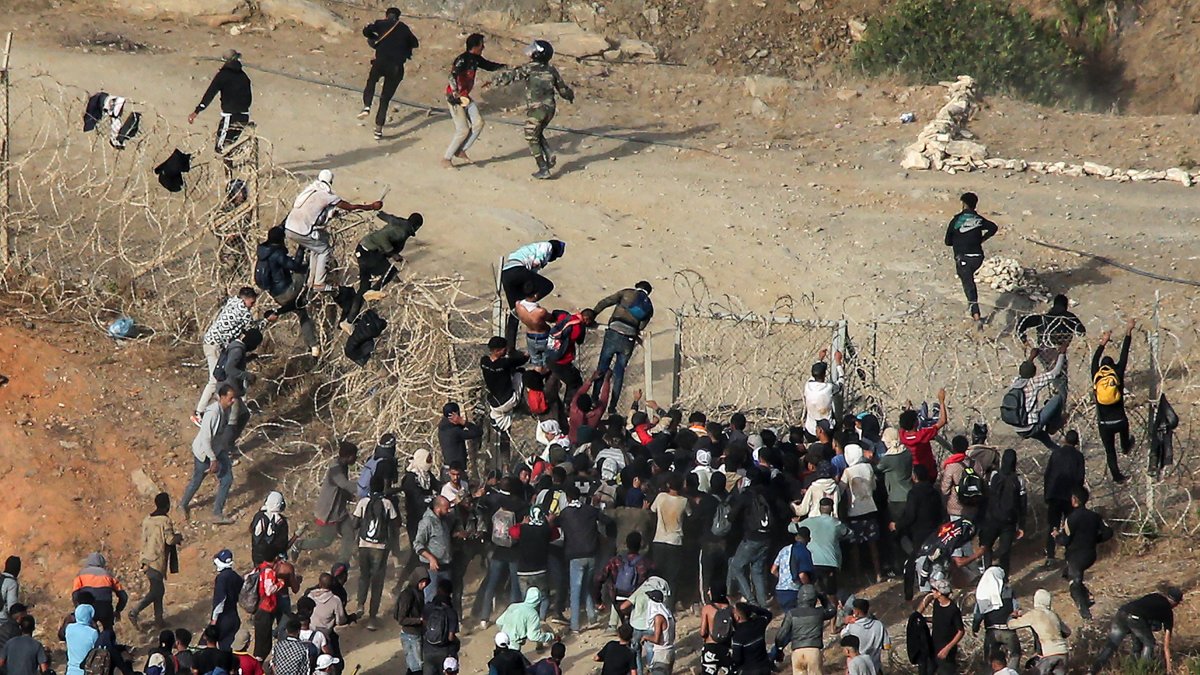
Migration crisis in Ceuta, Spain, in May 2021. File photo

There is a critical situation in Spain as a result of the migration crisis. In recent hours, hundreds of illegal immigrants have swum across to Ceuta, a Spanish exclave located on the African continent. It is one of the two land borders that the European Union shares with Africa, along with the city of Melilla, also Spanish territory.
These videos, published by the Spanish newspaper El Faro de Ceuta, show how hundreds of immigrants have crossed into Spain illegally from Morocco.
In less than two weeks, around 2,000 people, mostly from Morocco, have managed to enter the country illegally, overwhelming the capacity of political authorities and security forces to contain the situation.
The president of Ceuta, Juan Jesús Vivas Lara, appeared before the media to explain how the crisis could become identical to the one the territory suffered in May 2021, when more than 10,000 illegal immigrants managed to scale the border fences, sparking a diplomatic standoff between Spanish and Moroccan authorities.
Vivas Lara is calling for “appropriate measures,” such as declaring a national emergency, to stem this intense influx of illegal immigrants.
“If appropriate measures proportional to the scale and scope of the problem are not implemented, and if the intensity of the influx continues, we may soon see numbers similar to those in May 2021,” said the leader. “We must immediately address this emergency and lay the groundwork to prevent situations of this nature in the future.”
New immigration law promoted by Pedro Sánchez and upheld by the courts is responsible
The trigger for this migration crisis is a ruling issued by the Spanish Supreme Court in late June. The highest court in all jurisdictions ruled in favor of the new immigration law promoted by the government of Pedro Sánchez which, among other provisions, prohibits so-called “immediate returns” of all migrants who attempt to enter by swimming from Morocco to Ceuta and Melilla.
In a statement, the Spanish Supreme Court explained that “the 10th additional provision of the Immigration Law does not allow for the application of rejection at the border, also known as ‘immediate returns,’ to migrants intercepted on the high seas who attempt to enter the cities of Ceuta and Melilla by swimming.”
According to Spain's highest court, this type of expulsion may only be applied to those illegal immigrants who attempt to enter by “overcoming established border containment measures.”
"Invasion"
Political reactions to this critical situation are already coming in. Alberto Núñez-Feijoo, president of the Popular Party (P.P.) and leader of the opposition, demanded that a national emergency be declared, as requested by the president of Ceuta.
“The situation in Ceuta is desperate. The government cannot turn a blind eye to its obligations because we are facing a national security crisis. We fully support Vivas, who is quite rightly calling for the emergency to be recognized and for control of our borders to be immediately restored,” said Núñez-Feijóo.
Santiago Abascal was even more forceful. The president of right-wing party Vox called Sánchez a “traitor, corrupt and indecent” for allowing this crisis to occur by reforming the immigration law. He described the situation as an “invasion,” despite the fact that the Socialist Party tries to make people believe that all immigrants who enter Spain illegally are doing so to “flee” wars and poverty.
“They are not fleeing any war, nor are they fleeing poverty. It is an invasion. They are men of military age summoned by Sánchez’s corrupt government to storm our borders so they can later roam the streets of Spain chanting ‘Long live Pedro Sánchez,’” Abascal stated.
Silence reigns within Sánchez’s government. The only information available is that Interior Minister Fernando Grande-Marlaska plans to travel to Ceuta in the coming hours.
LATEST