Iran strikes US bases in the Gulf and Jordan again; Washington denies having carried out any attacks in recent hours
A U.S. official clarified to the press that the U.S. military has not carried out any attacks in recent hours, despite Iranian media reports of explosions in the south of the country, in areas such as Bushehr—home to a nuclear plant—Konarak, Choghadak, and Bandar Abbas.
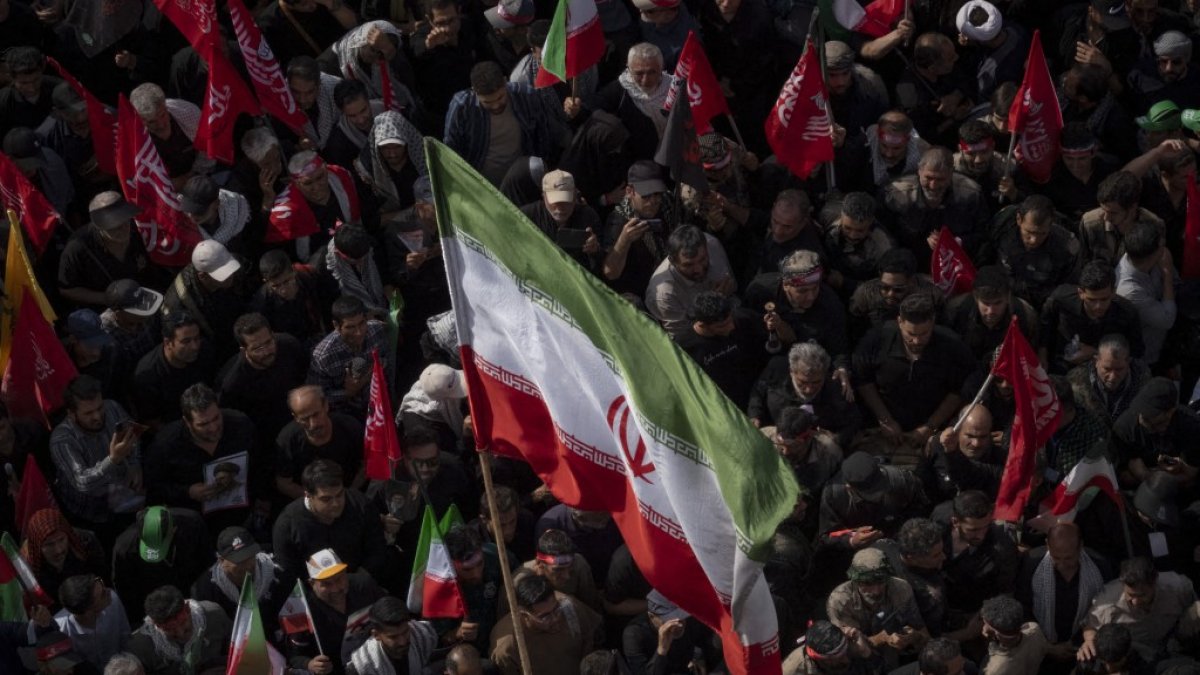
Pro-government supporters attend the funeral of Iran’s late supreme leader

Iran launched a simultaneous offensive on Thursday against U.S. military facilities in Kuwait, Qatar, Bahrain, and Jordan, in the most extensive escalation since Washington broke the three-week truce with new airstrikes against Iranian territory.
According to a statement released by Iranian state media, the Iranian Army attacked Patriot systems in Kuwait, an early-warning site in Qatar and a U.S. Army fuel depot in Bahrain. Kuwait confirmed that it had intercepted a cruise missile, three ballistic missiles, and 10 drones in its airspace, with one person injured by shrapnel. In Jordan, sirens sounded after Iranian missiles were detected; eight were shot down without causing damage or injuries, although the Revolutionary Guard later claimed to have fired 10 ballistic missiles at the Jordanian base in Azraq, used by U.S. troops, and at a U.S. military command center in the region.
Meanwhile, a U.S. official clarified to Fox News that the U.S. military has not carried out any attacks in recent hours, despite Iranian media reports of explosions in the south of the country, in areas such as Bushehr—home to a nuclear plant—Konarak, Choghadak, and Bandar Abbas. A local official said that a U.S. missile struck the perimeter of the Bushehr plant, although that same perimeter had already been hit in previous attacks.


The new attacks come hours after CENTCOM confirmed that it had struck some 90 Iranian military targets on Wednesday, including air defense systems, coastal surveillance assets, and missile and drone depots, in retaliation for the Iranian attack on three oil tankers near the Strait of Hormuz. According to figures from Iranian state media, the U.S. airstrikes on Wednesday and Thursday left 14 dead and 78 wounded across five provinces.
The Strait of Hormuz remains at the center of the conflict. The Revolutionary Guard Navy maintained that U.S. maneuvers to reroute maritime traffic are hindering the full reopening of the waterway, though it acknowledged that traffic under Iranian supervision has recovered to about 50% of pre-war levels over the past two weeks. The U.S. Army, for its part, insisted that it has facilitated the passage of more than 800 ships and 380 million barrels of crude oil through the strait since May, and that Iran does not exercise control over that sea lane, through which nearly one-fifth of the world’s oil used to flow before the war.
The offensive also coincided with the funeral of Iran’s Supreme Leader, Ayatollah Ali Khamenei, who was killed on February 28 in a joint U.S. and Israeli attack that marked the start of the war. The funeral procession arrived Thursday at a shrine in Mashhad after a week of processions, with a crowd carrying anti-Trump banners.
Qatar, which hosts the largest U.S. base in the region and often mediates between Washington and Tehran, condemned the attacks on commercial ships, but called for a return to diplomacy, in line with calls from Turkey and Oman to avoid further escalation. A second U.S. official stated that Washington remains committed to a negotiated solution and that technical talks are continuing.
LATEST