NATO 0.0
NATO has not emerged stronger from the summit in Ankara. On the contrary, all its contradictions and differences remain.

A podium bearing the NATO logo
International organizations have traditionally been like old rockers — “they never die.” Although, as we saw at the recent NATO summit in Ankara, these high-level meetings are a bit like the post-election assessments: everyone claims to have won. But one would have to be very gullible to believe that this summit was a resounding success, as we’re being bombarded with claims from European governments, from NATO itself, and from much of the media that covered it.
Those who are more moderate in their enthusiasm believe it was a success because the promises of increased defense spending by European allies have averted a certain breakup and prevented Trump from deciding to leave the organization entirely; The most optimistic are trying to sell us on the idea that the Atlantic Alliance is entering a new phase — what the U.S. Under Secretary of Defense, Elbridge Colby, called this past February, NATO 3.0, in which the Alliance’s European pillar assumes responsibility for Europe’s conventional defense at all levels — from command and control to combat units, including logistics and procurement.
Both views share what the Alliance’s current Secretary General, Mark Rutte, calls a major achievement: the announcement that European allies have committed to spending an additional 50 billion to strengthen their defense.
But to focus solely on the promises — something which Europeans are experts at — is to overlook many other aspects of this summit that do not bode well for the organization created back in 1949 with the purpose, as its first Secretary General, Lord Ismay, so aptly put it, “to keep America in, the Russians out, and Germany down.”
To start, the Ankara meeting has made it clear, once again, that NATO’s sole leader has been, is, and can only ever be the United States. This is not only due to the disparity in military power between the members — despite the long-standing Atlantic commitment that no country should contribute more than 50% of the capabilities critical to the alliance’s proper operational functioning — but also because of the evident difference in political power: The Europeans were ready to flatter Donald Trump as part of their strategy (which was actually a tactic), following in the footsteps of their secretary general, and were prepared to open their checkbooks as much as necessary. But the American president wasn’t particularly interested in the numbers — something he takes for granted — but rather has shifted the agenda toward war with Iran (including his latest airstrikes in the middle of the summit), criticizing allies for their lack of solidarity, and repeating his demand to take control of Greenland on national security grounds — just when the Europeans thought the issue had been put to rest. European leaders have managed to avoid being kicked out of the big league, but they’ve only been allowed to sit — not to voice their opinions. Because, although everyone is equal in the Alliance, some are more equal than others.
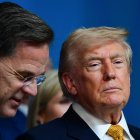
Second, the European allies thought they could appease Trump because they now see him — to a large extent — as a lame duck, having reached the halfway point of his term and facing midterm elections in which, secretly, they hope the Republicans will suffer a major defeat, thereby diminishing Trump’s power. I don’t know what the results of this fall’s elections will be, but whether the Republicans win or lose, I’m convinced that Donald Trump will find a way to push his policies forward, with or without Congress. But in any case, when you look at the group photo and see a Keir Starmer, with only weeks left in his political career, or a Macron sporting his sunglasses, whose future is more than uncertain, or even German Chancellor Friedrich Merz, paralyzed by his own governing coalition and facing the ever-rising opposition of the AfD — not to mention the Spanish president, who has had to travel without his wife, who is barred from leaving Spain by a court order due to the alleged flight risk — the American president’s potential weakness must be put into perspective, and significantly so. He is the leader with the most power and the longest tenure of them all.
But on a more serious note, Europeans lack strategic vision. They flaunt their euros as if they could use them to stop that much-touted Russian advance on NATO soil. If they were actually to spend what is being said (which hasn’t even been achieved in Germany following its much-publicized rearmament plan), that spending must translate into real capabilities. It’s not enough to raise — deservedly so — soldiers’ pay, as Spain plans to do; nor is it enough to build more tanks, as Germany wants to do.
It was French Marshal Ferdinand Foch who said that “generals always prepare for war with the previous one in mind.” And Europeans have, militarily speaking, been looking backward for too long. Large platforms may help, industrially speaking, the only sector left for the EU’s Keynesianism to exploit — in search of a sector that adds some growth to a decrepit economy lacking new technologies and innovation. Let us recall here that while Allied leaders promised to improve their industrial capabilities, Volkswagen announced the layoff of 10,000 workers in Germany.
The great Prussian military thinker Carl von Clausewitz, made it clear that war never changes its nature, only its characteristics. And this has been accepted for the past two centuries. But perhaps in the 21st century, given what we are seeing in Ukraine and the Middle East, we will be forced to reevaluate his assertion. This is not a trivial or frivolous matter, because if we are wrong about future conflict, we will be building systems designed to fight the previous one — and we will pay dearly for it. For example, in 2022 and 2023, everyone was talking about a return to trench warfare, the importance of artillery, and the need to increase production of heavy ammunition in light of the extremely high daily consumption of shells, especially 105- and 155-mm rounds; in 2024, in light of Russia’s use of an increasing number of missiles and rockets of all kinds, the emphasis shifted to the need for air defense and missile defense systems, whose effectiveness had been proven by Israel against rockets fired by Hamas, Hezbollah, and even ballistic missiles launched from Iran; and in 2025, we have witnessed an explosion in the use of drones and anti-drone systems of all kinds. But what has not been as clearly recognized are the intelligence, communications, command, and control systems that enable us to identify and select targets, anticipate the enemy’s moves, and multiply the destructive power of all other capabilities. Warfare has been rapidly evolving in recent years, and what lies ahead will bring even more automation, robotics, and deadlier weapons.
Unfortunately, the Ankara summit looked more in the rearview mirror than ahead. And it has once again demonstrated that European allies fear Trump more than Putin and that whatever they say they’re going to do has much more to do with pleasing the American president than deterring the Kremlin leader. That was the case under Biden four years ago, and it remains so today.
NATO is not making progress toward its transformation into this “3.0” organization. Rather, it is limping toward a “0.0” NATO — a watered-down, decaffeinated version — in which the United States will take less and less interest and the Europeans will offer only their lamentations. It is true that there are alternatives for ensuring a defense system for Europe, including the absorption of the European pillar and whatever remains of NATO into the EU. Some are more plausible than others, such as the gradual hollowing out of the organization’s capabilities. But the only real alternative for Europe’s defense is for Europeans to take charge of it themselves, including the nuclear component. And that, as things stand today, does not seem viable — neither in terms of capability nor will.
NATO has not emerged stronger from this summit in Ankara. On the contrary, all its contradictions and differences remain. Perhaps the only one who can be satisfied is the Ukrainian leader, Volodymyr Zelensky, who has secured more funding from the Europeans for his military, the possibility of manufacturing Patriot missiles on Ukrainian soil under an American license, and a press conference with Donald Trump in which he was even allowed to crack jokes without getting burned.
The Europeans, whatever they may say, have little to celebrate.
LATEST