LIVE | Trump criticizes several countries for lack of ‘enthusiasm’ in reopening Strait of Hormuz
The president accuses NATO of functioning "only one way" and recalls American aid in conflicts that, like Ukraine, were of no interest to the U.S. Oil prices remain above $100 a barrel despite the fact that some countries have already begun to release part of their strategic reserves.

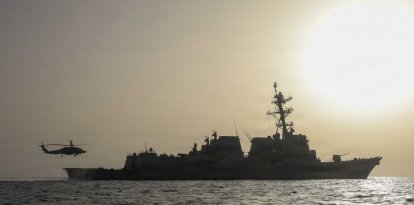
The USS Pinckney during Operation Epic Fury.
The third week of the Middle East war began with a warlike and dialectical escalation between the two sides. In addition to the exchange of threats between Trump and various members of the Iranian regime about what may come next, they have increased pressure on rival economic targets in the region.
The U.S. president has increased pressure on his allies and even China to unblock the Strait of Hormuz. Trump stresses that the countries most affected by the Iranian blockade (China, Japan and Europe), should be the most interested in reactivating maritime traffic in the area. in this line, he launched a serious warning to his NATO partners, whom he predicted "a bad future" in case they do not respond to his call.
Meanwhile, oil prices remain above $100 a barrel, despite the fact that countries such as Japan have already begun to bring barrels from their strategic reserves onto the market to bring down costs.
Times correspond to Eastern Standard Time.
Trump does not know the status of Mojtaba Khamenei
During his appearance at the White House, President Donald Trump stated that he does not know whether Iran’s new supreme leader, Mojtaba Khamenei, is dead or alive.
“They’re saying that he’s badly disfigured. They’re saying he lost his leg—one leg—and he’s been hurt very badly. Other people are saying he’s dead,” the president said. “We don’t know … if he’s dead or not.”
Trump criticizes some countries for lack of “enthusiasm” to help reopen Strait of Hormuz
President Donald Trump criticized several countries for not making an effort to reopen the Strait of Hormuz, which Iran has blocked since the start of the war.
“For 40 years, we're protecting you, ... but they said, we'd rather not get involved,” Trump said. “We strongly encourage the other nations to get involved with us and get involved quickly, with great enthusiasm.”
Iran threatens to attack American companies in the Middle East
After stating that it would be capable of taking the war “as far as necessary,” the Iranian regime threatened to attack U.S. companies with offices in the Middle East.
In a message obtained by AFP, Iran’s Revolutionary Guard Corps urged employees of U.S. companies to “leave these areas immediately” because the areas where the companies are located “will be attacked.”
Missile fragments fell at the Church of the Holy Sepulchre and near the Knesset
Israeli police reported that several fragments of Iranian missiles that were intercepted fell in symbolic areas of Jerusalem.
Specifically, officers found pieces of projectiles that caused property damage at the National Library, near the Israeli parliament (Knesset), and at the Church of the Holy Sepulchre.
CENTCOM: "We are dismantling Iran's industrial defense base"
More than 50,000 Americans are working on Operation Epic Fury in the Middle East as the joint operation with Israel enters its 16th day. So far there have been more than 6,000 combat flights and more than 100 Iranian naval vessels have been sunk.
"We will continue to rapidly deplete Iran's ability to threaten freedom of navigation in and around the Strait of Hormuz," said Brad Cooper, commander of Central Command (CENTCOM), in charge of providing updates on the offensive.
To that goal of protecting the strait, Cooper added that of dismantling "Iran's ability to threaten freedom of navigation in and around the Strait of Hormuz." As examples, he showed photographs of the destruction of a naval drone storage facility, a drone production factory, an IRGC military depot.
The commander also accused Iran of having attacked civilians on more than 300 occasions in several countries in the region: Oman, Saudi Arabia, Israel, Jordan, Cyprus, Cyprus, Turkey, Azerbaijan, United Arab Emirates, Qatar, Iraq, Kuwait and Bahrain. Specifically, he condemned a recent attack in Tel Aviv:
"In just the last few days, the Iranian regime launched a reckless attack against civilian neighborhoods in Tel Aviv with cluster bombs, an inherently indiscriminate type of munition. We join countries across the region in condemning this aggression, and we stand shoulder to shoulder with our partners in bolstering our own defenses."
Wall Street opens up
(AFP) The New York Stock Exchange opened higher on Monday, driven by a slight drop in oil prices.
In early trading, the Dow Jones was up 0.80%, the Nasdaq index was up 0.98%, and the broader S&P 500 index was up 0.82%.
Iran threatens to take the war “as far as necessary”
The Iranian regime's Foreign Minister Abbas Araqchi threatened to take the war “as far as necessary,” while President Donald Trump is urging major powers to press for the reopening of the Strait of Hormuz.
“I think by now they have learned a good lesson and understood what kind of nation they are facing—one that does not hesitate to defend itself and is ready to continue the war wherever it may lead, and to take it as far as necessary,” Araqchi said, according to remarks reported by AFP.
Trump's stark warning to NATO over Strait of Hormuz: "If there's no response or if it's a negative response I think it will be very bad for the future of NATO"
President Donald Trump warned that NATO faces a "very bad" future if U.S. allies do not help open the Strait of Hormuz, key to transporting oil and blocked by Iran in the Middle East war.
"If there’s no response or if it’s a negative response I think it will be very bad for the future of NATO," he said.
Trump lamented that the Atlantic organization "is a one-way street" and recalled that his country has collaborated in conflicts, such as Ukraine, that were far outside its borders to help its allies.
Also, he insisted that the countries most affected by the closure, which are China, Europe and Japan are the first that should make efforts to reopen the passage. "It’s only appropriate that people who are the beneficiaries of the Strait will help to make sure that nothing bad happens there."
Oil prices remain above $100, triggering volatility in stock markets
The situation in the Middle East war is causing the price of crude oil to continue to rise and remain above the $100 per barrel barrier. At the close of the Asian market and in the first European movements, the Brent barrel reached $106.50, while the U.S. benchmark, the West Texas Intermediate, reached $104 dollars.
This has generated wide volatility in the markets, which closed with different signs. Thus, in Asia, the indexes of Tokyo, Shanghai, Sydney, Wellington, Taipei, Manila, Bombay, Bangkok and Jakarta closed down, while Hong Kong, Seoul and Singapore rose.
London, Frankfurt and Paris were up at the start of the European session.
Australia and Japan refuse to participate in operation to break Ormuz blockade
The governments of Australia and Japan ruled out seconding Donald Trump's call to help reopen the Strait of Hormuz, blocked by Iran since the start of the Middle East war.
"We will not send a ship," said Australian Transport Minister Catherine King, despite acknowledging the importance of reopening the lane.
For its part, Tokyo is "not considering" a maritime security operation in the area, Japanese Defense Minister Shinjiro Koizumi said.
Japanese Prime Minister Sanae Takaichi commented later, "The question is what Japan should do on our own initiative and what is possible within our legal framework, not what the United States is asking for."
Saudi Arabia and UAE intercept missiles and drones
Saudi Arabia's anti-aircraft defenses intercepted 61 drones, according to figures released by the Defense Ministry. Also the defense systems of United Arab Emirates intercepted missiles and drones launched by Iran, according to the Gulf country's Defense Ministry.
Earlier, authorities in Dubai reported a fire sparked by a "drone incident" near the city's airport, which forced a brief suspension of flights.
Israel resumes airstrikes on Tehran and Beirut
The Israeli Army announced new bombing raids on Tehran and southern Beirut during the early hours of Sunday morning into Monday. Loud explosions were reported in Tehran, while Lebanese media reported that Israeli bombs had hit neighborhoods that had been warned to evacuate during Sunday morning.
Man dies in Abu Dhabi hit by Iranian missile while driving his vehicle
A civilian was killed on the outskirts of the Emirati capital Abu Dhabi when a missile struck his vehicle, officials reported, as Iran continued its retaliation in the Gulf for the U.S.-Israeli attack.
Israel announces "limited ground operation" in Lebanon.
The Israel Defense Forces announced the start of "limited and targeted ground operations against key Hezbollah strongholds in southern Lebanon, with the aim of reinforcing the forward defense zone."
In a statement, the military noted that "this activity is part of a broader defensive strategy aimed at establishing and reinforcing an advanced defensive posture, which includes the dismantling of terrorist infrastructure and the elimination of terrorists operating in the area, in order to create an additional layer of security for the residents of northern Israel.
Macron conveys to Iranian president that it is "unacceptable" for Tehran to attack French interests in the region
French President Emmanuel Macron, said Sunday that he had told Iranian President Masud Pezeshkian that it was "unacceptable" to attack French interests.
Thursday night, an Iranian-made drone attack in the Erbil region of Iraqi Kurdistan left one serviceman dead and six other French soldiers wounded.
Netanyahu releases video mocking Iranian messages that he had been assassinated.
Israeli Prime Minister Benjamin Netanyahu came out against reports from Iran that he had been assassinated, as well as death threats against him made by the ayatollahs.
In a video, Netanyahu scoffed at those claims and reappeared in a video ordering coffee in a coffee shop: "Am I dead? I die for coffee and for my people," he said. The president also showed both his hands to counter those who spread rumors of his death because of a previous video in which he appeared to have six fingers.
Everything that's happened in the war so far, here

World
LIVE | Trump accuses Iran of using AI to spread false reports of U.S. military losses
Williams Perdomo
LATEST