ANALYSIS
The keys behind the collapse of the Chinese real estate market
For years, the Chinese real estate market grew steadily. Supported by rising housing prices, booming construction and high participation in the financial system. However, in recent years this system took a 180-degree turn.
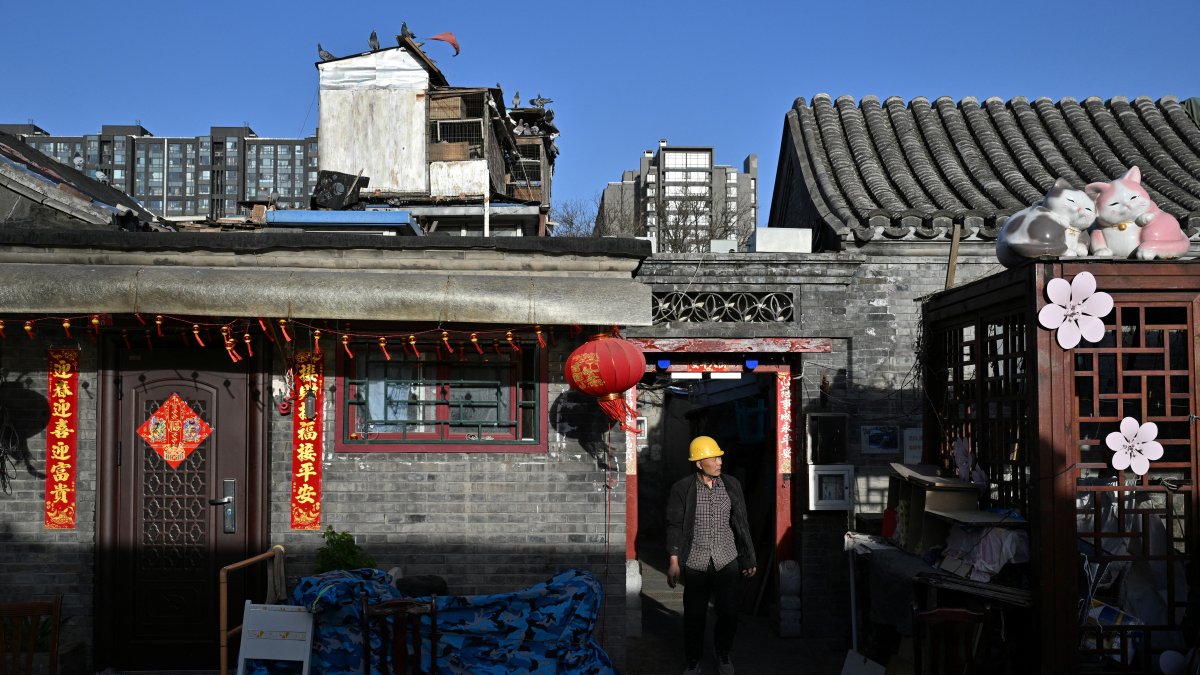
Housing in Beijing/ Adek Berry.

What is behind the collapse of the housing market in China? Despite the lack of updated official data, a report by The Economist pointed out that the magnitude of the crisis is such that it caused 85% of the gains recorded between 2011 and 2021 to vanish. The aforementioned media also warned that this negative scenario could extend until 2030, due to state regulations, an accumulated oversupply, and a subsequent price collapse.
For years, the Chinese real estate market grew steadily. Supported by rising home prices, booming construction and high participation in the financial system. However, in recent years this system took a 180-degree turn.
According to The Economist, new home sales have fallen by roughly half since 2021, new home construction has fallen by almost three quarters, there are tens of millions of unsold homes and investment has fallen by a third.
Faced with the lack of official information, which even led to the suspension of social network accounts that disseminated data on the real estate situation, the aforementioned media outlet consulted private reports such as those of Enhance International.


"Yet it is house prices that are causing the most concern. Larry Hu of Macquarie, an investment bank, calculates that 85% of the gains seen in the decade to 2021 have been wiped out. By comparison, the American housing meltdown of 2007 erased a mere 47% of the increase in home prices between 1996 and 2006" reported The Economist.
While the main official indicator is based on an index that surveys prices in 70 large cities, which already reflect a significant drop, the analysis warns that this data could "understate the problem": "Thousands of smaller cities, where the downturn has been most severe, are excluded."
What happened?
After decades under a closed communist system, the government gradually began to allow land commercialization, which was implemented during the 1990s. Since then, local governments became largely financed by land sales, which incentivized a sustained expansion of the real estate sector.
Over time, this model evolved into a heavy reliance on credit, as developers borrowed to build and financed new projects with pre-sales. Gradually, and despite population growth, the system began to become increasingly risky, as dependence on credit led to heavy indebtedness in the sector.
By the end of the 2010s, the system reached a limit point.What happened then? Developers accumulated high levels of debt and were constantly dependent on new financing to sustain their projects, while continuing to build and sell under the logic that prices would continue to rise.


Economy
Why is diesel a much bigger economic problem than gasoline since the war with Iran broke out?
Emmanuel Alejandro Rondón
In this context, the Chinese government decided to intervene with a corrective policy called the "three red lines," which limited the sector's indebtedness. By abruptly cutting off financing, the measure exposed the fragilities of the system and gave way to the current crisis.
According to a report by the International Monetary Fund (IMF), the previous growth of the real estate sector had a high component of indebtedness and inflated prices, so that expectations of price increases allowed developers to take on debt aggressively.
The course for 2030
Despite the Chinese government's corrective policy, the outlook is not very positive for 2030.
This was pointed out by an analyst from the Wanbo Economic Research Institute, who spoke to Yicai Global. According to its prediction, more than 80% of Chinese real estate developers and construction companies will eventually exit the sector.
According to The Economist, the outlook for the next five years looks "grim": "Analysts at the consultancy (Enhance International) believe that prices for non-new homes have another 40% to fall, despite having already dropped to their lowest in a decade. Even more worrying, they reckon that China’s property crisis may continue until 2030."
To finish correcting the course of the real estate market, the IMF advised a tightening of regulations to "prevent the accumulation of risks in the future," while they should "support local developers."
"A nationwide property tax and improved pension or other saving options would help reduce households’ need to invest in housing. Fiscal reforms that close local governments’ structural mismatch between revenues and spending obligations will also be needed to reduce their reliance on land sales and property activity," they ruled.
LATEST