Under the hood of Cuba's power structure: The regime's key figures
The dictatorial leadership of the island is made up of the main leaders who concentrate political, economic and military power. Here are the names, positions and roles of the key figures who make strategic decisions and determine the course of Cuba, in the midst of the island's mounting crises.
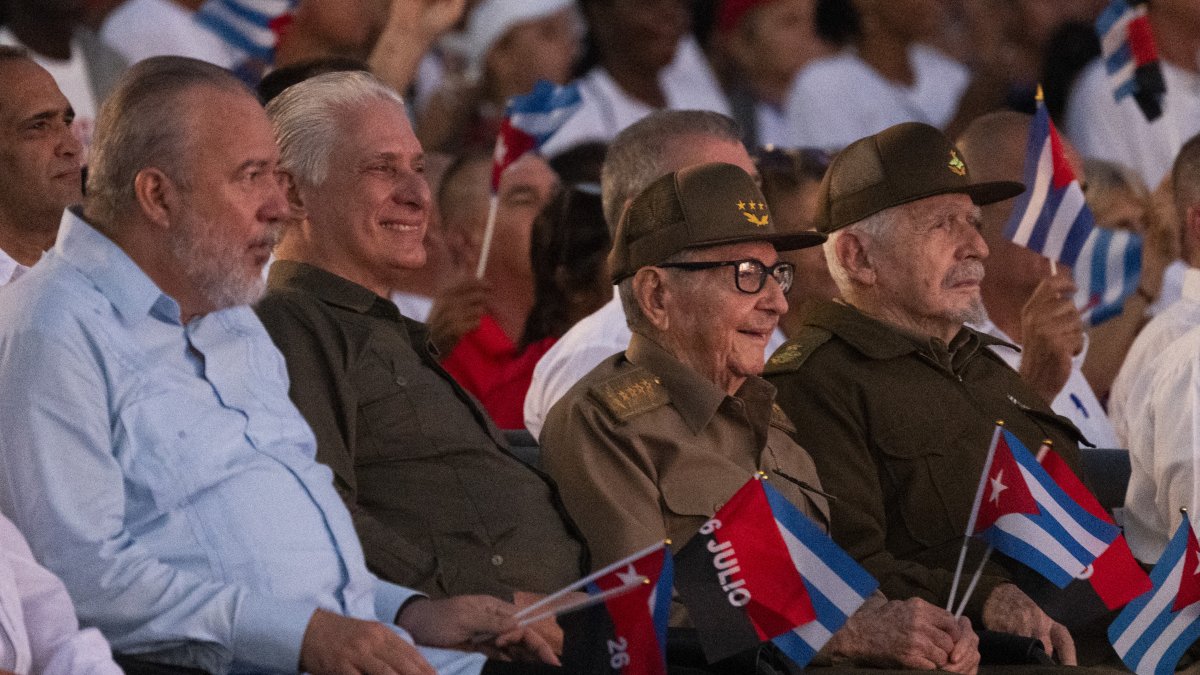
The leadership of the Cuban regime during a political event (Archive).

The Cuban political system is formally structured around the Communist Party of Cuba, but in practice, power is organized on three levels: the historical core of Castroism, the military and security apparatus, and the civilian government that manages the administration of the state. Around it operates an economic network dominated by companies linked to the military.
The historical core of power
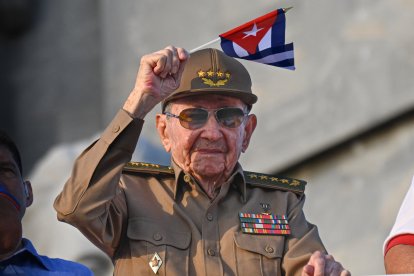
Former Cuban President Raúl Castro
Raúl Castro
For decades, real power in Cuba was concentrated in the figure of Raúl Castro, brother of Fidel Castro and one of the main commanders of the 1959 revolution. After assuming the presidency of the regime in 2008, Raúl consolidated a system in which the military became the country's main political and economic player.
Although he officially retired from that position in 2018 and stepped down from the leadership of the Communist Party in 2021, he is still considered the architect of the current model of power. Under his leadership, the role of the Revolutionary Armed Forces was strengthened in key sectors of the economy, especially tourism, foreign trade and finance.
Raúl Castro also pushed for a controlled transition to a new generation of leaders, ensuring that the military and security apparatus would continue to be the true mainstay of the political system.
Military and economic power
The second level, and for many analysts the most decisive, is the military-business complex that controls much of the Cuban economy.
Grupo de Administración Empresarial S.A. (GAESA)
GAESA is the business conglomerate controlled by the Revolutionary Armed Forces. It manages some of the most lucrative sectors in the country:
- International tourism
- Hotels
- Foreign currency exchanges
- Ports and logistics
- Retail trade
- Part of the financial system
It is estimated to control between 40% and 70% of the Cuban economy, depending on the calculation.
For years it was headed by Luis Alberto Rodríguez López-Calleja, an army general and Raúl Castro's ex-son-in-law, who was long considered the most powerful man in the Cuban economy until his death in 2022.
Under his leadership, GAESA became the economic core of the regime. Numerous analysts and Western governments pointed to the financial opacity of the conglomerate, since a large part of its operations are not subject to public or legislative control.
Rodríguez López-Calleja was sanctioned by the U.S. government for his role in the control of this business system.
The current head of GAESA
With a long career within the military business apparatus, Lastres Morera belongs to the circle of officers who manage the economy linked to the military. From her post, she oversees a conglomerate that controls key sectors of the Cuban economy—especially tourism, foreign exchange trade, port logistics, remittances and store media—and concentrates a large part of the country's hard currency revenues.
Her profile is discreet and not very public, something usual among the managers of the Cuban military economic network, characterized by financial opacity and little public accountability.
However, recent posts place her daughter as a financial director in Panama, and her sister in Florida, at the head of powerful companies and investments.
A key but unofficial piece: Raúl Guillermo "El Cangrejo" Rodríguez Castro
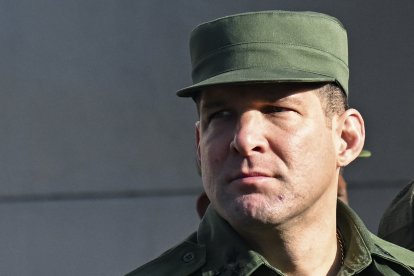
Cuban Colonel Raúl Guillermo Rodríguez Castro, grandson of Raul Castro (File).
Raúl Guillermo "El Cangrejo" Rodríguez Castro, grandson of Raúl Castro, has established himself as a figure of enormous influence within the Cuban power elite. The son of Débora Castro Espín and the late General Luis Alberto Rodríguez López-Calleja, who headed the powerful military conglomerate GAESA, Raúl Guillermo holds strategic positions within the Ministry of the Interior and his grandfather's personal security.
His role as head of the General Directorate of Personal Security places him at the heart of decision-making, controlling access to Raúl Castro and ensuring the protection of one of the regime's most important—if not the most important—leaders on the island. Although he has no official title in the government or the Communist Party, his proximity to the top gives him real power that transcends any formal position.
His influence extends beyond security, being linked to the economic and political network that sustains the continuity of the regime. Because of his privileged position and family connections, he has been singled out as a possible intermediary in discreet negotiations, and even as a key player in political transition scenarios, albeit confidentially. The combination of access, family loyalty and control over protection mechanisms makes "El Cangrejo" a strategic figure within the fabric of Cuba's power structure, an example of how personal ties to leadership can translate into real authority within a highly centralized system.
Also attributed to him are multiple entertainment and leisure businesses on the island, while the country languishes in the worst crisis in its recent history.
The security and intelligence apparatus
The maintenance of the Cuban political system depends to a large extent on an extensive state security apparatus, in charge of internal surveillance, intelligence and political control.
Lázaro Alberto Álvarez Casas is the minister of the interior and responsible for the state security system. Under his ministry are:
- The national police
- Intelligence services
- The prison system
- Counterintelligence bodies
Various human rights organizations have claimed these structures play a major role in the surveillance of opponents, activists and independent journalists. His ministry is considered as one of those most responsible for the repression in Cuba.
Alejandro Castro Espín
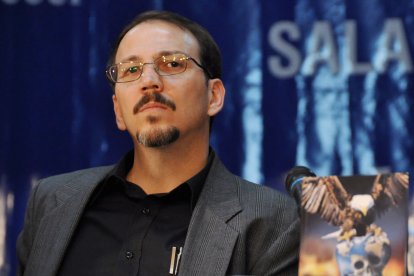
Cuban Colonel Alejandro Castro Espín, son of Raúl Castro.
Alejandro Castro Espín is an intelligence colonel and the son of Raúl Castro. Although he does not hold a particularly visible public position, he is considered one of the regime's top national security strategists.
He participated in the secret negotiations that led to the reestablishment of diplomatic relations between Cuba and the United States in 2014. His influence is mainly linked to the field of intelligence and strategic security.
Journalistic sources recently reported that, with the mediation of Mexico, Colonel Castro Espín is leading negotiations with CIA agents to carry out a transition on the island.
Formal political leadership, but no real power
Miguel Díaz-Canel
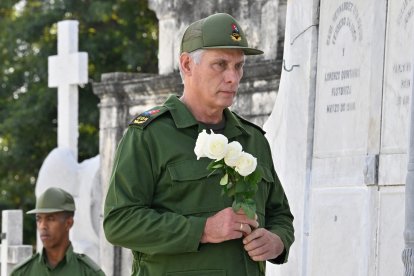
Cuban President Miguel Diaz-Canel (Archive).
Miguel Díaz-Canel is the current president of Cuba and first secretary of the Communist Party. An electronics engineer by training, he rose through the decades within the political apparatus to become the successor chosen by Raúl Castro.
Although he formally holds the highest office in the state, many analysts believe that his power is limited by the weight of the military and party structures.
His government has faced a deep economic and social crisis, marked by food shortages, inflation and energy blackouts. His figure has also come under fire following the crackdown on mass protests on July 11, 2021, the largest anti-government demonstrations in decades.
Manuel Marrero Cruz
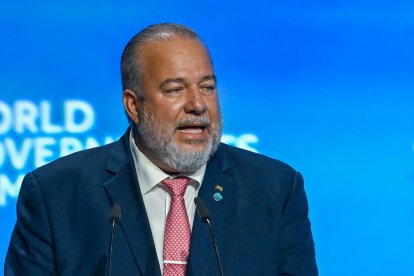
Cuban Prime Minister Manuel Marrero Cruz
Manuel Marrero Cruz has served as prime minister since 2019. He previously served for years as minister of tourism, one of the most important sectors of the Cuban economy.
His role is mainly focused on the administrative management of the government, overseeing ministries and economic policies: one ill-advised decision after another.
Several reports connect him to a luxurious life and great privileges that he extends to his family, while asking for sacrifices from the people.
Bruno Rodríguez Parrilla
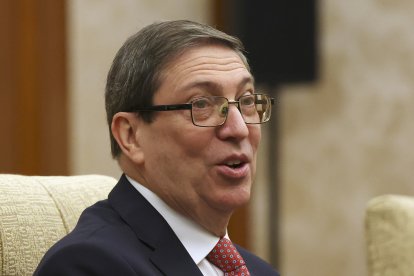
Cuban Foreign Minister Bruno Rodríguez Parrilla
Bruno Rodríguez Parrilla is the minister of foreign Affairs and principal international spokesman for the Cuban regime. A career diplomat, he has been a central figure in the defense of the dictatorship in international forums, especially in debates on economic sanctions and human rights.
Álvaro López Miera
Álvaro López Miera serves as the minister of the Revolutionary Armed Forces. A military veteran close to Raúl Castro, he is responsible for the country's military apparatus.
Following the 2021 protests, he was placed on sanctions lists by the U.S. government due to his role within the state security system.
Ramiro Valdés
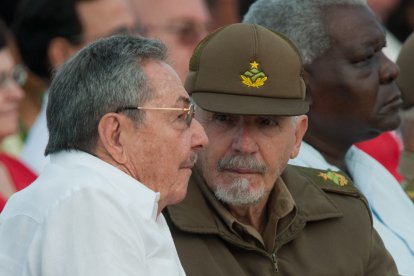
Ramiro Valdés Menéndez, one of the commanders of the regime (Archive).
Ramiro Valdés Menéndez is one of the historical commanders of the revolution and an emblematic figure of the most hard-line wing of the regime. He was minister of the interior in the early years of the revolutionary government and later held various government positions.
For decades, Valdés has been associated with the development of the state security and surveillance apparatus.
The latest reports on his health assure that he remains hospitalized in critical condition, suffering from a serious illness alongside likely complications due to old age. He will turn 94 years old next April.
World
Report warns Cuba is the 'epicenter' of destabilization in the US and Latin America
Virginia Martínez
Financial scandals and corruption cases among the Cuban elite
GAESA and control of the economy
One of the main focuses of controversy is the military business conglomerate Grupo de Administración Empresarial S.A., which controls much of the Cuban economy, especially strategic sectors such as tourism, retail, remittances and imports.
Economic investigations have pointed out that GAESA controls key companies such as CIMEX, Gaviota and TRD Caribe, accumulating huge foreign exchange reserves outside the control of the state budget.
Some analysts have described GAESA as a "parallel central bank," as it reportedly holds billions of dollars in reserves while the rest of the state economy suffers liquidity crises.
Offshore companies and tax havens (Panama Papers / Pandora Papers)
International financial leaks such as the Panama Papers and the Pandora Papers revealed the existence of networks of offshore companies linked to Cuban state interests.
Journalistic investigations identified companies registered in tax havens such as: Luxembourg, Bahamas, the British Virgin Islands and Cyprus.
Among the names linked to these structures appears Guillermo Faustino López-Calleja, brother of General López-Calleja, associated with shipping companies and holding companies used for international financial operations.
According to investigations by The Miami Herald and other media outlets, these offshore companies have been used to carry out international commercial operations and move capital outside conventional financial mechanisms, avoiding sanctions or financial controls.
Historic accusations of ties to drug trafficking in the 1980s
During the 1980s, accusations of cooperation between Cuban officials and drug trafficking networks arose.
Colombian drug traffickerJaime Guillot Lara testified to American authorities that Cuban officials allegedly allowed marijuana shipments to pass through Cuban territorial waters in exchange for payment.
According to those testimonies, some agreements included payments for each shipment transported and logistical support on Caribbean routes. The Cuban regime has always denied these allegations.
Control of remittances and use of foreign currency
Another point of controversy is state control over the remittances sent by Cuban emigrants.
Companies under the military conglomerate came to control this financial flow, which allowed part of the money to be used to finance tourism projects and state enterprises.
Economic research maintains that this system allows the state apparatus to take a significnt portion of the foreign currency that enters the country, making it one of the main sources of income for the state and the companies controlled by the military.
LATEST