Cuba to release 51 prisoners after Vatican's efforts: The island has more than 1,200 political prisoners
The authorities did not disclose the names of the prisoners or the crimes for which they were convicted.
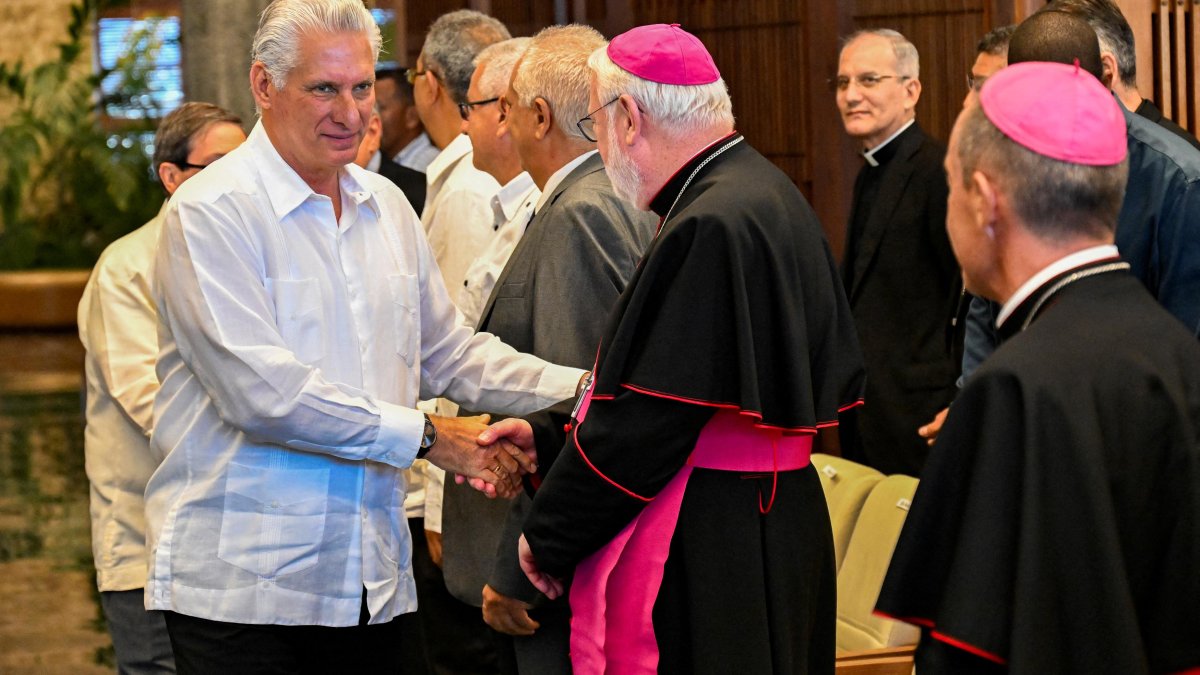
Miguel Díaz-Canel and Vatican envoy Archbishop Paul Richard Gallagher (Files)

Cuba announced Thursday night the early release of 51 prisoners, in what it described as a gesture of "goodwill" toward the Vatican, which has historically acted as a mediator on sensitive issues related to the island.
In a statement, the Ministry of Foreign Affairs informed that the decision responds to the "close and fluid relations between the Cuban State and the Vatican." According to the regime, the beneficiaries are prisoners who have served a significant portion of their sentences and have maintained good behavior.
The authorities did not disclose the names of the inmates or the crimes for which they were convicted. Nor did they mention whether some of these "possible freed prisoners" have political causes.

Cuba holds more than 1,200 political prisoners
Human rights organizations reacted to the announcement by calling for greater transparency. Prisoners Defenders, which monitors detentions since the July 11, 2021, anti-government protests, claims there are at least 1,214 political prisoners to date in Cuba.
The upper echelons of the dictatorship have historically rejected that claim.
A historic channel of dialogue
The Catholic Church has played a key role for decades as a mediator and channel of dialogue between Havana and Washington. Its intervention was fundamental in the reestablishment of diplomatic relations between the two countries in 2015, during the second term of former President Barack Obama.
In this context, on Feb. 28, Cuban Foreign Minister Bruno Rodríguez met at the Vatican with Pope Leo XIV during a diplomatic tour of Europe, amidst Cuba's complex situation.
Days earlier, Vatican Secretary for Relations with States Paul Richard Gallagher met with American diplomats to address the situation on the island.
The last mediation by the Catholic Church dates back to 2025, when Cuba pledged to release 553 prisoners following an agreement with the Vatican. That announcement came after then-U.S. President Joe Biden removed Cuba from the list of state sponsors of terrorism, a decision that was reversed shortly thereafter by Donald Trump upon taking office.
Two months later, Havana announced the release of those 553 prisoners, although human rights organizations pointed out that only a portion corresponded to political prisoners, while others were common prisoners. The Cuban government did not publish an official list of the beneficiaries at that time either.
The Catholic Church also played a key role in 2010, when it got then-President Raúl Castro to release some 130 political prisoners, including the 75 opposition members detained during the so-called "Black Spring" of 2003.
LATEST