ANALYSIS
Ten years since 13-N: When the Islamic State unleashed terror on the French capital
On Nov. 13, 2015, what started as an ordinary Friday night turned into the worst terrorist attacks in the history of France, with a toll of 130 dead and more than 400 wounded, many in serious condition.
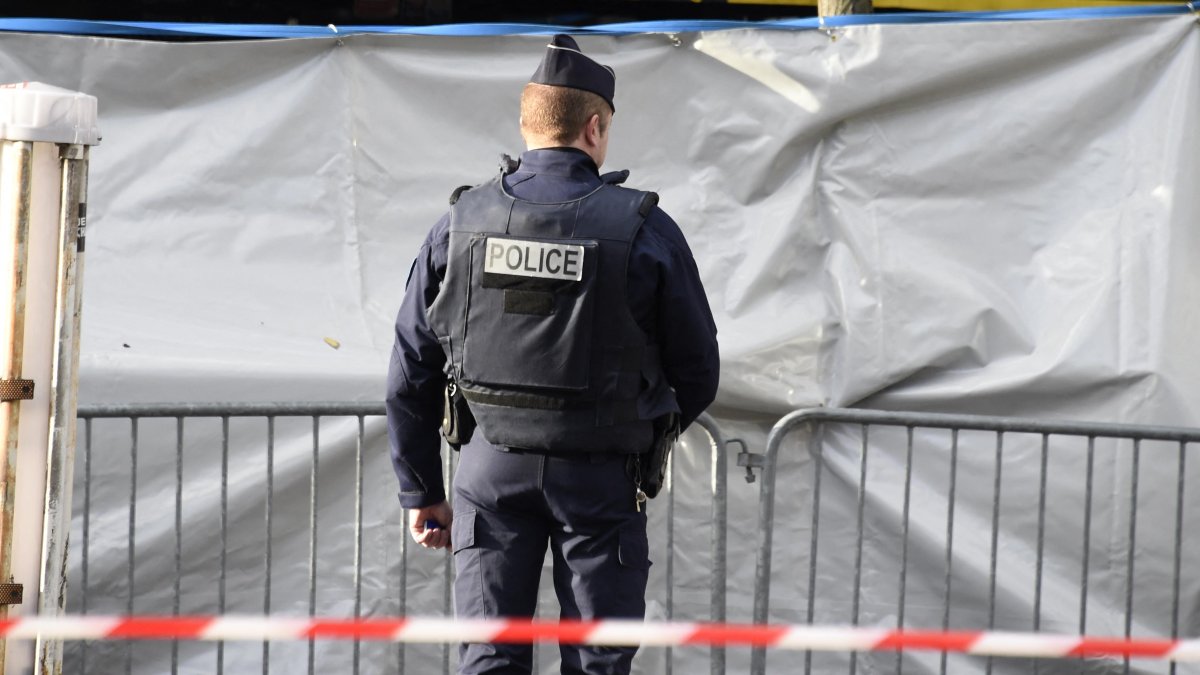
A policeman in front of the Bataclan theatre, one of the sites of the attacks.

Thursday marks exactly 10 years since the worst terrorist attacks in the history of France. On the night of Nov. 13, 2015, nine jihadists belonging to the Islamic State (I.S.) executed a series of coordinated attacks using AK-47s, grenades and explosive vests, turning Paris into a battlefield that, in just three hours, left 130 dead* and more than 400 injured, many of them seriously.
All the direct attackers were French and Belgian nationals, born or raised in Europe, although most had Maghrebi family origins and were second-generation jihadists who were radicalized in Europe.
"France is at war"
On Nov. 13, what began as a normal Friday night in the vibrant French capital turned into the worst attack in its history.
The first attack occurred at 9:16 p.m., when three suicide bombers blew themselves up next to the Stade de France, located in the Paris suburb of Saint-Denis, during a soccer game between France and Germany. Although the jihadists did not gain access inside the stadium, the explosions killed one person and left several injured.
That night, French President François Hollande was at the Stade de France and, following the loud explosions, was evacuated by security services.
"France is at war. The act of terror on Nov. 13 was an act of war that sought to strike not only France, but also Europe and the world," President Hollande declared after the attacks.
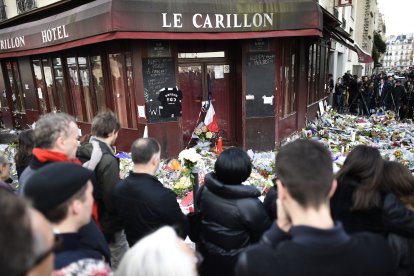
Congregation after the attack at Le Carillon.
Minutes later, between 9:25 and 9:36 p.m., two jihadist commandos fired on patrons in five bars located in eastern Paris. In just 11 minutes, the terrorists managed to turn five terraces in the capital into bloody war scenes.
A black Seat León drove 1.5 miles firing AK-47 shots at patrons of several bars and restaurants regularly frequented by Parisian youth, including Le Carillon, Le Petit Cambodge, Le Café Bonne Bière, La Casa Nostra and La Belle Équipe.
Massacre in the cafes of Paris
- 9:25 p.m. Le Carillon / Le Petit Cambodge (corner of Rue Alibert and Rue Bichat, 10th arrondissement).
- 9:28 p.m. Café Bonne Bière / La Casa Nostra (Rue du Faubourg-du-Templeand rue de la Fontaine-au-Roi, 11th arrondissement).
- 9:32 p.m. La Belle Équipe (Rue de Charonne, 11th arrondissement).
- 9:45 p.m. Le Comptoir Voltaire (Boulevard Voltaire).
*Victim 131: Guillaume Valette, psychologically shattered, ended his life two years after the attack. In 2019, a French court officially recognized his status as a direct victim of the attacks.
The attack in the first terrorist operation resulted in 39 dead and dozens of wounded. This was the first wave of attacks in Paris, before the massive massacre that took place at the Bataclan theatre during the concert of the American band Eagles of Death Metal.
The Bataclan: A massacre behind closed doors
At approximately 9:40 p.m., three men armed with AK-47 rifles, nine hand grenades, three explosive belts and 800 7.62×39 mm cartridges, entered through the front door of the concert hall located on Boulevard Voltaire.
The terrorists gained access to the venue as they shouted "Allahu Akbar! This is for Syria!" and fired at the ceiling to create panic. They then proceeded to massacre the spectators in the stalls of the Bataclan as the band fled the stage.
The attack resulted in 90 people killed in cold blood by the jihadist commando.
"I saw a boy with his face smashed. I tried to cover his wound with my scarf. He looked at me and said, 'Thank you.' Then he stopped breathing."
During the attack, many survivors hid among the corpses, playing dead to avoid being killed, while the jihadists shot at anything that moved. At around 10 p.m., negotiations by telephone with the police began. The terrorists were demanding the withdrawal of Western troops from Syria.
"We know that there are people who died because they didn't silence their phones. It's horrible to think that life depends on something so trivial..."
After a three-hour siege, 40 agents from the Brigade de Recherche et d'Intervention (BRI) and 30 agents from the elite unit (RAID) launched the final assault that lasted almost half an hour and in which they managed to kill two of the terrorists, while the third one blew himself up by detonating his explosive belt.
At the end of the anti-terrorist operation, the agents succeeded in freeing the hostages, many of them mutilated and seriously wounded by gunshot wounds.
When they searched the room later, investigators discovered a tape recorder that had filmed the entire night. The recording made it possible to quantify the attack: the first phase lasted 32 minutes and there were 258 shots fired.
Support network and logistics
- Abdelhamid Abaaoud, 28, Belgian national, was the overall coordinator of the attacks. He trained in Syria and returned to Europe to direct the attacks from Paris. He died in Saint-Denis during a police raid a few days after the attacks.
- Hasna Aït Boulahcen, 26, a French national, was Abaaoud's cousin and provided the hideout in Saint-Denis. During the police raid on the home she died along with the terrorist and another suspect.
- Najim Laachraoui, 24, a Belgian national, was the explosives manufacturer. He traveled with Abaaoud from Syria and died in a suicide attack at Zaventem Airport in Brussels in March 2016.
Salah Abdeslam: The terrorist who did not set off his own bomb
Born in 1989 in Brussels, Belgium, to Moroccan parents, Abdeslam grew up in the Molenbeek municipality, the epicenter of jihadist radicalization in Europe.
Before the attacks, he led a relatively normal life. He was a mechanic, occasional DJ and father of a daughter. But in 2015, he joined the Islamic State (I.S.) network, recruited by his childhood friend Abdelhamid Abaaoud, the mastermind of the Nov. 13, 2015, attacks.
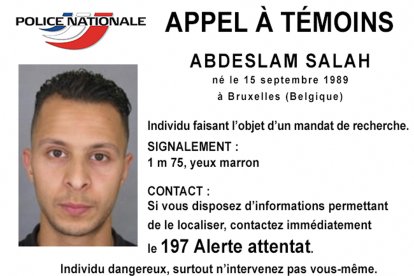
Salah Abdeslam wanted
Abdeslam's role during the attacks was logistical: he transported weapons and explosives from Belgium to France. During the trial in Paris, he claimed that he had entered a bar in the 18th arrondissement with the intention of detonating an explosive vest, but had changed his mind at the last moment.
The terrorist managed to escape Paris the night of the attacks thanks to a support network in Belgium. He fled by car to Brussels, passed several police checkpoints without being arrested and remained in hiding for more than four months, alternating shelters between the municipalities of Forest and Molenbeek.
Throughout that time, Abdeslam was the most wanted man in Europe, with a reward of 500,000 euros (roughly $580,000) for any information leading to his arrest. In March 2016, the terrorist was arrested by police in an anti-terror raid in Molenbeek and subsequently extradited to France in April.
During the trials held in 2021, after ten months of hearings, Abdeslam claimed he was a soldier of the caliphate and was sentenced to life in prison without possibility of parole.
Salah Abdeslam's ex-wife charged with two offenses
Ten years after the attacks, a French court on Monday filed to charges, one of them for an alleged jihadist plot, against the ex-wife of Salah Abdeslam, the only living member of the commando who perpetrated the Nov. 13 attacks.
The national anti-terrorism prosecutor's office (PNAT) indicated that it opened two separate judicial investigations against the woman, identified as Maëva B.
One concerns a USB memory stick with "jihadist propaganda" that she allegedly gave to Abdeslam and illegally connected to his computer, while the other corresponds to a terrorist attack plot, which was ultimately foiled.
In the latter case, three people, including Maëva B, were charged early Monday afternoon withunlawful association for terrorist purposes and sent to prison, a judicial source told AFP.
PNAT specified Monday that the woman, arrested since last Tuesday, presented an "evident radicalization and a fascination for jihad." She "acknowledged having acquired a USB stick, loading it with jihadist propaganda and giving it to Salah Abdeslam during a visit," the office stated.
According to the authorities, the other two detainees are "a 17-year-old minor" and "a 20-year-old man, [Maëva B/'s] new husband."
Charlie Hebdo attack: The entrenchment of radical Islamism
That rainy and cold January day, at 11:30 a.m., brothers Saïd and Chérif Kouachi, French nationals, burst into 10 Rue Nicolas-Appert. Armed with AK-47s, they shouted, "We will avenge the prophet!" and fired point-blank at everyone present in the newsroom.
In less than two minutes, 12 people were killed: cartoonists Cabu, Wolinski, Honoré and Tignous; the editor of the weekly, Charb; economist Bernard Maris, psychiatrist Elsa Cayat; and agent Ahmed Merabet, who was riddled with bullets on the sidewalk of the building while pleading for his life.
The attack against Charlie Hebdo was the prelude to the large-scale massacre that would be unleashed months later in the French capital and served as a first diagnosis of the dangerous entrenchment of radical Islamism in French territory and in Europe.
LATEST