ANALYSIS
The Islamization of Europe: The strange death of a silenced continent losing its cultural identity
The Islamization of Europe is accelerating at breakneck speed and progressive governments are preventing an honest debate on the problems of radicalization within our Western societies.

A Muslim woman reads the Quran - File Image.

In 2017, Douglas Murray published The Strange Death of Europe: identity, immigration, Islam. In this essay, the author travels through different European countries to document the negative effects of immigration, multiculturalism and, finally, the feeling of Western guilt that has allowed the demographic drama that is brewing in Europe.
In his book, Murray strongly criticizes the inability of the old continent to defend its cultural identity, as a consequence of a historical guilt that does not allow for an honest discussion on issues such as integration and national identity.
In his previous work, Islamophilia: A Very Metropolitan Malady, Murray already said: “The claim that Islam is a religion of peace is a nicety invented by Western politicians so as either not to offend their Muslim populations or simply lie to themselves that everything might yet turn out fine. In fact, since its beginning Islam has been pretty violent.”
Since both books were published, Europe has changed as a consequence of the lax migration policies of recent years, causing the process of Islamization to accelerate rapidly.
The United Kingdom: A country of Muslim candidates and Islamic courts
In Great Britain, 6.5% of the population is Muslim, with a higher concentration in London, where its own mayor, Labour's Sadiq Kahn, is a practicing Muslim politician.
Historically, Muslims have been part of the Labour Party coalition, currently in power. According to the party's own data, there are currently some 500 Muslim councilors throughout the country, of which 75% belong to this political formation.
Despite this, the Labour Party today faces what the philosopher Emmanuel Levinas called les imprévus de l'histoire. After Israel responded to the attack perpetrated by Hamas in 2023, many Muslims have been radicalized and now vote for independent candidates who are openly pro-Palestine.
In the last local elections, several young, independent Muslim candidates won seats on local councils, especially in areas with high Muslim populations such as Burnley, Bradford and Walsall.
A clear example of this is that of Maheen Kamran, barely 18 years old, who was recently elected councilor of the district of Burnley, in the county of Lancashire.
It was precisely in Burnley, a Labour-dominated town, that 10 councilors resigned from the party in November 2023 over the Palestine issue.
During his election campaign, Kamran was able to run as an independent candidate with a pro-Palestinian stance, motivated by what more progressive ranks have labeled as the genocide of the Palestinian people,
Likewise, there is a clear radicalism in his political discourse. In an interview with PoliticsHome, the young woman went so far as to say that she wants to encourage public spaces where there is no "free mixing" between men and women.
"There's a big aspect of free mixing," she said. "Muslim women are not very comfortable interacting with Muslim men. Surely we can have segregated areas, segregated gyms, where Muslim women don't have to sacrifice their health."
Likewise, Khalid Mahmood, former Labour MP for Birmingham Perry Barr, who lost the seat to a pro-Palestinian independent, said his party seems to be increasingly accommodating "Islamist" interests and that they need to stand up to this phenomenon.
"While some Islamist organizations continue to lobby the government under the pretext of combating Islamophobia, their demands are rarely about authentic inclusion. Their requirements are political and often incompatible with liberal democratic values," he told PoliticsHome.
In 2024, the United Kingdom saw sectarian candidates elected for the first time in nearly 100 years, with five pro-Palestinian independents, taking seats away from Labour, reported The Spectator.

World
UK outrage: Labour's 'moral panic' allowed cover-up of child sex grooming gangs
Carlos Dominguez
One such candidate was former Labour leader Jeremy Corbyn, re-elected as an independent after being ousted by Labour.
In the United Kingdom there are currently 85 sharia courts which, although they have no official legal validity, act as mediation bodies within Muslim communities in matters such as divorce, inheritance or family disputes.
These courts have been criticized for their lack of transparency and for practices that could violate rights, especially of women.
France: The rise of the political Islamism of French Muslims
In France, it is estimated that between six and seven million citizens are Muslims, accounting for 10% of the total population.
Faced with this reality, at the end of May, Emmanuel Macron convened a meeting of the Defense Council to examine a report which calls for "actions" on the ground "to curb the rise of political Islamism" in the hexagon.
In that document, it is assured that the Islamist confraternity of the Muslims of France are a "threat to national cohesion."
For his part, in 2024, the Minister of the Interior, Bruno Retailleau, stated, "Today we have a political Islam that is very intrusive."
This movement advocates the "preeminence of Koranic law," the "inferiorization of women" and the "instrumentalization of Islamophobia."
Prepared by two senior officials who conducted interviews with 45 academics, the document, examined by the Council of Defense, warns of a progression of Islamism "from below" and at the municipal level, which would constitute "a threat in the short and medium term" for the secular country.
According to the report, "municipal Islamism" could have "increasing effects on the public space and on the local political game," with "networks promoting communal withdrawal, up to the creation of Islamist ecosystems increasingly numerous."
Even if they "do not resort to violent action," there is "the risk of damage to the associative fabric and to republican institutions (...) and more broadly to national cohesion," the report reads.
Muslims in France are estimated to have 139 places of worship of their own and 68 others considered close by in 55 departments, where they promote networks of cultural associations to strengthen their influence at the municipal level.
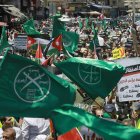
In total, this represents "7% of the 2,800 registered Muslim places of worship" in the hexagon, with an average attendance of "91,000 worshippers on Fridays," the report states.
Likewise, the number of active militants is estimated to be between 500 and 1,000 members who apart from mosques also control some 280 associations where Koranic education is provided.
The Muslims of France, which in 2017 succeeded the Union of Islamic Organizations of France (UOIF), is identified as the national branch of the Muslim Brothers in France.
This movement, born in 1928 in Egypt, defends the project of a conservative political Islam and several countries have banned it, including Russia, Saudi Arabia, Egypt and more recently Jordan.
Germany: The Muslim Brotherhood under strict surveillance
Some five million Muslims live in Germany, which is 6% of its total population.
There is no ban on the Muslim Brotherhood in the country, but the organization is under strict surveillance by the Office for the Protection of the Constitution (BfV) for its radical stance and links to extremist groups.
In September 2024, in Brandenburg, the authorities ordered the closure of the Islamic Center Fürstenwalde al Salam (IZF) which promoted teachings close to Hamas and the Muslim Brotherhood.
The IZF has also disseminated material from the "European Council for Fatwa and Research" (ECFR) and the Fatwa Committee Germany (FAD), both linked to the Muslim Brotherhood. This organization also supports on social networks The Merciful Hands, an entity that collects funding for Hamas terrorists.
In July 2023, the IZF was listed as an extremist organization by the Brandenburg BfV, the secret services of the Interior, DW picked up.
"We cannot tolerate organizations that are directed against the constitutional order or the idea of understanding between peoples. We must nip in the bud the embers of the Islamist culture of the Stone Age to avoid a conflagration," said Brandenburg Interior Minister, Michael Stübgen.
On the other hand, the Islamic Center Hamburg (IZH), linked to the Iranian regime and accused of "attacking the constitutional order," is likewise under the BfV's magnifying glass.
In July 2024, a simultaneous operation in seven states deployed 800 police to search 54 buildings associated with the IZH on suspicion of radicalization that goes against German law.
According to a study by the University of Münster, collected by Die Welt, it was detected that 19.9 % of 1,887 Muslims surveyed showed a "state of resentment" likely to favor radicalization, which would imply people at risk of idealizing religious violence as a response to real or perceived injustices.
The report concludes that around one million people would be at risk of radicalization in Germany.
Belgium: "European crossroads of the Brotherhood"
Muslims account for 7% of the nearly twelve million inhabitants of Belgium and are mostly concentrated in the cities of Brussels and Antwerp.
In the capital there are about 1.2 million inhabitants and approximately 20% practice Islam. Also, there are more than 100 mosques and prayer halls in the city.
In June, the conservative Reform Movement (MR) requested a detailed report on the influence of the Muslim Brothers in Belgium, mobilizing all the services of the State in the same way as the report carried out by France.
Faced with the revelations of the French report, which designates Belgium as "European crossroads of the Brotherhood," the RM considers it essential that the "authorities objectively assess this reality" to ensure the "preservation of Belgian democratic values."
According to France, around 200 militants are linked to the Muslim Brotherhood in Belgium, and a number of associations are directly linked to the Brotherhood, serving as a relay to the pan-Islamic pressure groups.
The French report even mentions that five Brussels municipalities, such as Saint-Josse and Molenbeek, present "the characteristics of confiscated territories, where Islamist control over the population seems almost total."
Molenbeek was part of the international news when several of the perpetrators of the attacks of November 13, 2015 in Paris, which left 130 dead, came from this neighborhood, including Salah Abdeslam, the sole survivor of the attack and arrested in that same neighborhood, after having spent more than four months as a fugitive from the authorities.
Moreover, according to a July 2024 report by the Coordinating Body for Threat Analysis (OCAM), radical Islamism remains the main terrorist threat in Belgium.
The silent Islamization of Europe
Also, any criticism of Islam is commonly judged as Islamophobia, which currently hinders an open and sincere debate on the limits of social and cultural integration of Muslim communities on the continent and of their radicalization.
LATEST