Maximum pressure against Maduro: Trump confirms he authorized CIA operations in Venezuela
The authorization to the agency is the latest step in the Trump Administration's ever-increasing pressure campaign against the regime of Nicolás Maduro.

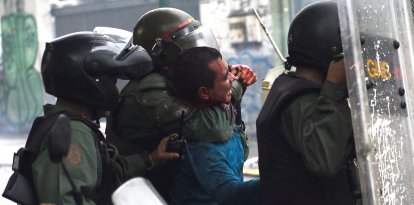
Pictured, Donald Trump, Nicolás Maduro and a detained member of the Aragua Train

President Donald Trump confirmed to the press on Wednesday that he authorized CIA operations in Venezuela, just hours after U.S. Air Force B-52 strategic bombers conducted a flyover in the Caribbean Sea, near the coast of Venezuela.
This Wednesday, The New York Times reported that the Trump Administration "secretly" authorized the CIA to carry out lethal operations in Venezuelan territory and also in the Caribbean Sea, where the U.S. Army maintains an imposing military deployment while its war against drug trafficking is ongoing.
Following the report, Trump was asked by a reporter who said, "I'm curious, why did you authorize the CIA to go into Venezuela? And is there more information you can share about these strikes on the alleged strike in the Caribbean?"
Trump, who was slightly evasive, confirmed the authorization: "Well, I can't do that, but I authorized it for two reasons, really. Number one, they have emptied their prisons into the United States of America. They came in through the, well, they came in through the border. They came in because we had an open border policy (...) And the other thing is drugs. We have a lot of drugs coming in from Venezuela. And a lot of the Venezuelan drugs come in through the sea, so you get to see that. But we're going to stop them by land also."
🗣️ Why did you authorize the CIA to go into Venezuela
— VOZ (@Voz_US) October 15, 2025
Trump: They have emptied their prisons into the United States of America pic.twitter.com/zDVzMjswH1
In the middle of the response, the U.S. president claimed the Venezuelan authorities were "playing dirty," accusing the Nicolás Maduro regime of sending criminals and unstable people to the United States, a claim that has become a recurring one from the White House.
According to the NYT, the authorization to the CIA is the latest step in the Trump Administration's ever-increasing pressure campaign against the regime of Nicolas Maduro, the dictator of that country. The newspaper reviewed that "American officials have been clear, privately, that the end goal is to drive Mr. Maduro from power."

Mundo
US destroys drug boat off Venezuela coast, Trump announces six ‘narco-terrorists' killed
Alejandro Baños
The report comes just a day after President Trump confirmed another attack against a Venezuelan narcolancha, adding a new attack counting vessels linked to the Tren de Aragua or the Cartel de los Soles, both designated terrorist organizations linked to Maduro and his entourage.
Maduro, in addition to the military pressure of recent weeks, is also facing a drug trafficking indictment in the U.S. Southern District Court of New York and a $50,000,000 reward for information leading to his arrest. This is the highest reward in US history.
The Trump Administration has reiterated on several occasions that Maduro is an illegitimate leader—citing the electoral fraud he committed last July 28, 2024—and a narco-terrorist. The Chavista leader, for months now, has privately attempted a de-escalation with Washington, sending letters to Trump and advocating for a dialogue through diplomat Ric Grenell, who has already been removed from talks with the Chavista regime.

Mundo
EEUU ya desplegó 10.000 soldados en el Caribe y Puerto Rico mientras Trump rechaza la intermediación de Qatar con Venezuela
Emmanuel Alejandro Rondón
According to the NYT, Maduro even offered his wealth to the US to curb the military pressure, an offer that the Trump Administration severely declined. In fact, the New York media stated that now, after the authorization, the Intelligence agency "would be able to take covert action against Mr. Maduro or his government either unilaterally or in conjunction with a larger military operation."
Yet, for the moment, it is unclear whether the CIA is planning any operation in Venezuela.
What Trump did confirm is that the US is already planning ground attacks against the cartels, because, allegedly, fast boats are no longer leaving from Venezuela because of the US military deployment.
"Don't wanna tell you exactly, but we are certainly looking at land now because we've got the sea very well under control. We've had a couple of days where there isn't a boat to be found," Trump said. Some media have also reported thatland attacks on Venezuelan territory could occur in these next weeks or days.

According to the NYT, the authorization was given by means of a presidential 'finding,' known as a memorandum of notification (MON), which is usually highly classified and constitutes one of the most powerful tools of the executive branch in covert matters. Only select members of Congress are briefed, with heavy limits on disclosure and oversight. Legally, so far, the White House has notified Congress that the United States is considered to be in armed conflict with cartels designated as non-state armed groups, whose actions "constitute an armed attack against the United States."
The authorization also coincides with the promise of CIA Director John Ratcliffe, who has pledged a less risk-averse agency in the past.
Right now, in addition to the authorization to the CIA for lethal operations, the US has a military deployment in the Caribbean Sea sustaining the counternarcotics offensive: some 10. The U.S. military is deployed in the region—most of them in Puerto Rico—a contingent of Marines on amphibious assault ships, eight surface ships and a submarine operating in the Caribbean. In recent weeks, U.S. units have attacked at least six vessels off the Venezuelan coast that, according to Washington, were carrying drugs. At least 27 people have been killed.
In addition to the maritime device and the CIA, the U.S. operation was supported by key air assets, with several F-35 fighters deployed in Puerto Rico and, more recently, at least two Air Force B-52 strategic bombers that flew over the Caribbean Sea.
The question, for now, is whether Washington will stop issuing threats and take action to dismantle the drug cartels linked to Maduro and his entourage. It is also open to the possibility that the operations may go further and seek a change of power in Venezuela after decades of a socialist regime that generated the worst migration crisis in the hemisphere.
LATEST