Bolivia: court annuls one of the cases against former president Jeanine Áñez and acknowledges pressure from pro-government prosecutors
The political prisoner, who has been in jail for four years, celebrated the ruling saying that "history will remember that this day legality was defended, judicial independence was vindicated and a step was taken towards a fairer and freer Bolivia."
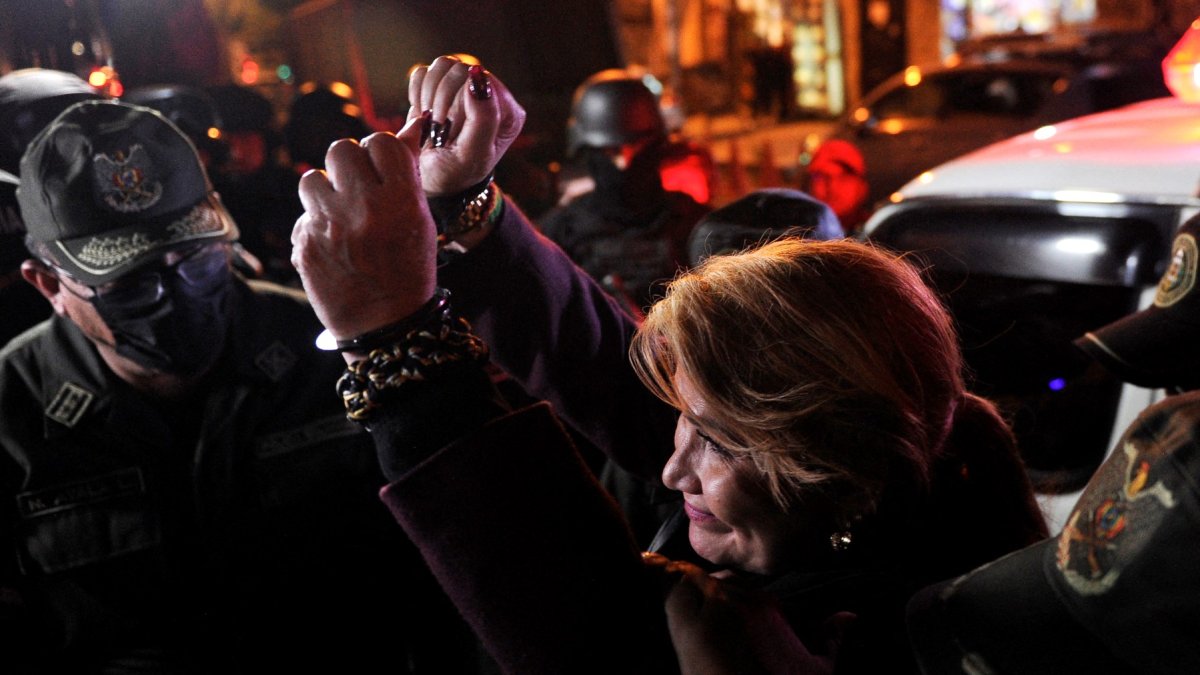
Former President Jeanine Añez in a file image

A court in the Bolivian city of El Alto on Monday annulled a criminal proceeding against the country's former interim president Jeanine Añez, recognizing that the case should be transferred to a trial of responsibilities—that is, to the legislative branch—reserved for high-ranking state dignitaries under Bolivian law.
The decision comes in a context of political change after the defeat of the left in the general elections last August 18 and growing complaints about the instrumentalization of justice to persecute opponents, including especially Áñez.
During Monday's hearing, the judges revealed that they were pressured by officials of the Ministry of Justice, the Attorney General's Office, and the Prosecutor General's Office, institutions controlled by the ruling party, led by leftist President Luis Arce. Añez's lawyer, Luis Guillen, celebrated the court's decision.
"This is a historic day. Justice is acting independently. It is very important that the resolution has considered the intimidation suffered by the Ministry of Justice, the Attorney General's Office, and the Public Prosecutor's Office," he said.
Áñez, imprisoned since 2021 and a recognized political prisoner who received the support of various international organizations such as the OAS and the European Union, took advantage of the hearing to reject any responsibility for the deaths in the Senkata area in November 2019, for which she was tried.
"I signed a decree to enable the Armed Forces in public order tasks, but it was never a license to kill," said Áñez, who attributed the events to the former president of Bolivia, Evo Morales, who—according to Áñez—encouraged the protests out of "angst for power" after perpetrating an electoral fraud and violating the Bolivian Constitution in order to run for the fourth time for the Presidency.
Context: electoral fraud and power vacuum
Áñez came to power in 2019 after the resignation and flight from the country of Evo Morales himself, accused of electoral fraud in a presidential election annulled by the OAS and unknown to a large part of the international community. Faced with the resignation of the direct succession figures—all belonging to the ruling MAS political party—the then second vice-president of the Senate assumed the interim presidency of Bolivia, also with wide recognition by the international community.
The MAS, however, never accepted that constitutional handover and, since its return to power in 2020 with Luis Arce after the call for new elections by Áñez herself, used justice to prosecute the one who was interim president in at least nine different cases, including a 10-year sentence for the so-called "coup II," widely criticized as a political reprisal.


Senkata, the judicial excuse
The Senkata case, particularly, refers to the death of ten protesters and dozens of injuries in November 2019, during clashes between security forces and sectors mobilized around a gas plant in El Alto. Although the Prosecutor's Office charged Áñez and high-ranking military officers for the said victims, the court recalled that the events took place while she was interim president, so she can only be tried in the legislative process.
The court also ordered the release of all the defendants, which sparked protests from the victims' relatives, who denounced impunity and announced that they would appeal the decision.
"Legality was upheld"
After the ruling in his favor, Áñez celebrated the decision, knowing that his freedom could come closer.
"I want to say that history will remember that on this day legality was defended, judicial independence was vindicated, and a step was taken towards a fairer and freer Bolivia. Long live Bolivia!" he said.
Quiero decir que la historia recordará que este día se defendió la legalidad, se reivindicó la independencia judicial y se dio un paso hacia una Bolivia más justa y más libre.
— Jeanine Añez Chávez (@JeanineAnez) August 26, 2025
¡Que viva Bolivia! https://t.co/2nupXpdYWc pic.twitter.com/AF57ZhSppN
Although she won a major legal victory, the former president will remain in prison due to other pending proceedings. According to her defense, she faces a total of nine cases, six with pre-trial detention and one with a final conviction, so she still has a long way to go.
End of cycle for the Bolivian left
The recent events surrounding the Áñez case are not coincidental, since they occur a few days after the resounding defeat of the MAS, which was left out of the presidential runoff for the first time in two decades, in the midst of a strong economic and social crisis in the trans-Andean country. Two opposition candidates, Senator Rodrigo Paz Pereira and former President Jorge "Tuto" Quiroga, advanced to the runoff in a scenario that largely reflects the fall of the socialist project of Evo Morales and his allies.
For international observers, the new scenario has potentially liberated the courts, which now mark distance from the ruling party and give signs that they can become independent again after years of complaints about persecution and instrumentalization of justice against the opposition, in the style of the dictatorships of Venezuela, Cuba, and Nicaragua.
LATEST