ANALYSIS
The ultimate refuge from progressive globalism: why does billionaire Peter Thiel move his life and fortune to Milei's Argentina?
This move represents a forceful statement of principles in the face of growing regulatory pressures in the United States.
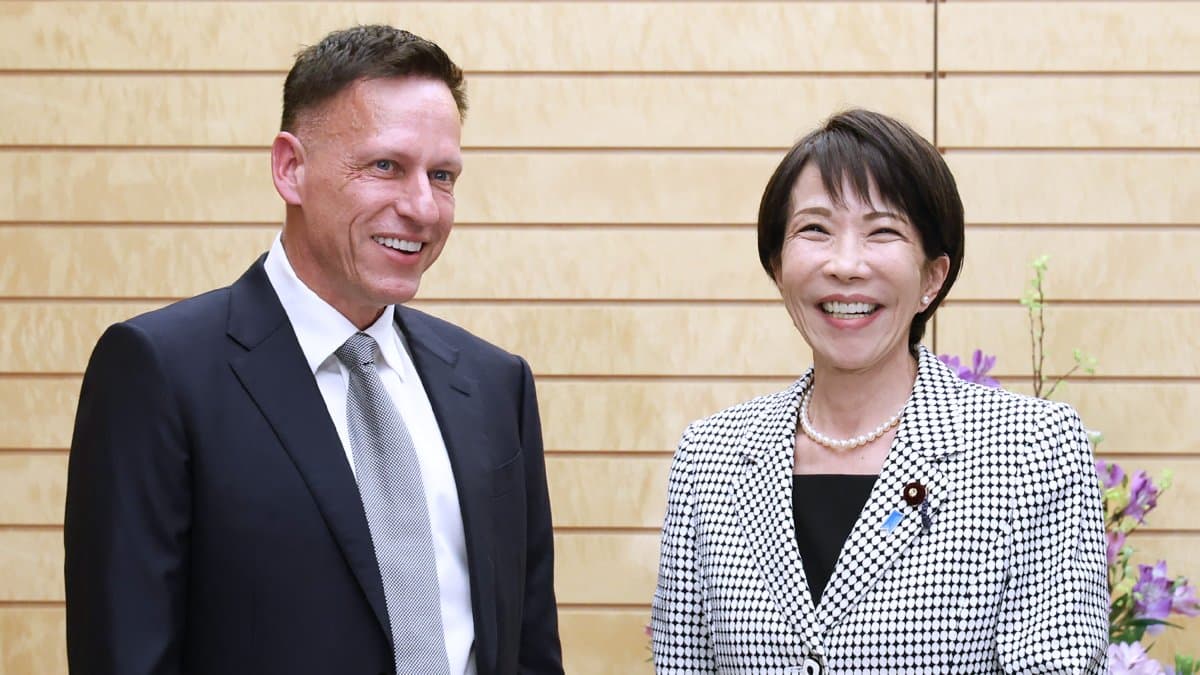

According to a New York Times investigation, German-born billionaire, co-founder of PayPal and Palantir and prominent donor to the Republican cause, Peter Thiel, has decided to move his residence and family to Buenos Aires.
The move represents a forceful statement of principle in the face of increasing regulatory and fiscal pressures that stifle entrepreneurial dynamism in the United States.
Thiel, 58, has not only acquired a high-end residential property in one of the most exclusive districts of the Argentine capital, but has already proceeded to enroll his children in the local educational system.
His immersion in Rio de la Plata life has included activities as diverse as playing local chess tournamentsin the traditional neighborhood of Almagro - where he won third place - and holding intense intellectual debates with economists from the region regarding the global challenges of the West.
Libertarian tune-up against the woke agenda and fiscal asphyxiation
.
The main catalyst for this change of course lies in the deep ideological affinity that unites Thiel with the Argentinean leader, Javier Milei.
Both share a stance of outright rejectionof socialism, state interventionism, excessive taxation and the identity politics of the woke agenda.
During a recent private meeting held at the official Olivos residence, Milei himself described the meeting as the convergence of two "anarcho-capitalists"determined to materialize the ideas of freedom.
The economic factor in the United States accelerated the search for more competitive horizons.
Thiel, who has historicallycriticized the American statist model, decided to disassociate himself from California after leftist groups promoted an initiative aimed at imposing a 5% tax on the assets of citizens with multimillion-dollar estates.
Faced with this scenario of fiscal persecution, the deregulation and economic openness reforms promoted by Milei's administration have turned the Argentine nation into a magnet for capital fleeing from interventionism.
The governmental support for this type of profile was ratified by the Chief of Cabinet of Ministers, Manuel Adorni, who declared before the Argentine Congress: "Wherever the world's billionaires want to flee from countries that are increasingly regulated, with higher taxes and governments that persecute their citizens, they are welcome in the Argentine Republic, the new land of freedom".
Adorni also confirmed Thiel's interestin the deep structural reforms underway.
A geopolitical plan B in the face of global risks.
Beyond economic incentives, the move respondsto a long-term geopolitical diversification strategy.
Thiel has repeatedly publicly warnedabout the dangers of nuclear escalationand the risks associatedwith the uncontrolled advance of Artificial Intelligencein the northern hemisphere.
Due to its geographical position isolated from the major theaters of international conflict, the Southern Cone is emerging as an enclave of stability and institutional resilience.
Complementing its commitment to the region, the investor has acquired land in the rural sector of Uruguay, in the vicinity of Punta del Este.
This vision is shared by other referents of the technology industry in his environment, such as Martin Varsavsky, who maintains that the region would remain on the sidelines in the hypothetical scenario of a world conflagration, making it an ideal shelter for the continuity of western civilization.
As was to be expected in a polarized political scenario, the arrival of the Founders Fund founder has generated mixed reactions.
The sectors linked to the ruling party and the defenders of the free marketcelebrate his presence as irrefutable evidence that Milei's policies are restoring legal certainty and investment attractiveness to the country.
On the contrary, traditional leftist groupings and local progressivism have reacted with hostility, spreading narratives that accuse the tycoon of seeking to interfere in electoral processes or hoarding databases through his firm Palantir.


🛠 Do you think there is an error in this article?
Recommendations







LATEST