Messi makes history: ties Klose's World Cup hat-trick record as Argentina routs Algeria in title-defense opener
The Albiceleste mercilessly dominated the African team, which had no answer for the unstoppable Leo Messi, who scored his first World Cup hat trick.
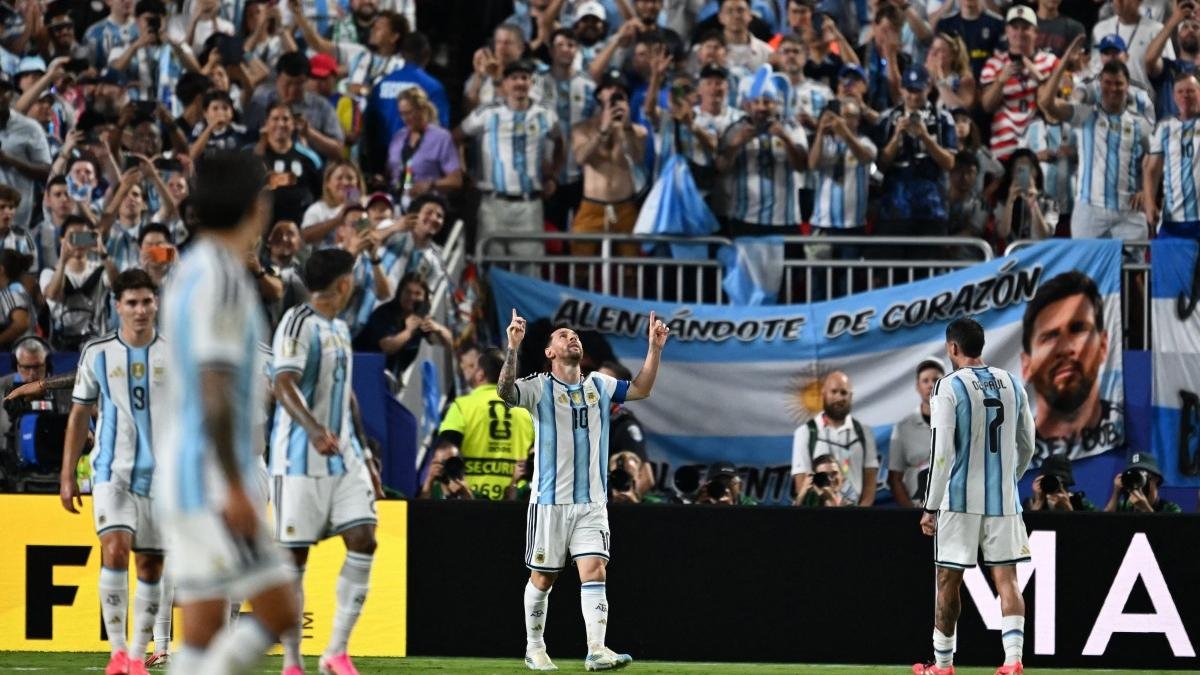
Lionel Messi, number 10, celebrates his third goal against Algeria

The wind is older than time, yet it continues to blow. At Russia 2018, when Argentina fell to the eventual champion France, many doubted that Messi (at age 35) would be at his peak for the 2022 World Cup. Not only did he make it, but he put on a historic performance, on par with the greatest legends in soccer history who shone on the biggest international stage (Zidane, Maradona, Ronaldo, Pelé, among a select few). Now, at 39 and far from the European elite, many once again thought the Argentine star would arrive at soccer’s biggest stage past his prime. Once again, they were wrong to doubt Leo Messi’s ability.
Argentina’s captain and icon, just as he has done throughout his career, once again set a new record by scoring his first World Cup hat trick and tying German Miroslav Klose’s record (16) as the tournament’s all-time leading scorer. With that, Messi led the “Scaloneta,” which kicked off its World Cup title defense in style with a 3-0 rout of a combative, but disorganized and ineffective Algeria.
In fact, the match had already started well for Messi, who, just as the game began, received a sublime assist from forward Lautaro Martínez inside the box. Leo received the pass, paused, and subtly slotted it past Luca Zidane, son of the legendary French midfielder “Zizou.” However, the goal was disallowed for offside.

Soccer
The Iranian national team was reportedly forced to leave the United States immediately after its World Cup debut
Andrés Ignacio Henríquez

Moments later, Algeria responded with another goal that was also ruled offside. Montiel, selected by Scaloni to start at right back, dozed off, and, behind him, midfielder Fares Chaibi appeared to score past “Dibu” Martínez. VAR intervened to disallow the goal, in what appeared to be an evenly matched, back-and-forth match.
But it was a mirage. Argentina, accustomed to fielding technically gifted midfielders—players who have all spent time in the playmaker role—began to move the ball with a measured rhythm, cadence, and purpose, leaving the Algerian midfielders gasping for air and growing desperate. Little by little, the Albiceleste began to create danger, and it was in the 17th minute that Rodrigo De Paul found his great friend and teammate from Inter Miami, Leo Messi, behind the opposing midfield, in an area better known as “the Messi zone.”
The Argentine star controlled the ball, turned, and fired a powerful shot that Luca Zidane parried, but not enough to prevent Messi’s first goal in this World Cup.
The 1-0 lead appeared to free Argentina up for a few more minutes, but the hydration break seemed to disrupt Scaloni's side. The Albiceleste began to struggle both to win the ball back and to move it with the same fluidity. Algeria, with several talented players, started to control the ball and create scoring chances, even putting Martínez and the Lisandro-Romero defensive pairing under slight pressure. However, it wasn’t enough to change the score.
In the second half, Argentina finally found its rhythm. Lautaro, who had a strong game, was replaced by Julián Álvarez in the 55th minute, when Nico González also came on for Almada. Argentina shifted from having nearly six playmakers to four key attackers and two players who provided depth.
It was in the 60th minute that the match was decided. Mac Allister fired a thunderous shot that Zidane failed to clear properly, leaving a subtle and perfect rebound for the best player on the field: Leo Messi, who had already anticipated a potential opportunity in the box and beat the center backs to the ball.


Sports
FIFA reverses decision, will include Spanish in translations of all World Cup press conferences
Williams Perdomo
The 2-0 lead was too much for the Algerians. Argentina settled in and began playing at the pace set by Enzo Fernández, back in the midfield and at the heart of Argentina’s play—a role very different from the one he plays at Chelsea in London and very similar to that of 2022 World Cup in Qatar, where he was a standout and named best young player.
The score could have reached 3-0 on several occasions, but fate had it that Messi would seal the game precisely in the area where he’s scored hundreds of goals in the same way: from the edge of the box, placing his shot into the bottom left corner—a shot that was truly unstoppable for Zidane, who had no chance to make a save.
It was a decisive result and performance for Argentina, which was able to field its starting midfield and ideal backline once again: Romero and Lisandro, both of whom had been dealing with injuries. Julián Álvarez, who had been dealing with an ankle injury, also returned and got some playing time under his belt. Likewise, Facundo Medina, a defender for Marseille in France, proved to be reliable, well-integrated, and even at ease, showing Scaloni that he has a competent fullback to fill in for the absent Tagliafico.
All in all, Argentina proved, once again, that it is the best-playing team in the world when its players are in top form, healthy, and motivated to keep winning.
LATEST