Alternative routes: How Chinese-made vehicles are finding ways into the US
Through 'nearshoring,' manufacturing plants in California, and acquisitions made by other foreign brands, Chinese automakers are finding ways to enter the U.S. market.
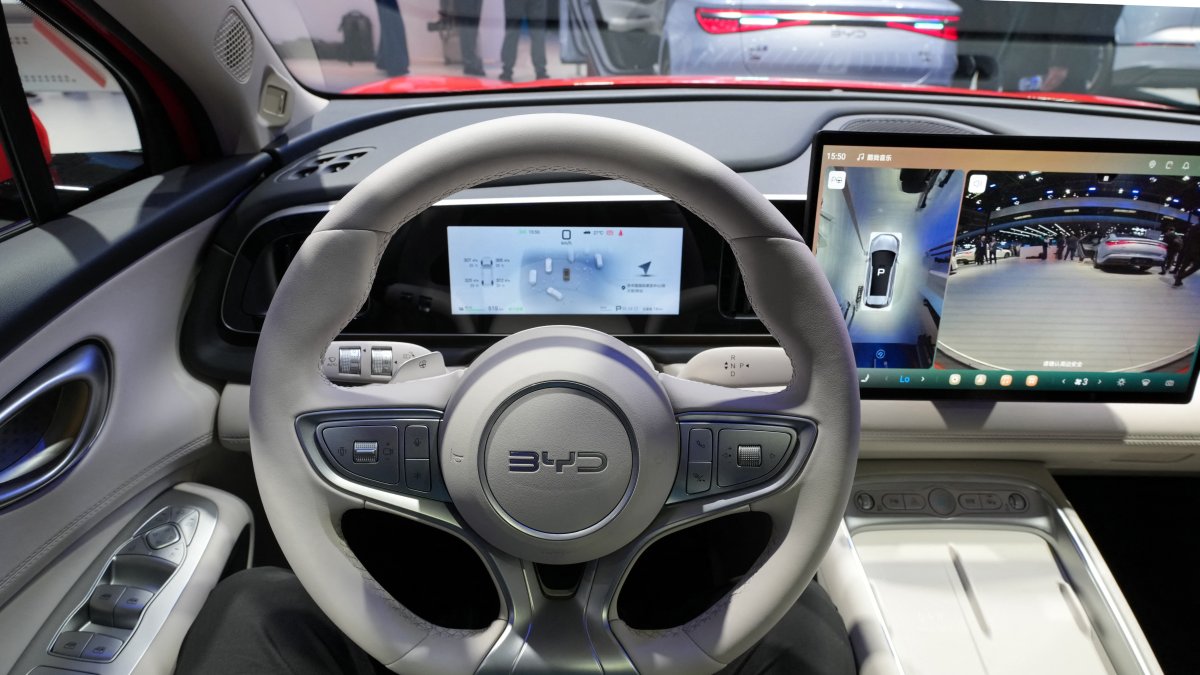
Interior of a vehicle made by the Chinese company BYD. File image

Donald Trump and Xi Jinping showed good rapport during the president's visit to China. During their meeting, the leaders of the world's two major powers suggested to each other "to be partners and not rivals" in every area. Including in the commercial and economic field. This slight advance, which for the moment is merely verbal, is attracting the attention of U.S. industry. Also that of a specific sector: automobiles.
This possible opening of trade between Washington, D.C. and Beijing could mean that Chinese vehicles could begin to be marketed in United States, which would force the national automotive industry to shield itself against increased foreign competition. Something that can be seen in Europe, South America and Oceania, where China is consolidating and surpassing the factories of these continents.
To date, the presence of vehicles made in China is practically non-existent. And why is it non-existent? Because China, despite tariff barriers and strict trade policies, has managed to dodge the pitfalls so that its automotive sector can be present in U.S. territory.
A plant in California
The first evidence that the Chinese vehicle sector is expanding in the United States is a manufacturing plant. Specifically, the company BYD - the world's largest electric vehicle manufacturer - has a facility in the town of Lancaster, California, where it produces electric buses and trucks that are already on the road in different parts of the country such as Los Angeles, Denver and Kansas City, BYD reported a few years ago.

This plant - opened in 2013 - is about 550,000 square feet (more than 50,000 square meters) and employs roughly 750 people. BYD has already invested more than $250 million.
'Nearshoring' in Mexico and Canada
In the face of Washington, D.C.’s policies, Chinese factories considered setting up in Mexico and Canada, in locations close to their borders with the United States, to carry out so-called nearshoring.
This practice - which occurs in many industrial sectors - consists of a business strategy in which production is moved to countries close to the final country in order to reduce costs, circumvent restrictions, mitigate risks and shorten product delivery times. BYD has considered opening a production plant in Mexico, although the plan has not yet been implemented.
The company wants to be in North America. While the Mexico issue is in limbo, the possibility of inaugurating a production plant in Canada is becoming more real. What is a fact is that Chinese vehicles are already being sold in Canada, which could lead Americans to cross the border, purchase one and bring it to the United States, despite the fact that the T-MEC - Treaty between Mexico, the United States and Canada - could hinder the entry of a Chinese vehicle.
Swedish vehicles purchased by China
Finally, it is possible to say that there are indeed vehicles made in China in the United States. Specifically, through two Swedish brands, Polestar and Volvo, whose largest shareholder is the Chinese company Zhejiang Geely Holding Group Co. since 2010. According to a report from Volvo Car USA, in this fiscal period it sold 121,607 units in the United States. All of them manufactured at its South Carolina plant.
The tariff wall blocking Chinese vehicles
The measure endured even with the entry of the new administration. The Trump Administration not only maintained the policy of its predecessor, but even increased tariffs on components that Chinese vehicles have, such as lithium batteries and semiconductors. All this in the midst of a trade war with China - the communist regime responded in the same way - and under the argument of defending itself against national security risks.
LATEST