ANALYSIS
The price of letting our guard down: How eliminating the teacher literacy test in New York left Hispanic students without the tools they need
Nine years after repealing the ALST, New York has no literacy test for teachers, and nearly half of Hispanic teenagers remain at the "Below Basic" level in reading.
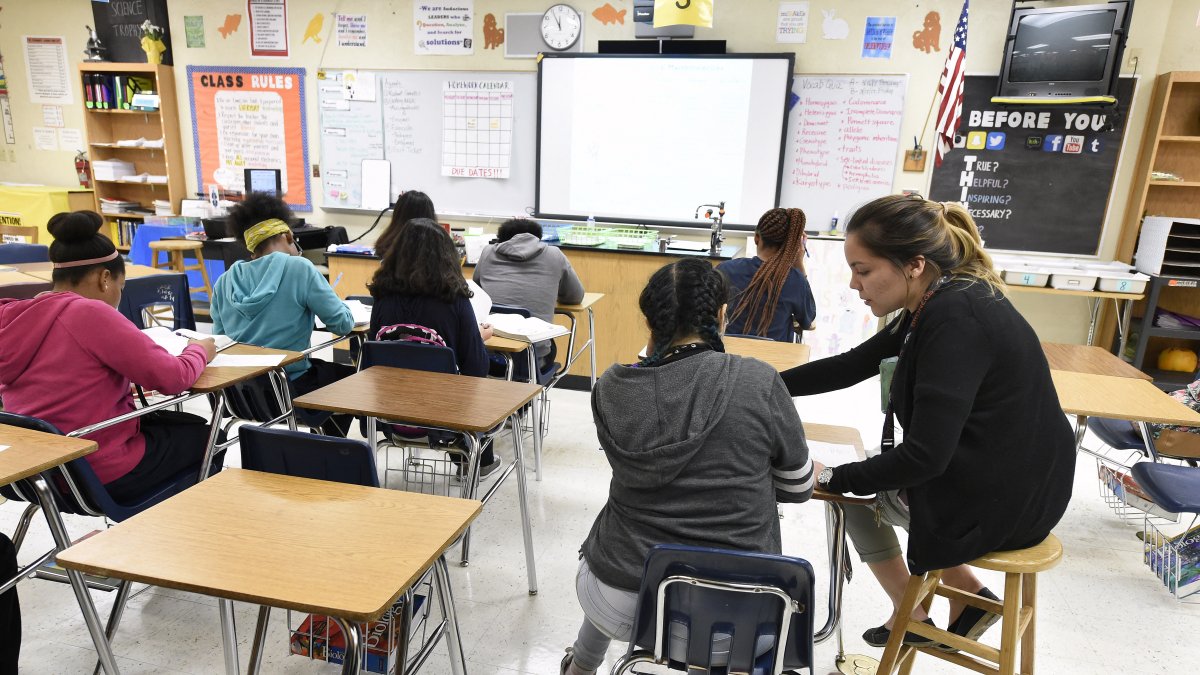
A teacher with her students in a classroom—File photo

In March 2017, the New York State Board of Regents made a decision that would change the future of thousands of Hispanic students: it eliminated the Academic Literacy Skills Test (ALST), an exam that assessed the analytical reading and argumentative writing skills of those aspiring to become public school teachers.
The official rationale was clear: the test was "redundant," costly, and acted as an unfair barrier to teacher diversity. But nearly a decade later, official data tells an uncomfortable story. Hispanic and black students—the very ones the regents intended to protect—remain trapped in a statewide literacy crisis. In the 2024 National Assessment of Educational Progress (NAEP) reading test, 51% of Hispanic students and 55% of black students in fourth grade in New York public schools scored "Below Basic," compared to 32% of white students. In eighth grade, those rates were 47% among Hispanics, 42% among Black students and 28% among white students.

Politics
Tax credits and school scholarships: How Trump’s federal program will expand school choice
Joaquín Núñez
The crisis no one wants to talk about: 47% of eighth-grade Hispanics do not read at the most basic level
The numbers don't lie. According to the Education Trust–New York report on adolescent literacy, published in June 2025, 47% of Hispanic eighth-graders in New York scored "Below Basic" on the 2024 NAEP national test. This means that nearly half of Hispanic teens have not mastered even the most basic reading skills: identifying sequences of events, recognizing character traits or extracting the main idea from a text.
Statewide, 30% of eighth-grade students are Hispanic, but only 21% reach the "Proficient" level or higher in reading, according to official data from the National Center for Education Statistics (NCES). In New York City, the gap is even wider: 62% of Latino fourth-graders are "Below Basic," and only 13% are "Proficient."
These are not abstract numbers. Education Trust–New York estimates, based on the 2023–24 state ELA assessment, that more than 70,000 eighth-grade students did not reach reading proficiency. And behind every statistic is a teenager who cannot follow instructions in science class, who gets lost in math problems or who gives up on reading out of embarrassment.

Society
The US slows the global decline in PISA, but the setback in reading sounds the alarm
Carlos Dominguez
The crucial distinction: Who won, and who lost?
Immediate winners (2017)
- Hispanic and black teacher candidates: A formal barrier was removed where they were failing at a much higher rate (46% and 38% pass rates, vs. 69% for white students).
- Teacher training programs: Lower costs, fewer exams, more flexibility.
- Hispanic and black students: They continue to have the lowest reading rates in the state (47% and 42% "Below Basic" in eighth grade; 51% and 55% in fourth grade).
- All New York students: The state remains at the national average (31% Proficient) while Massachusetts leads with roughly 40%.

What was the ALST and why did it disappear?
The ALST was part of the set of more rigorous exams that New York introduced in the 2013–2014 school year, along with the edTPA (Classroom Performance Assessment) and the Educating All Students (EAS). Designed by Pearson, the test cost $131 and required candidates to analyze complex passages and write coherent arguments.
On March 13, 2017, the Board of Regents, then chaired by Betty A. Rosa, repealed the ALST via emergency action, effective the following day. The permanent regulation was adopted in July 2017. The official NYSED statement cited three reasons: the cost, the excessive number of tests, and "redundancy" with regard to a college degree and other exams.
A federal judge, Kimba Wood, had ruled in August 2015 that the ALST was not discriminatory because it measured teaching-related skills, unlike a previous test (LAST-2), which was indeed declared discriminatory in June 2015. But the regents' working group and deans from colleges with high minority enrollment argued that the exam was an unfair barrier and a hindrance to faculty diversity.
The unfulfilled promise: More Latino teachers—reality or mirage?
The equity argument was powerful. If the ALST passed fewer Hispanic candidates, the test reduced the flow of Latino teachers into predominantly Latino classrooms. But official data from 2025 reveals an uncomfortable reality: the elimination of the ALST did not resolve the teacher diversity pipeline.
According to the New York Equity Coalition, using NYSED figures from the 2023–24 school year, Latino students account for 30% of the state's enrollment and only 7% of teachers. In New York City public schools, Latinos make up 41–42% of students and approximately 18–19% of teachers. Black students account for about 20–24% of the city's enrollment, and black teachers account for about 16–17%.
Education Trust–New York described the racial composition of the teaching force as "relatively stagnant" between 2018–19 and 2021–22. Teacher shortages—in special education, math, science, ELA and bilingual education—remain critical.

Politics
Fewer bureaucrats and more funding for students: Greg Abbott sets a strict cap on administrative spending in Texas schools
Andrés Ignacio Henríquez
The regulatory gap: What New York requires today
- EAS: Inclusive pedagogy. Passing score lowered to 500 (will return to 520).
- CST: Subject Matter Knowledge. Passing score: 220 (range 100–300) or 520 (range 400–600).
- edTPA: Eliminated in April 2022. No external standardized test.
- ALST: Eliminated in March 2017. No academic literacy test.
LATEST