ANALYSIS
The US slows the global decline in PISA, but the setback in reading sounds the alarm
The PISA 2025 report ranks 15-year-old U.S. students above the OECD average in science (502 points) and reading (490), although the 14-point drop in reading since 2022 marks the lowest level since the country began participating in the assessment.
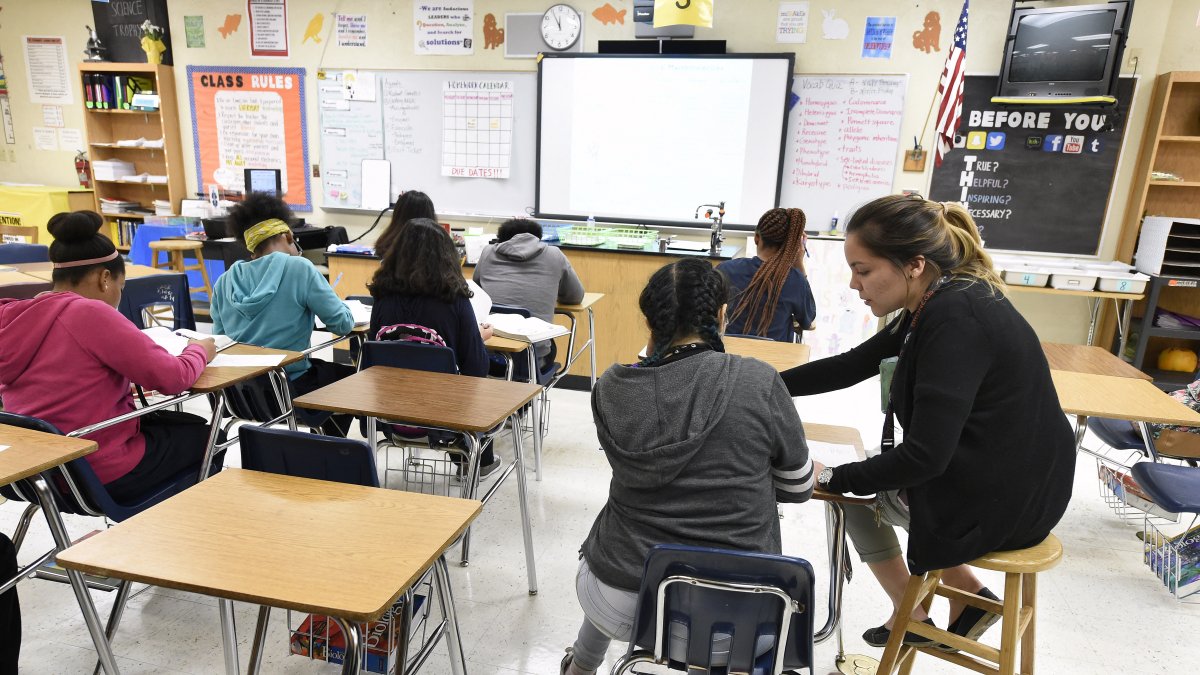
A teacher interacts with her students in a classroom—File photo

The United States remains above the Organization for Economic Cooperation and Development (OECD) average in science and reading in the latest edition of the PISA report, but shows a sharp decline in reading between 2022 and 2025, reflecting the global trend of decline in this basic skill.
The report, published Tuesday by the OECD, describes a "bleak overall picture" with the lowest average performance level ever observed, although U.S. data show a more stable trend in science and math than that of many other countries in the organization.
The assessment, one of the world's leading barometers of education systems, analyzed the skills of some 760,000 15-year-old students in 91 countries and territories in science, reading, and mathematics.
United States: Above average, but with warning signs
In this context, the United States presents a mixed picture. In science, 15-year-old students scored 502 points, two more than in 2022 and 20 points above the OECD average (482). The percentage of students performing at a low level in this subject was 22.3%, compared to the organization's average of 25.7% and the percentage at the highest levels (Levels 5 and 6) reached 12.9%, nearly double the OECD average (7.2%).
However, the most concerning figure is that for reading. The average score stood at 490 points, above the OECD average (461), but it represented a 14-point drop from 2022, the same magnitude as the average decline across the organization and the lowest score recorded by the U.S. since it began participating in PISA. The gap between boys and girls was 24 points in favor of girls, slightly larger than the OECD average (30 points).
In mathematics, the U.S. average was 463 points, exactly the same as the OECD average, representing a 2-point decline from 2022, a change that is not statistically significant and smaller than the average decline of 9 points across the organization. The gender gap was 24 points in favor of boys, nearly double the OECD average gap (13 points).
The report also highlights a new dimension: computational problem-solving, where the U.S. scored 513 points, above the OECD average of 500.
China and Singapore at the top
The PISA 2025 scores confirm Asian dominance. The Chinese regions of Beijing, Shanghai, Jiangsu, and Zhejiang led in science with 597 points and in mathematics with 612; in reading, they scored 527 points, placing second. Singapore ranked first in reading comprehension, with 535 points, and was also among the top-performing systems in science (560) and mathematics (563).
Macau scored 541 points in science, 549 in math and 501 in reading. Taiwan scored 540 in science, 546 in math, and 508 in reading; Japan scored 538, 525, and 503, respectively; and South Korea scored 526, 522, and 501.
Among the highest-ranking non-Asian countries, Estonia scored 527 points in science, 508 in math and 499 in reading. The United Kingdom scored 511, 488 and 494 points, respectively, while Ireland stood out particularly in reading, with 500 points. Canada scored 510 points in science, and New Zealand, 509; the latter also scored 497 points in reading, the ninth-highest score.
Latin America and Spain: Below the OECD average
The Latin American countries that participated in PISA 2025 once again failed to rank among the top performers in the three assessed areas. Uruguay and Chile topped the regional table, although their scores are well below the OECD average
In science, Uruguay scored 445 points and Chile 442, while the OECD average is 482. In reading comprehension, Chile outperformed Uruguay with 436 points compared to 423; both are below the average of 461. In mathematics, the gaps widen: Uruguay scored 405 and Chile 403, compared to the OECD average of 463.
The rest of the region posted even lower scores. Costa Rica scored 424 points in science, 416 in reading, and 387 in mathematics. El Salvador, although it improved its performance in science compared to 2022, remains among the lowest-performing systems in the region.
In Europe, Spain is close to the OECD average, but with a sharp decline across all three skills. Spanish students scored 477 points in science, 451 in reading, and 457 in math. In reading, the score of 451 points is the country's worst on record and places it ten points below the OECD average.
Widespread decline in math and reading
The OECD warns of a troubling global picture. "Scores in science remain roughly stable, but there is a decline of more than 20 points in reading and math," noted Éric Charbonnier, an education specialist at the organization. According to the OECD, a 20-point difference is roughly equivalent to one year of schooling.
Between 2015 and 2025, science scores declined by an average of seven points across OECD countries. In math, the decline reached 22 points, compared to eight points in the other systems evaluated. The decline was even more pronounced in reading: scores fell by 28 points in OECD countries over the past decade, compared with 16 points in the other participating nations.
Why the decline in reading is so worrying
To explain this trend, the organization cites several factors: the growing use of screens, a loss of interest in reading among young people, and changes in students' relationship with school since the COVID-19 pandemic.
The report also examined the use of artificial intelligence in classrooms. The OECD found that more intensive use of these tools is often associated with lower science scores. However, some of the most successful education systems, such as Singapore and Macau, are among those whose students report using AI most frequently.
LATEST