Stephen Miller: A chief of staff for wartime
By appointing Stephen Miller as chief of staff, Trump is sending a powerful message. He will not water down the MAGA movement. He will make it more radical.
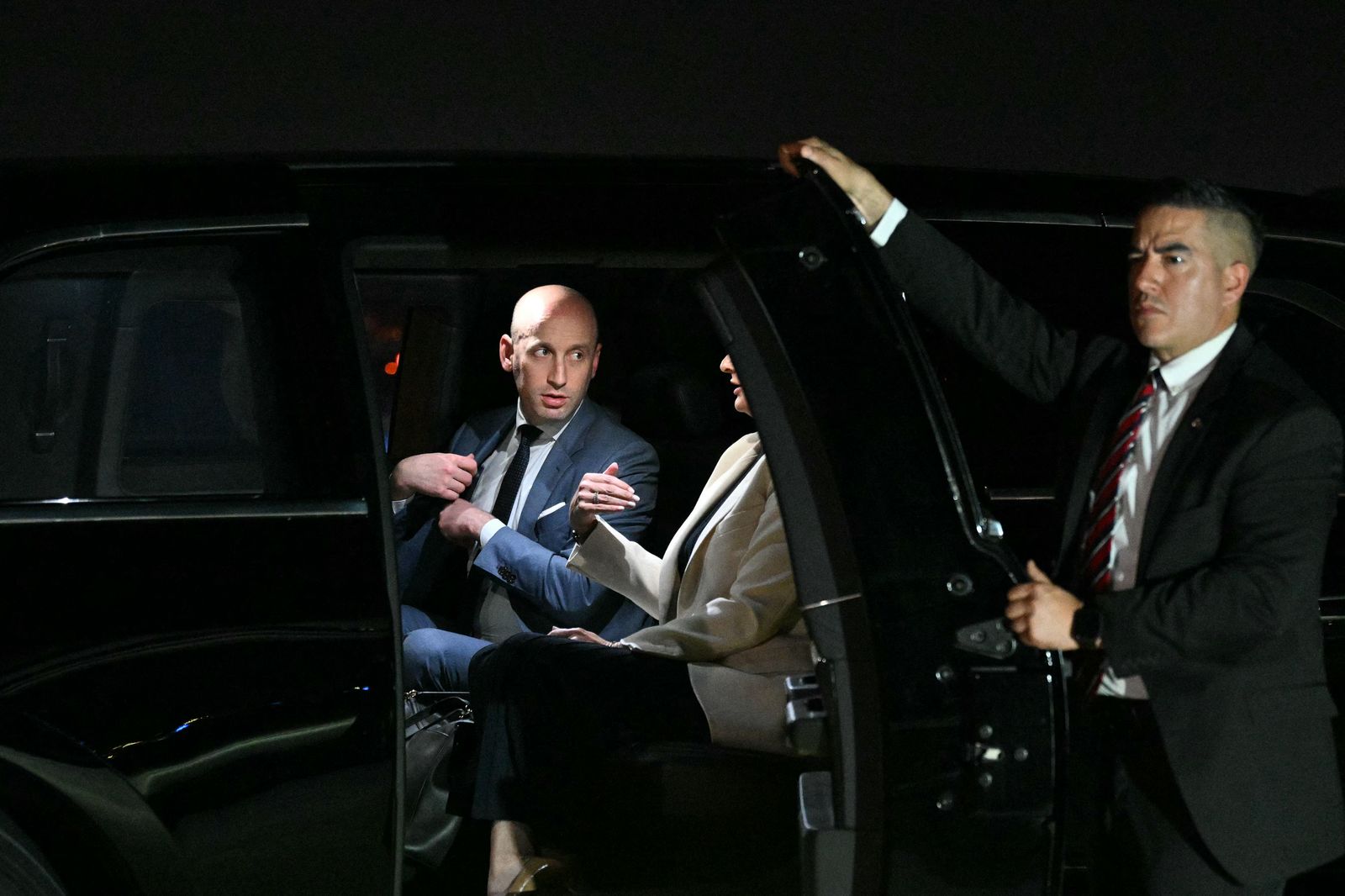
Stephen Miller on Nov. 6.
Published
Following the Republicans' dramatic defeat in the midterm elections, Trump had two options: to moderate his policies or to radicalize them. The appointment of Stephen Miller as his new chief of staff proves that he chose the latter.
Many Republicans across the country, reflecting on the defeat, suggested that President Trump should, above all, relax immigration policy—which drove many Hispanic communities away from the party, mainly in states like Florida and Texas.
Undoubtedly, the hard-line immigration policy—which involves deporting undocumented immigrants indiscriminately—affected the Republican Party's performance among Hispanic communities. However, for a large portion of Trump's base—on which the MAGA movement relies— this is the main reason they support the president.
Moderation carried a risk, though it could have yielded electoral gains. Doctrinaire MAGA supporters would have criticized the president for failing to carry out mass deportations—one of his campaign promises. The coalition would likely have broken apart, the MAGA movement would have fractured and gaps would have opened up for the emergence of new leaders from the new restrictionist right. But radicalization presents its own risks, perhaps with even worse consequences.
By insisting on a strict immigration policy, Trump could end up with no immigration policy. As Texas ceases to be a red state, all progress on border security and the detention of undocumented immigrants could crumble. Ultimately, political parties exist to gain power, and without Hispanic voters—who are now the most influential minority group in the United States—the Republican Party faces an uphill battle to regain control of the House, the Senate and the presidency.
But it seems that doesn't matter to Trump. And that makes sense. Trump is not seeking another term. In his inauguration speech, he hinted that, having survived Butler's assassination attempt, his mission as president is providential. God put him in the White House to change the United States forever and completely. Drastic structural changes—many of them unpopular, but necessary. And many in the administration see it this way: this is a once-in-a-lifetime opportunity. And it must be seized.
The cost could be high: a battered Republican Party, with little political capital left to win the next election. But the Trump movement sees it differently: in November 2024, the country spoke loudly, and Trump is obligated to deliver.
Stephen Miller has enjoyed a meteoric rise in politics. Not many years ago, he was a student leader spouting inflammatory slogans. He took a chance on Trump during the 2015 campaign and gradually became part of his coalition, to the point of becoming one of the president's closest and most influential advisors. Because Miller is a man of ideas, he is loyal, and his character largely reflects the global trend of populist, nationalist and aggressive forces. And the MAGA movement is forged in the midst of conflict. Ever since Trump walked down the stairs of Trump Tower and announced his candidacy, he has been not in politics but at war. He lives in a trench. And someone like Miller, who understands war as an extension of politics—very much in the Schmittian sense—is absolutely relevant.
Miller is the architect of the administration's more aggressive tone on virtually every issue: immigration, the economy and foreign policy. Behind these measures lie concepts such as the defense of identity, oikophilia, imperial nationalism, purification, remigration and civilization. It may be twisted, but Miller has his own philosophy, one that terrifies any moderate.
Steve Bannon, who knew Miller well, said in an interview with The New Republic that there are three authors who have shaped the worldview of Trump's current chief of staff: Pat Buchanan, Samuel Huntington and Oswald Spengler.
It is an interesting selection, and taken together, these figures embody a deeply nationalist mindset, with a civilizational sensibility, historical consciousness and a commitment to resistance against the drift the West is currently undergoing. Spengler is the great prophet of the West's decline; Huntington, a realist, advocates for the preservation of a culture, above all for its value relative to others; and Buchanan is one of the first major voices on the American right to question a certain Republican orthodoxy: he stands against globalism, the secularization of the West, mass migration and the automatic identification of conservatism with free trade.
With the appointment of Stephen Miller as chief of staff, Trump is sending a powerful message. He will not water down the MAGA movement. He will make it more radical, in line with the philosophy that Miller helped shape: politics as war, the emphasis on the power and imperial character of the United States, remigration, the restoration of sovereignty, and the preservation of identity.
It is a commitment to combative approaches in politics—neither condescending nor complacent. And, as so many have already said: it is a designation of wartime.
🛠 Do you think there is an error in this article?
Recommendations



LATEST