ANALYSIS
Tax credits and school scholarships: How Trump’s federal program will expand school choice
The program will allow taxpayers to donate up to $1,700 to scholarship organizations and receive a federal tax credit for the same amount, while states decide whether to participate.
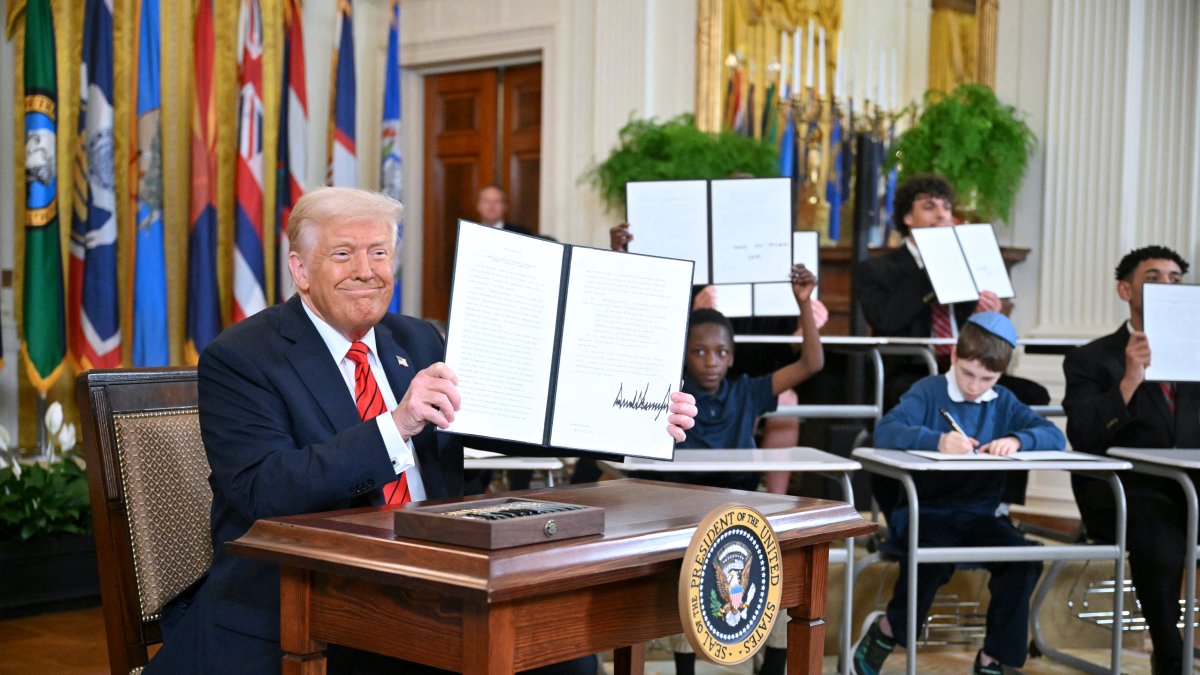
Donald Trump at the White House/ Mandel Ngan

In July 2025, when President Donald Trump signed the Working Families Tax Cuts Act, Republicans succeeded in codifying an unprecedented education policy. For the first time, the federal government had created a mechanism to incentivize private donations to promote school choice.
Specifically, it is a tax credit designed to encourage private donations to fund K-12 scholarships. Its goal is to use the tax system to attract private funds to organizations that award educational scholarships and, in turn, expand the options available to families.
Republican Senator Ted Cruz drafted the provision, describing it as the most far-reaching measure ever enacted on school choice, defined as policies that expand families' options in deciding how and where to educate their children.
"School choice it's how you help people get out of poverty. It's how you help people get out of failing schools and get an excellent education. I think every child in America deserves access to an excellent education, regardless of their race, their wealth, or their zip code," Cruz told VOZ in an interview conducted in 2025.
The program will take effect on January 1, 2027, while the Department of the Treasury and the Department of Education finalize their regulations.
How does it work?
The logic behind the measure stems from a simple question: How can we enable more families to access educational alternatives they currently cannot afford?
In the United States, a family's ZIP code and neighborhood can determine which public schools are available to their children. A family cannot always simply choose the public school it considers best. Often, the choice depends on where they live.
In practice, this can leave some children stuck in the public school assigned to them by address, even when their parents believe the school isn't providing the education their children need.
If the family does not earn enough to send their child to a private school, the other option would be to move to another school district, but for families who cannot afford that expense, sending their children to a private school may also be out of reach.
The new mechanism aims to reduce that barrier through incentives for private schools.
Instead of creating a program in which the federal government collects and then directly distributes the money to families, the law uses the tax system to encourage private individuals to fund these scholarships.
Under the law, a taxpayer may donate up to $1,700 per year to a nonprofit organization that awards educational scholarships, known as a Scholarship Granting Organization (SGO). For that donation, the taxpayer may receive a federal tax credit equal to the amount contributed, subject to the conditions established by law.
For example, if a person donates $1,000 to an eligible organization, they can receive a tax credit of up to $1,000 against their federal taxes. If you donate $1,700, you can receive up to $1,700 in tax credit and reduce your federal taxes by up to $1,700. The credit cannot exceed the amount of federal taxes you owe.
The organization that receives the donations then awards scholarships to students who meet the program's requirements. These scholarships can be used for various educational expenses covered by law, including private school tuition, tutoring, transportation, technology, and other eligible educational expenses
In this way, the government seeks to expand educational options by using a tax incentive to mobilize private funding, rather than creating a new federal program that directly provides money to families.
Who is eligible for the program?
The scholarships are intended for students who meet certain requirements. Among other things, they must come from households whose income does not exceed 300% of the area's median gross income (AMGI) and be eligible to enroll in a public elementary or secondary school.
For example, if the median gross income in an area is $100,000 per year, the income limit for a family would be $300,000. Gross income is income earned before taxes, and the limit varies by area and household size.
Organizations that award scholarships must verify each household's income and size before awarding them. However, federal law does not set the amount of each scholarship.
"Education choice is spreading faster today than ever before"
Jonathan Butcher, acting director of the Center for Education Policy at the Heritage Foundation, spoke with VOZ about the importance of the program. The expert stated that "education choice is spreading faster today than ever before."
"The new federal tax credit scholarship will allow individuals to make charitable contributions worth up to $1700 to scholarship organizations. Donors will receive a tax credit for their donation. Crucially, the US Departments of Education and Treasury are working on the rules and regulations for the program now to protect students, donors, and private schools from undue regulations," he added.
Butcher also highlighted the expansion of state-level educational freedom policies in recent years, such as private school scholarships and education savings accounts (ESAs). The latter allow families to use state-allocated funds for various educational expenses, such as private school tuition, tutoring, school supplies, or other authorized options.
Do all states participate?
Under the law, states may choose whether or not to participate in the program. As of September 2026, 30 states had chosen to participate, including both Democratic and Republican states: Alabama, Alaska, Arkansas, Colorado, Florida, Georgia, Idaho, Indiana, Iowa, Kansas, Kentucky, Louisiana, Mississippi, Missouri, Montana, Nebraska, Nevada, New Hampshire, North Dakota, North Carolina, Ohio, Oklahoma, South Carolina, South Dakota, Tennessee, Texas, Utah, Virginia, West Virginia, and Wyoming.
For a taxpayer to donate to an SGO and claim the credit, the state where that SGO is located must have chosen to participate in the program and submitted a list of eligible SGOs to the IRS.
LATEST