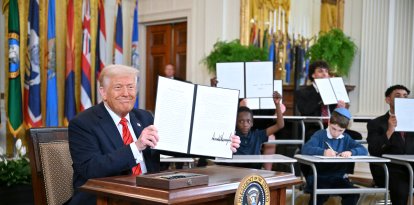
Trump to meet with congressional leaders a day before deadline to avoid government shutdown
No proposal to avert the shutdown has achieved a consensus in Washington, D.C., so leaders will discuss with the president to reach a deal that can get the necessary votes in both chambers.
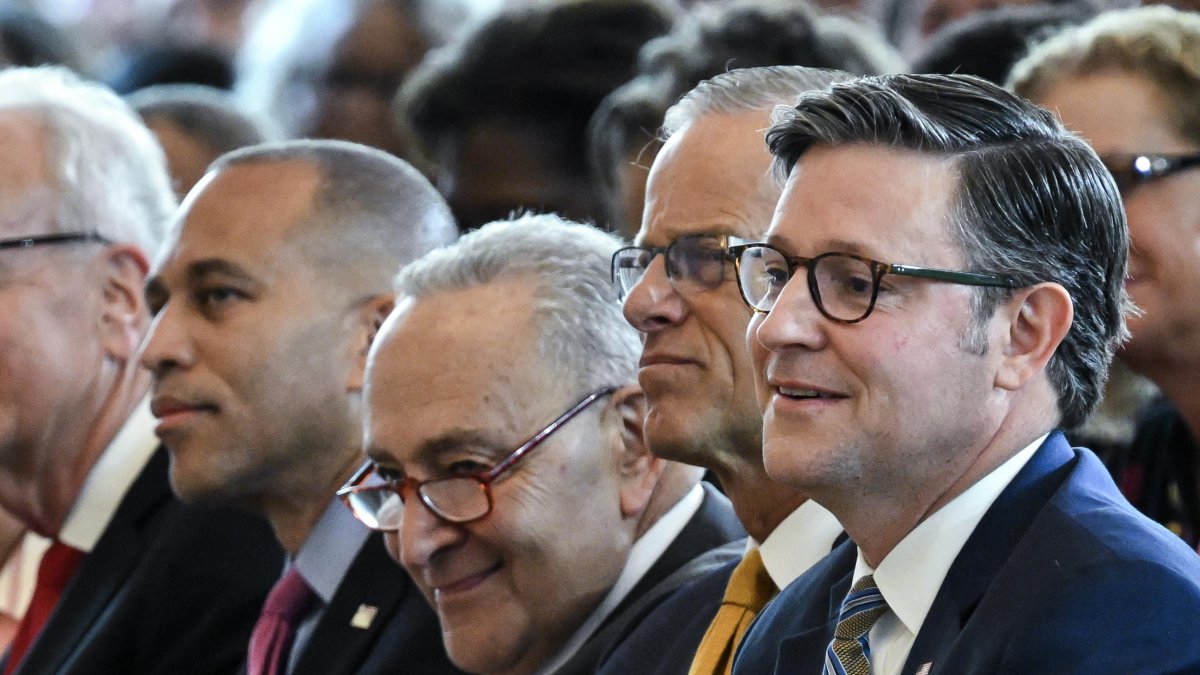
Congressional leaders on Capitol Hill/ Drew Angerer.

Donald Trump will meet with congressional leaders on Monday to discuss a possible government shutdown. The president called a meeting for one day before the September 30 deadline. If lawmakers do not reach an agreement before that date, the federal government will be shut down in whole or in part.
The meeting will be attended by Mike Johnson, speaker of the House of Representatives; Hakeem Jeffries, House Democratic leader; John Thune, Senate majority leader; and Chuck Schumer, minority leader.
Currently, no proposal to avoid the shutdown has achieved consensus in Washington, D.C., so leaders will discuss with the president to reach a deal that can garner the necessary votes in both chambers.
Opinion
Posible cierre del Gobierno a la vista: estas son las estrategias de los dos partidos
Vanessa Vallejo

While Democrats are seeking to extend health insurance subsidies, which expire at the end of the year, Republicans are seeking partial funding to extend the deadline to negotiate the funds more broadly.
The meeting is scheduled for 2 p.m. on Monday and was initially reported by Punchbowl News. Previously, Trump canceled a meeting with Democratic leaders to discuss the shutdown.
What is a government shutdown?
The logic comes from the National Constitution, specifically Article 1, Section 9: "No Money shall be drawn from the Treasury but in Consequence of Appropriations made by Law, and a regular Statement and Account of the Receipts and expenditures of all public Money shall be published from time to time."
Once closure is reached, certain agencies directly cease to function. They may be all, some or particular ones. Their employees cannot work, and their pay is withheld until lawmakers reach an agreement.
The United States was completely unaware of this scenario until well into the 20th century, when the first government shutdown took place in 1980. Jimmy Carter was the first president to be in charge during this situation, which lasted a little over 24 hours on that occasion. The shutdown was repeated in 1982 (twice), 1983, 1984 (twice), 1986, 1987, 1990, 1995 (twice), 2013, 2018 and 2019.
The last one, coincidentally the longest, was in 2019. It took 35 days for everything to return to regular operation. An estimated 800,000 public employees did not receive their money during that time period.
LATEST