Analysis
Trump ‘takes over’ Washington, DC: Is the president breaking the law?
The president remarked that the capital is a country's calling card to the world, so action was urgently needed.

Trump in the White House press briefing room/ Andrew Caballero- Reynolds.

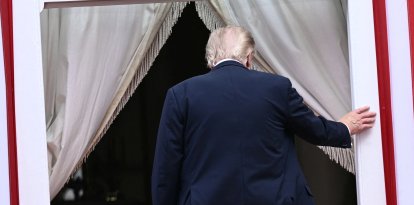
"It will not only be about ending crime, murders and deaths in our nation's capital, but also about cleaning up and overall physical renovation and the state of our once beautiful and well-kept capital," Donald Trump explained regarding his decision to take control of security forces in Washington, D.C.
In a press conference held on Monday, the president remarked that the capital is a country's calling card to the world, so urgent action was needed.
The unprecedented move was to invoke Section 740 of the Home Rule Act, the 1973 legislation that established home rule for the city previously governed by Congress.
In practice, the legislation gave D.C. a local government of its own, composed of a mayor and a City Council elected by residents. Thus, it can pass laws on local matters, although always under the supervision of Congress.
That law also included Section 740, which Trump is relying on to transform the city. Although many Democrats have defined the White House initiative as an "assault of federal power against the will of elected leaders," the truth is that the legislation protects Trump's actions.
What does section 740 of the Home Rule Act say?
The Home Rule Act of 1973 was designed to give autonomy to the nation's capital. But it also included a back door in case things get out of control. That is precisely section 740.
Should the need arise, the president can take control of the Metropolitan Police Department (MPD) for a period of 30 days, provided Trump notifies Congress of his decision.
"Whenever the President of the United States determines that special conditions of an emergency nature exist which require the use of the Metropolitan Police force for Federal purposes, the Mayor of the District of Columbia shall provide such services of the Metropolitan Police force as the President may deem necessary and appropriate," the law reads.
It is important to note that the text does not specify that an actual emergency must exist, but that it is sufficient for the President to determine that such an emergency exists.
On the duration of these powers, there is an ambiguous area. While it is unlikely to extend for more than 30 days, since it would require a resolution passed by both houses of Congress, Section 740 does not expressly contemplate that the president may "chain" or extend this emergency indefinitely.
If a president were to attempt to declare a new emergency just after the previous one expires, arguing that it is "another" emergency, there is no provision expressly prohibiting this. However, this action would likely end up going through some court, given that the spirit of Congress was to limit temporary presidential intervention.
What about the National Guard?
Throughout the country, it is the governors who activate the National Guard to act on different situations, such as riots, emergencies or natural disasters.
In the case of Washington, D.C., since it is not a state, the National Guard reports directly to the White House. Under Title 32, Section 109 of the U.S. Code and Title 49, Section 409 of the D.C. Code, the National Guard in the nation's capital is"subordinate to the President of the United States" at all times.
Therefore, Trump does not need any emergency or special situation to order the deployment of these forces. Although the mayor can request their deployment, in this case, Muriel Bowser, the final decision goes through the Oval Office.
Another question is under what legal framework the National Guard is deployed. The Posse Comitatus Act (PCA) limits federal armed forces from intervening in police duties within the country. When the National Guard is federalized (under Title 10), it is considered a federal force and must abide by these limitations.
The case is different if the deployment is under Title 32. In that status, the National Guard remains under state or local control and is not considered a federal force, so that it can support the police in law enforcement duties. Thus, it can be deployed without violating the PCA.
LATEST