These are the keys to the "Big Beautiful Bill": defense, the border, tax reform and energy
The bill aims to profoundly reform federal government spending and budgets.
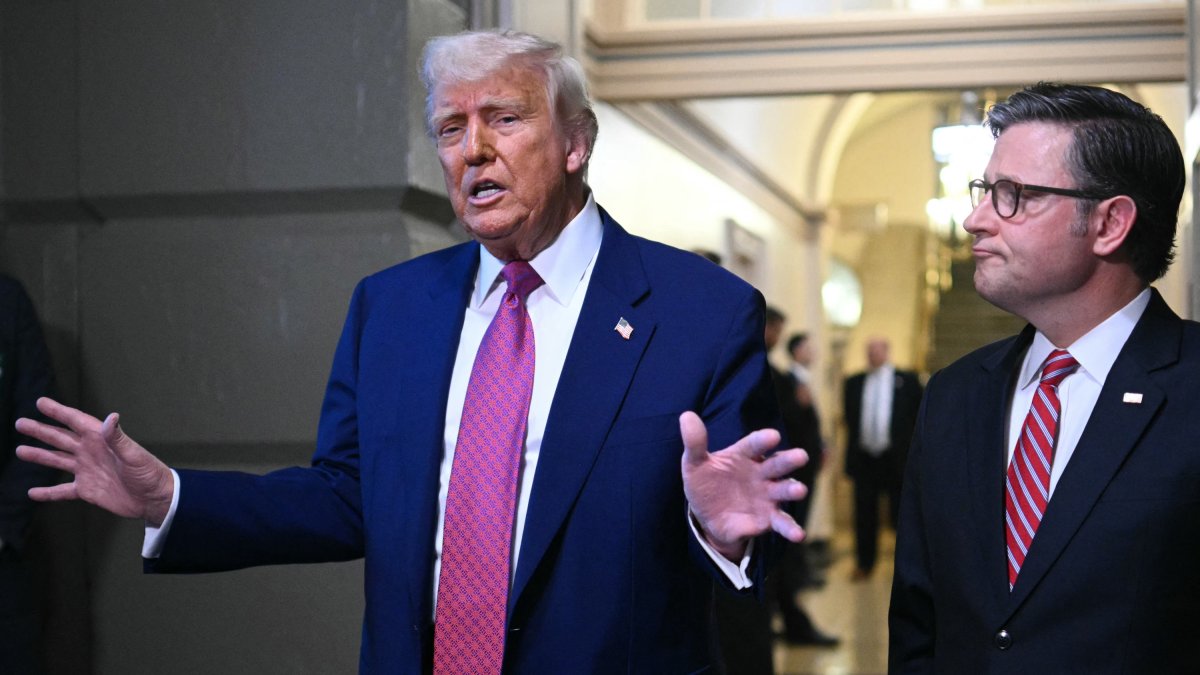
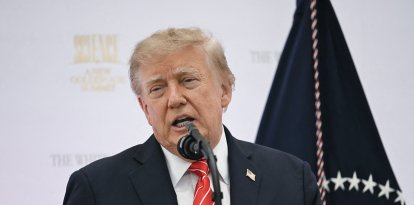
Donald Trump and Mike Johnson after a meeting with GOP congressmen.

Learn the details of the "Great Big Beautiful Bill," the Trump Administration's massive initiative that seeks to redefine key areas of federal government and budget spending.
The bill Introduces new deductions for tips, overtime and auto loans. It raises the child tax credit to $2,500 and establishes $1,000 savings accounts for each baby born between 2025 and 2029.
The bill does not stop there and also affects controversial social issues, such as funding for trans operations on minors or the southern border with Mexico.
Below,VOZ breaks down for you the main points in which the bill intervenes in public spending and revenue collection.
Tax Reforms and Tax Relief
Extension of 2017 cuts
- Indefinitely extends the individual income and estate tax cuts passed in the Tax Cuts and Jobs Act of 2017, which were scheduled to expire at the end of 2025.
- These cuts especially benefited higher incomes under the original law.
New exemptions
- Elimination of the federal tax on tips received by workers.
- Elimination of the additional federal tax on overtime worked.
- Exemption from federal tax on interest on certain auto loans (stipulated in sections amending the Internal Revenue Code).
Increased deductions and credits
- Standard income tax deduction raised to $32,000 for couples filing jointly.
- Child Tax Credit increased to $2,500 per child through tax year 2028. After 2028, the credit will be $2,000.
Baby Savings Account ("Trump Account")
- A new type of savings/investment account for children will be established: $1,000 for each child born between 2025 and 2029, deposited in an interest-earning investment account, managed in a manner similar to college savings accounts.
SALT (State and Local Tax) Deduction
- Elevation of the maximum state and local tax deductible limit from $10,000 to $40,000, applicable only to taxpayers with adjusted gross income below $500,000.
Border Security and Immigration
Border Security Funding
- Appropriation of $175 billion to reinforce the border with Mexico, to be used for:
- Construction or reinforcement of walls and physical barriers.
- Hiring and pay raises for Border Patrol and Immigration and Customs Enforcement (ICE) agents.
- Deportation operations for undocumented immigrants.
Immigration restrictions and social programs
- Mechanisms are being established for undocumented immigrants to be removed from federal welfare programs, including Medicaid and SNAP, through amendments to the Social Security Act and the Internal Revenue Code.
- Eligibility requirements for certain benefits (such as Medicaid) exclude noncitizens as of the time the law takes effect, rather than deferring to 2029.
Defense Spending
Total additional appropriation of $350 billion
Of that $350 billion, $150 billion is specifically directed to the Department of Defense (Pentagon), for:
- Development and implementation of the "Golden Dome" missile defense system.
- Research, development and acquisition of advanced technologies, including drones and unmanned systems.
- Modernization of ground, naval and airborne equipment.
The rest of the defense funding ($200 billion)...
- Maintain and expand military presence at global strategic points.
- Strengthen cybersecurity and joint operations with allies.
- Maintain and modernize existing facilities and arsenals.
Reforms to Social Programs.
Medicaid
- About $700 billion in federal funding for Medicaid is eliminated over the next decade (according to Congressional Budget Office estimates).
- These cuts take effect immediately upon enactment, rather than postponed until 2029 as had been discussed in earlier versions.
Stricter labor requirements
- Mandatory employment or work program participation requirements are introduced for certain Medicaid beneficiaries.
- Exclusive exemption for individuals with certified disabilities or primary caregivers of disabled family members.
Restrictions on state funding
- The ability of states to use taxes on medical providers as part of their contribution to the program (matching funds) is limited.
- Prohibition of coverage for Planned Parenthood
- Specifies that no federal Medicaid funds may go to clinics or entities that provide abortion services or any services affiliated with Planned Parenthood.
Supplemental Nutrition Assistance (SNAP)
- Beneficiaries without dependents receiving SNAP must meet "employment requirements" up to age 64 (previously it was up to age 54).
- Exemption for persons over 64, disabled or pregnant.
Exclusive focus on U.S. citizens
- Only persons with U.S. citizenship are eligible for SNAP; categories that allowed legal residents or qualified immigrants to participate are eliminated.
- Closing loopholes that allowed college students who were dependent on their families to access the program without meeting work requirements.
Energy and Environment
Elimination of green incentives
All tax credits and subsidies related to the Inflation Reduction Act of 2022 (Inflation Reduction Act) are repealed, including:
- Electric vehicle credits.
- Subsidies for solar and wind energy projects.
- Tax breaks for energy efficiency in buildings.
Electric vehicle mandate repeal
- Any federal requirement that would force automakers to increase production or sales of electric vehicles within a certain time frame is eliminated.
Energy project permitting streamlined
- Fast-track approvals are granted for new pipelines, refineries and oil and gas extraction projects, with exemptions to certain environmental impact studies.
- The Environmental Protection Agency (EPA) is required to complete reviews within a maximum of 90 days, instead of the current 180 or more.
Strategic Petroleum Reserve Filling
- Specific funds are earmarked to purchase crude oil and increase the current levels of the Strategic Petroleum Reserve (SPR) to its maximum capacity.
Artificial Intelligence (AI) Regulation
10-year state moratorium
- All 50 states are expressly prohibited from implementing or enacting any regulation or tax related to artificial intelligence for a period of ten years from the effective date.
- Any local AI regulations or taxes in existence at the time of passage are repealed.
Federal centralization
- The Executive Branch, through the Office of Science and Technology (OSTP) and the Federal Trade Commission (FTC), assumes exclusive authority to regulate the development, deployment and use of AI systems in the United States.
A National AI Oversight Council is created within the Department of Homeland Security (DHS), charged with:
- Defining security standards for AI systems employed in federal institutions.
- Assess risks of AI use in critical sectors: health, defense, transportation, energy and financial services.
- Edit annual guidelines on "responsible practices" around AI, mandatory for federal agencies.
Integration in key agencies
The Departments of Defense, Homeland Security, Health and Human Services, and Transportation are required to implement AI systems in:
- Cyber threat detection and response.
- Medical risk assessment and health data management.
- Route and traffic flow optimization at airports and federal highways.
- Systems for strategic decision support in defense and natural disaster response.
Other Provisions.
Reproductive Health
- Federal Medicaid funds are strictly prohibited from being used to fund "direct care" services to entities that perform abortions or provide abortion counseling (e.g., Planned Parenthood).
- This restriction covers cervical cancer screenings, testing for sexually transmitted infections, and provision of contraceptives at Planned Parenthood partner clinics.
Weapons and Related Regulations
- Elimination of the silencer tax. Eliminates the $200 federal tax in effect since 1934 on the purchase of silencers (suppressors) for firearms.
- Restores the classification of silencers as "accessories" subject only to ATF (Bureau of Alcohol, Tobacco, Firearms and Explosives) authorization, with no additional surcharge.
Agriculture
Investment in agricultural programs. Allocates $60 billion in new funds for:
- Direct subsidies to farmers of previously unsubsidized crops (fruits, vegetables, energy crops).
- Soil and water conservation programs on family farms.
- Research on biofertilizers and precision farming techniques.
- Creation of a $5 billion fund for small-scale farmers affected by drought or flooding, administered by the Department of Agriculture (USDA).
Minors and Family Issues.
- Gender-affirming surgery for minors:
It establishes an immediate ban on federal funding (Medicaid, public health programs) for any gender-affirming surgery (gender-affirming surgery) for minors under the age of 18.
Reinforcement of social services.
- Funds are earmarked to expand psychological support programs for transitioning youth, although surgery will remain without federal coverage.
LATEST