ANALYSIS
Garbage, endless blackouts and hidden negotiations: The Cuba that the regime does not show
White House spokeswoman Karoline Leavitt affirmed this week that the Cuban regime "is falling" and warned that it will have to implement "drastic changes very soon," within the framework of the maximum pressure strategy promoted by Washington.
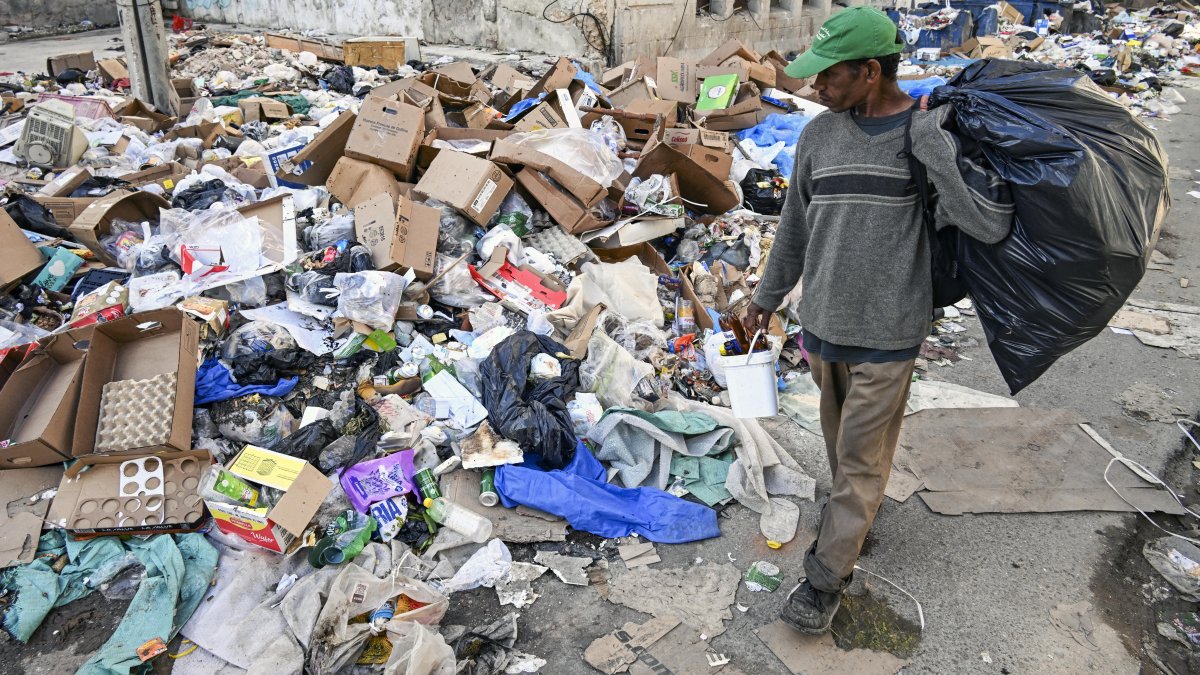
A man walks down a Havana street that has been turned into a garbage dump.

The Trump administration has elevated its political and economic pressure on the Cuban regime, while maintaining discreet contacts with key figures in the power environment in Havana, in a strategy that combines energy sanctions, diplomatic pressure and possible parallel negotiation channels. Official statements from Washington, a report by the U.S. media Axios and reports on the internal deterioration of the island point to a critical moment for the Cuban dictatorship, facing a structural crisis unprecedented in decades.
White House: "The regime is falling"
White House spokeswoman Karoline Leavitt affirmed this week that the Cuban regime "is falling" and warned that it will have to implement "drastic changes very soon," as part of the maximum pressure strategy pushed by Washington. The statement follows the executive order signed by Trump on Jan. 29, which authorizes the imposition of tariffs and sanctions on countries that supply oil to Cuba, a measure that has de facto cut off the island's main energy sources.
">🇺🇸🇨🇺‼️ | ÚLTIMA HORA — La Vocera de la Casa Blanca, Karoline Leavitt, afirmó que Cuba es “un régimen que está cayendo” y que el país se encuentra en colapso, reiterando que para Estados Unidos lo ideal es ver una isla “verdaderamente libre y próspera”. La Administración del… pic.twitter.com/3ilYC1ahij
— UHN Plus (@UHN_Plus) February 18, 2026
The Secretary of State, Marco Rubio, has reiterated that U.S. policy seeks a political transition in Cuba if the government does not release political prisoners or move toward a democratic system. Trump himself reinforced this stance by recently declaring that "Cuba is right now a failed nation," in reference to the energy collapse, widespread shortages and deterioration of basic services.
The tightening of sanctions coincides with the interruption of oil shipments from Venezuela and the suspension of supplies from Mexico, which has deepened the island's energy chokehold and further weakened its already fragile economic structure.
Axios report: Secret contacts with Raul Castro's entourage
According to Axios, Marco Rubio has held discreet conversations with Raúl Guillermo Rodríguez Castro, grandson and caretaker of former President Raul Castro, in an attempt to explore future political scenarios for Cuba outside official channels.
A senior U.S. official quoted by the media stated that these contacts do not constitute formal negotiations, but "discussions about the future," and stressed that Washington considers that Raul Castro remains the real center of power on the island, above the formal president, Miguel Diaz-Canel.
The report notes that Rubio and his team see in the younger Castro's entourage a more pragmatic generation potentially open to change, in contrast to the traditional Communist Party apparatus. A State Department spokesman avoided commenting on these contacts, while the Cuban government officially denied the existence of negotiations, although it acknowledged "exchanges of messages."
This approach reflects a strategy similar to that previously used by Washington in Venezuela, where economic pressure was combined with selective contacts with power figures to facilitate a controlled transition.
Domestic collapse: Fuel, garbage and services paralyzed
In Havana, only 44 garbage trucks remain operational out of a total of 106, which has led to the massive accumulation of waste on the streets. Residents quoted by local reports describe the situation as unsustainable, with piles of garbage remaining uncollected for days and representing a growing sanitary risk.
The fuel rationing imposed by the regime has prioritized hospitals and critical infrastructure, but has left much of the urban services inoperative. The state platform 'Ticket,' created to distribute gasoline, is saturated, with drivers waiting weeks, or even months, to access limited amounts of fuel.
This operational collapse extends to multiple sectors: airlines have suspended flights, public transport is operating at historic lows, blackouts are dragging on for hours, and hospitals are facing difficulties in maintaining operations.
World
Cuba today: Record blackouts, economic crisis, insecurity and a country on the brink
Virginia Martínez
The outcome will depend largely on Washington's strategic decisions and the Cuban regime's ability, or inability, to sustain itself in the midst of a crisis that continues to deepen.
LATEST