LIVE | Trump says Strait of Hormuz will be 'completely open' Friday
While the international community celebrates the de-escalation, various political actors remain skeptical about the commitments made by both sides.
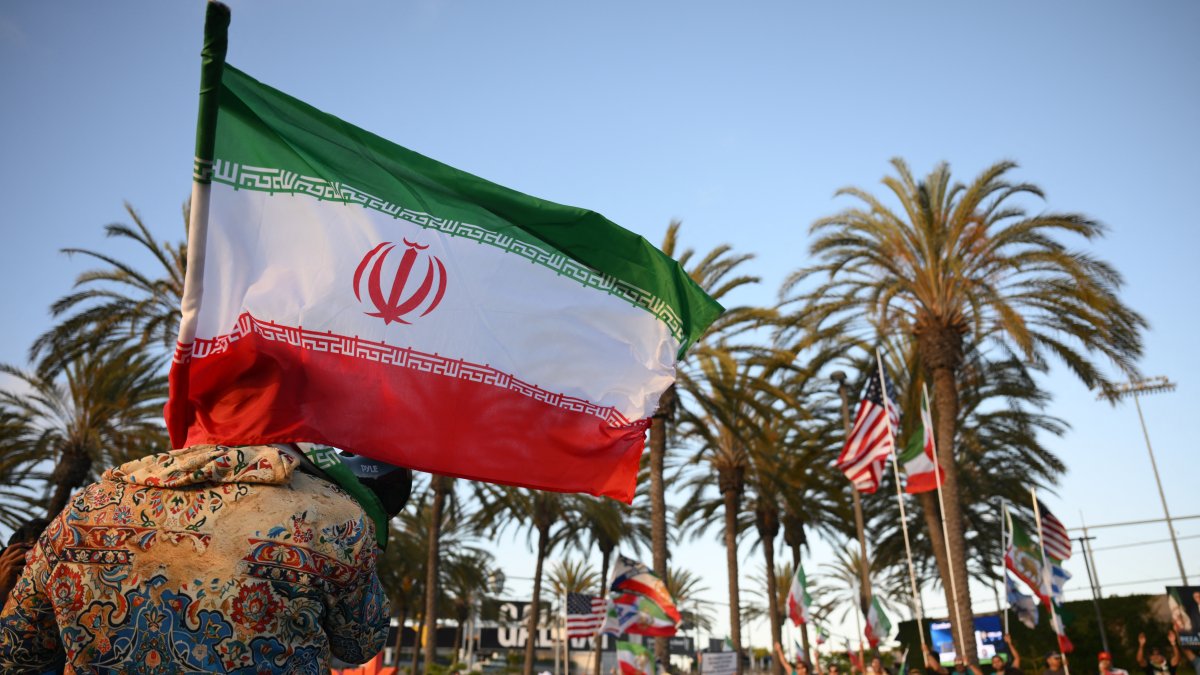
A man holds an Iranian flag in front of people carrying flags from other countries.
The United States and Iran have signed a peace agreement that promises to defuse one of the most volatile crises of recent years in the Middle East. The announcement sparked immediate reactions from world leaders, financial markets and regional actors, ranging from expressions of support to caution and criticism.
In this minute-by-minute update, we review all the latest developments, statements and implications of a deal that could redefine the geopolitical balance in the region.
Trump says Strait of Hormuz will be 'completely open' Friday
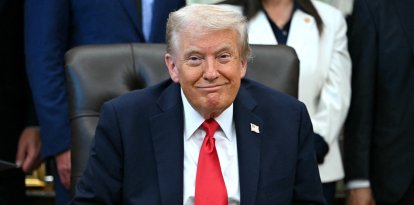
The Strait of Hormuz will be "completely open" starting this Friday following the agreement reached between the Iranian regime and the United States to end the war in the Middle East, which had restricted maritime traffic in this critical waterway, President Trump declared on Monday.
AFP reported that during the opening of bilateral talks with his French counterpart, Emmanuel Macron, ahead of the G7 summit in France, Trump added: "I don’t think we’re going to need much help" to keep the strait open, after London and Paris proposed a joint naval mission.
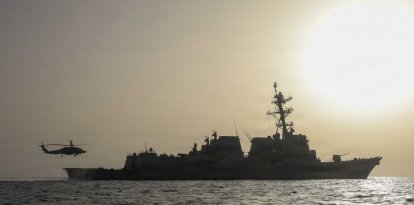
Trump said that the Strait was "already partially opened," although there was "hunting" going on to ensure it was de-mined.
The president praised the agreement reached with the Islamic Republic, stating: "The main thing is Iran will not have a nuclear weapon."
The Iranian regime claims that "deep mistrust" toward the U.S. persists despite the agreement
Iran's Ministry of Foreign Affairs stated on Monday that Tehran still harbors "deep mistrust" toward the United States, despite the framework agreement reached to end the war.
"Unfortunately, we must acknowledge that Iran's deep mistrust of the United States stems from a long history of wrongful actions by U.S. leaders," said Foreign Ministry spokesman Esmaeil Baghaei during a press conference.
"The United States still has a long way to go before it can earn the trust of the Iranian people," he added, noting that the framework agreement is "only a step toward reducing tensions."
Trump says ships “starting to move” out of Hormuz
U.S. President Donald Trump said Monday that oil tankers were moving out of the Strait of Hormuz, apparently on a route near to Oman, following a peace deal with Iran.
"Ships are starting to move, many loaded up with Oil, out of the Strait of Hormuz. They are going along the Southern ‘Highway,’ which is totally safe, secure, and pristine. There are other areas of travel, also!!!" the president wrote on Truth Social.
Iran wants U.N. security council to endorse final agreement with U.S.
Iran's Foreign Ministry wants the United Nations Security Council to endorse any final agreement reached with the United States, including provisions related to Tehran's nuclear program, the ministry said on Monday.
"We expect the final agreement to be backed by a U.N. Security Council resolution within 60 days of its signing," Foreign Ministry spokesperson Esmail Baghaei said during his weekly press briefing.
According to Baghaei, Tehran intends to "learn from past experiences."
Wall Street opens higher after Middle East agreement announcement
U.S. stocks opened sharply higher on Monday after the announcement of an agreement between Washington and Tehran aimed at ending the conflict in the Middle East, easing concerns over inflationary pressures.
In early trading, the Nasdaq rose 2.21%, the S&P 500 gained 1.34%, and the Dow Jones Industrial Average advanced 1.13%.
U.S.-Iran agreement included last-minute Strait of Hormuz shipping toll clause
Iran's Fars news agency reported Monday, citing an informed source, that Iran inserted a last-minute clause into the framework agreement with the United States concerning the payment of a maritime toll in the Strait of Hormuz.
"In the final moments of the negotiations, the text of the memorandum of understanding was amended to clearly and explicitly emphasize the issue of Iran's and Oman's sovereignty over the Strait of Hormuz," Fars quoted the anonymous source as saying. The strategic waterway serves as a key transit route for oil and natural gas exports from the Gulf region.
"The use of the term 'maritime services' means that the United States has accepted the payment of tolls to Iran," the Iranian news agency added.
Lebanon "was not informed" of agreement between Iran and the United States
The Lebanese government was not informed of the agreement between the United States and Iran, which calls for an end to the war on all fronts in the Middle East, including the conflict between Hezbollah and Israel, an official source told AFP on Monday.
"We were not informed of the terms of the agreement," nor of when the ceasefire will take effect in the conflict that has pitted the pro-Iranian Hezbollah movement against Israel since March 2, said the source, who requested anonymity.
In recent hours, the intensity of the violence in the south of the country has decreased. On Monday morning, the official news agency NNA reported Israeli artillery shelling but no airstrikes.
For its part, Hezbollah did not claim responsibility on Monday for any attacks against Israeli territory.
According to Iranian Deputy Foreign Minister Kazem Gharibabadi, the pact brings "an immediate end to the war."
Egypt believes the U.S.-Iran agreement could mark a "turning point" for peace in the Middle East
Egypt stated on Monday that the agreement announced by the United States and Iran to bring a lasting end to the war in the Middle East could mark a "turning point" for peace in the region.
"Egypt hopes that this agreement will mark a turning point toward strengthening mutual trust, the establishment of new bases for cooperation, the creation of an environment conducive to peace, and the promotion of diplomatic efforts aimed at resolving outstanding regional issues," the Egyptian Ministry of Foreign Affairs said in a statement.
Israel says it will not withdraw its troops from Lebanon, Syria or Gaza
"Prime Minister Benjamin Netanyahu and I are implementing a clear policy under which the Israel Defense Forces (IDF) will remain in the security zones of Lebanon, Syria, and Gaza for an unlimited period of time, in order to protect the border and Israeli communities from jihadist elements," Israel Katz said in a statement.
Katz also warned Iran that if the Islamic Republic attacked Israel in response to its campaign in Lebanon, Israel would retaliate with "full force."
Saudi Arabia praises agreement between Iran and the U.S.
Saudi Arabia also praised the agreement on Monday—the details of which have not been made public—between the two nations to end hostilities and begin peace talks, though it warned that any lasting solution must take into account the security interests of the region.
The country welcomes the "agreement reached between the United States and Iran to end military operations and begin detailed negotiations within 60 days with the aim of reaching a permanent agreement," the Ministry of Foreign Affairs said in a statement posted on social media.
It also insisted that a lasting peace agreement must take into account the security interests of the countries in the region and adhere to the principle of non-interference in internal affairs.
Pakistan views the U.S.-Iran agreement as a "historic step toward peace"
Pakistani Prime Minister Shehbaz Sharif said Monday that the agreement between the United States and Iran to end the war in the Middle East, reached through his country’s mediation, is a “historic step toward peace.”
"Today, the world has witnessed a historic step toward peace. After the darkness of war, the sun of peace has risen," declared the leader, who highlighted the "extraordinary" role played in the negotiations by his country’s army chief, Asim Munir.
Oil plummets and Asian stock markets rise on Iran-U.S. agreement
Oil prices fell by about 4% on Monday at the opening of Asian markets, after the United States and Iran announced an agreement to end the conflict in the Middle East.
Around 12:45 a.m. GMT on Monday, the price of a barrel of North Sea Brent for August delivery, the global market benchmark, fell 4.03% to $83.81.
West Texas Intermediate (WTI), the U.S. benchmark, fell 4.7% to $80.89 per barrel after dropping nearly 5% at the open.
Meanwhile, the Tokyo and Seoul stock markets opened with sharp gains, driven by the agreement between the United States and Iran.
The Japanese Nikkei 225 index rose 4.99%, while South Korea’s Kospi surged 5.54%.
Washington and Tehran reached an agreement to end the war in the Middle East “immediately and permanently” on all fronts, including Lebanon, the Pakistani mediator announced on Monday.
One-fifth of the world’s crude oil
Traffic through this strategic passage had been at a standstill since the conflict began in late February, triggering a sharp spike in oil prices.
One-fifth of the world’s crude oil typically passes through the Strait of Hormuz.
“Before the conflict, about 140 ships passed through the strait every day. Traffic has improved, but remains well below normal levels. A full reopening would therefore have an immediate impact" on oil prices, estimated Stephen Innes, an analyst at SPI Asset Management, on Sunday.
United Kingdom, France, Germany and Italy ready to lift sanctions against Iran
The United Kingdom, France, Germany and Italy welcomed on Sunday the agreement reached between the United States and Iran, which calls for an end to hostilities, and said they were willing to lift some sanctions against Tehran.
"Iran must never acquire a nuclear weapon. We are ready to work with the United States, Iran, and the IAEA (International Atomic Energy Agency) toward this end," the four countries stated in a joint communiqué.
They added that they are "willing to lift relevant sanctions in response to clear and verifiable steps by Iran regarding its nuclear program."
Iranian media outlet claims U.S. will immediately unfreeze $12 billion
A memorandum of understanding between Iran and the United States provides for the immediate release of $12 billion in frozen assets, the Iranian news agency Mehr reported on Monday.
The document provides for "the release of $24 billion in Iranian assets frozen during the 60-day negotiation period" that begins following the conclusion of the memorandum of understanding, according to Mehr.
"Half of this sum must be made available to Iran before the start of negotiations," the report states, though this has not been officially confirmed.
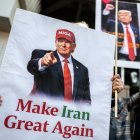
Trump says Strait of Hormuz will reopen after signing of Iran deal on Friday
President Donald Trump said on Sunday that the Strait of Hormuz would reopen after the signing of the peace agreement with Iran on Friday, in an apparent contradiction to his earlier statement that the waterway would open immediately.
Trump added on his Truth Social network on Sunday that "this Great Agreement will bring Peace and Security to the entire Region."
Iran says talks for a "final agreement" will begin within 60 days
The memorandum of understanding reached late Sunday night between the two countries paves the way for negotiators to reach a final agreement within 60 days, according to Iran’s Deputy Foreign Minister.
"Negotiations will begin within 60 days with the aim of reaching a final agreement," Kazem Gharibabadi told state television. He added that "mistrust toward the United States still exists."
U.S. and Iran to hold preparatory talks in Qatar before signing agreement in Geneva
"This week in Doha, there will be separate preparatory meetings with each of the parties, prior to the official signing in Switzerland and the launch of technical talks," a diplomat close to the talks told AFP on condition of anonymity.
According to him, the mediators sent by Qatar left Tehran after “17 hours of intensive negotiations,” which began on Sunday and culminated in an announcement of an agreement to end the conflict.
UN chief hails announcement of U.S.-Iran agreement as a "crucial step" toward peace
The most anticipated news
Donald Trump and Iran announced the long-awaited peace agreement and the reopening of the Strait of Hormuz after nearly four months of conflict.
Iran’s Deputy Foreign Minister, Kazem Gharibabadi, also confirmed during a phone call on his country’s state television that the agreement with Washington has been finalized and that the official signing will take place next Friday in Switzerland.
LATEST