Americans prefer spending cuts to tax increases to reduce the deficit
According to a new Gallup poll, 49% of adults believe Congress should reduce the deficit through spending cuts, while only 17% support resorting to tax increases, and 27% prefer a balanced combination of both strategies.
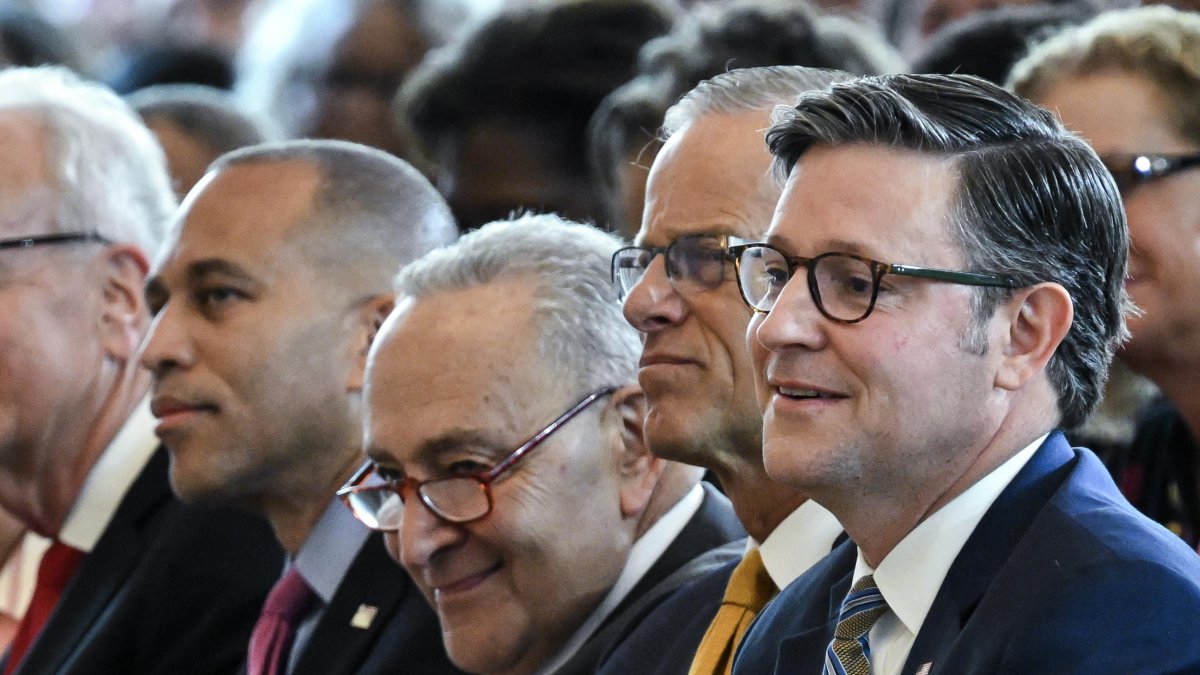
Congressional leaders on Capitol Hill/ Drew Angerer

A recent poll by Gallup, conducted Sept. 2-16 of this year, reveals that Americans have stark preferences on how to address the federal budget deficit, with a general inclination toward spending cuts rather than tax increases.
However, support for raising taxes on high-income Americans and reforming the tax code is also significant, especially among Democrats and independents.
Overall preferences for deficit reduction
According to the poll, 49% of U.S. adults believe that Congress should reduce the deficit primarily or exclusively through spending cuts (27% "mostly" and 22% "only").
On the other hand, only 17% support resorting mainly or exclusively to tax increases, while 27% prefer a balanced combination of both strategies.
These results align with historical trends observed by Gallup at times of fiscal stress, such as in November 2012, before the "fiscal cliff," and in 2011, during federal debt limit negotiations. On both occasions, the majority also favored spending cuts, although the preference for a combined approach has been notable in the past.
Sharp partisan divisions
Preferences for deficit reduction vary significantly by political affiliation. Republicans show a clear tilt toward spending cuts, with 38% exclusively supporting this measure and 42% mostly favoring it.
In contrast, Democrats tend to prefer a more balanced approach: 41% support a combination of spending cuts and tax increases, while 28% are inclined to prioritize tax increases and 21% for spending cuts.
The independents, meanwhile, reflect a stance closer to the national average, with preferences distributed among the three options.
The survey measures
- Increase income taxes on high-income citizens (63%)
- Increase revenue through major changes to the federal tax code (54%).
- Make significant changes to Medicaid and food assistance programs to reduce their cost (49%).
- Cut spending on programs other than defense, Social Security, and Medicare (48%)
- Cut spending on Defense (42%)
- Increase tax revenues by imposing tariffs on products imported from other countries (41%)
- Make significant changes to Social Security and Medicare programs to reduce their cost (39%)
On the other hand, Republicans show majority support for measures such as imposing tariffs on imported products (89%), making significant changes to programs such as Medicaid and food assistance(75%), cutting spending on programs unrelated to Defense, Social Security or Medicare(72%), and reforming Social Security and Medicare programs (56%).
These proposals, however, have limited support among independents (no more than half) and even less among Democrats (26% or less).
Historical trends and the government shutdown
The Gallup poll was conducted at a time of intense fiscal disagreements between Republican and Democratic lawmakers, culminating in a government shutdown on Oct. 1 and still ongoing.
While Republicans insist on spending cuts, Democrats advocate an approach that combines tax increases, especially for the wealthiest, with spending adjustments.

About the poll
It features a random sample of 1,000 adults aged 18 and older residing in all 50 U.S. states and the District of Columbia.
National-level results have a margin of sampling error of ±4 percentage points, with a confidence level of 95%.
LATEST