How the Venezuelan economy was militarized: Report links its expansion to Cuba's GAESA model
The Miranda Center for Democracy presented a study in Washington that compares the business structure of the Venezuelan military with that of the Cuban military conglomerate. The report identifies 44 entities linked to Venezuela's Ministry of Defense and documents their presence in sectors such as oil, mining, banking, insurance, agriculture and commerce.
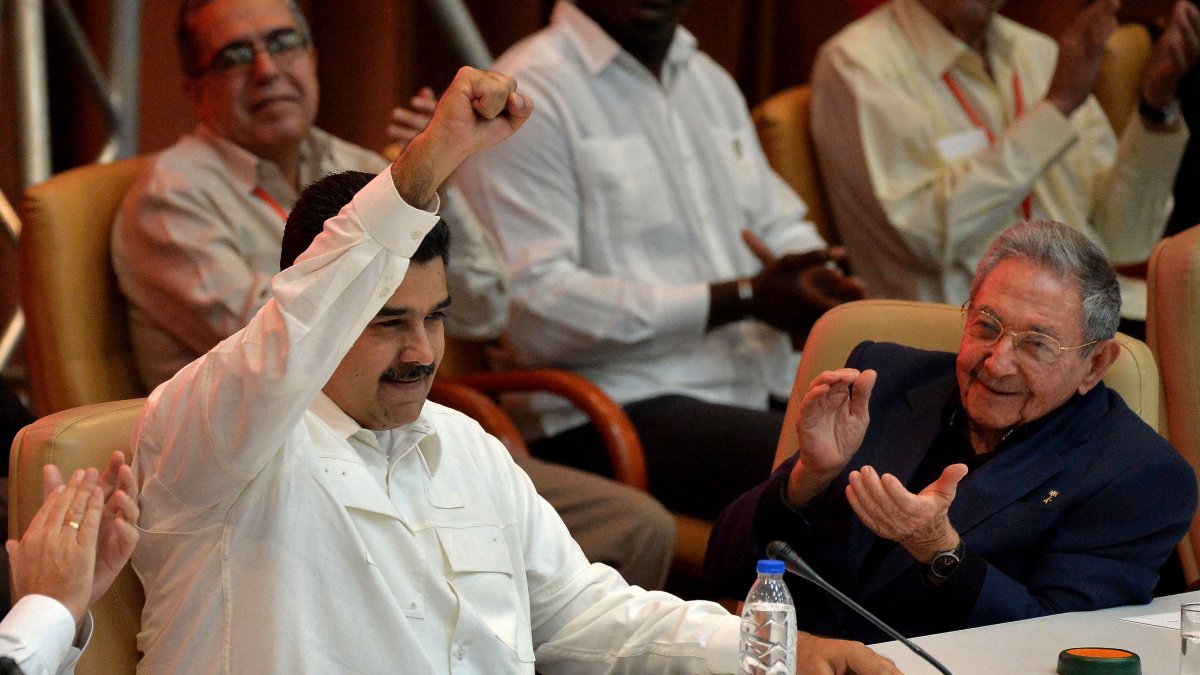
Former Venezuelan dictator Nicolás Maduro and Cuba's Raúl Castro (File photo)

The Venezuelan military has built over the past few decades an extensive business structure that has allowed it to intervene directly in strategic sectors of the economy, ranging from oil and mining to banking, insurance, agriculture and commerce, according to a report presented in Washington by the Miranda Center for Democracy.
The study, titled “Armies that Own Economies: Military-Commercial Capture in Cuba and Venezuela,” compares the Venezuelan system with GAESA, the business conglomerate of the Cuban regime's military, which, according to the study, controls between 40% and 50% of Cuba's economy.
The report argues that both countries developed models that differ in form but are similar in function. Cuba concentrated a large part of its military economic activity within a single structure, GAESA, while Venezuela distributed that power among dozens of companies, foundations and agencies linked to the Ministry of Defense.
44 entities under the purview of the Venezuelan Ministry of Defense
The study identifies 44 entities linked to Venezuela's Ministry of Defense, including 24 companies and 20 foundations or autonomous agencies.
Their operations span finance, oil, mining, manufacturing, agriculture, technology, logistics and retail, among other sectors.
The report also notes that the Venezuelan Ministry of Defense has not published its annual report on activities and accounts since 2015, despite this being a legally mandated accountability mechanism.
At least 103 military officers have held positions on the boards of directors of state-owned companies, according to research compiled by the Miranda Center.
According to the authors, this expansion allowed the Armed Forces to go far beyond their traditional defense functions and become a business entity with the capacity to manage resources and participate directly in the market.
Banking, insurance and a military financial network
Venezuelan military influence also extends to the financial system.
According to the report, the Ministry of Defense owns 99% of the Banco de la Fuerza Armada Nacional Bolivariana (BANFANB), which manages military payrolls and resources linked to the pension system.
It also controls Seguros Horizonte, described in the report as the country's second-largest insurer and responsible for providing coverage to the various branches of the military.
The Miranda Center believes that these institutions form a financial network capable of raising and redistributing resources with less reliance on civilian agencies.
Oil, gold and coltan
One of the most significant companies within the analyzed structure is CAMIMPEG, the Military Corporation for Mining, Oil and Gas Industries.
The company is involved in activities related to the oil sector and holds licenses for the exploration and extraction of gold and coltan in the Orinoco Mining Arc, according to the investigation.
The Miranda Center's summary also notes that illegal armed groups operate in that region, including the National Liberation Army (ELN) and criminal organizations such as Tren de Aragua.
The report argues that the military's presence in extractive sectors places the military in a privileged position within the process by which Venezuela's natural resources are transformed into revenue.
From factories to agriculture and television
The military's business interests extend beyond oil and mining.
The report identifies companies linked to the Armed Forces engaged in the production of textiles, uniforms, bottled water and household appliances, as well as agricultural and livestock activities.
It also mentions heavy transport companies, vehicle assembly plants, tire distributors, shipbuilders, printing companies, travel agencies and even a digital television platform that sells advertising.
According to the Miranda Center, military companies may also benefit from preferential access to certain state-controlled resources, which distorts the conditions under which private companies compete.

Joint venture model
The report identifies structures in which ownership is typically divided into 51% for the military partner and 49% for private partners.
According to the study, the private sector can contribute capital, technology or technical expertise, while military entities offer access to licenses, resources, infrastructure or government contracts.
The report concludes that this type of partnership helped consolidate a network of economic interests centered around military power.
GAESA: The Cuban model
To explain the Venezuelan phenomenon, the Miranda Center devotes a significant portion of its research to GAESA—Grupo de Administración Empresarial S.A.—the conglomerate owned by the Revolutionary Armed Forces of Cuba.
According to the study, GAESA controls approximately 40% to 50% of the Cuban economy through companies operating in tourism, foreign trade, banking, remittances and logistics.
In 2024, the conglomerate reportedly had approximately $17.9 billion in assets, including more than $14.4 billion in bank accounts, according to leaked documents cited by the study.
Despite the volume of its resources, GAESA does not publish financial statements, does not appear transparently in the national budget and its accounts are not subject to standard public audit mechanisms, the report states.
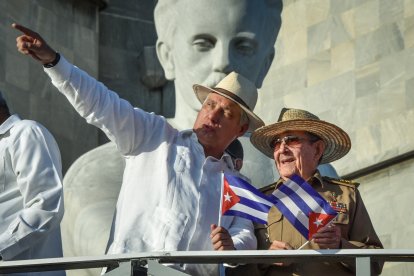
The Cuban regime's leadership: Miguel Díaz-Canel and Raúl Castro
Fewer than 15 people at the top of GAESA
The Miranda Center notes that GAESA's leadership is concentrated in a small group of fewer than 15 people linked to the Cuban power circle.
The investigation maintains that Raúl Castro promoted the creation of a structure that would allow for the concentration of vast economic resources in the hands of a small group of trusted leaders.
Subsequently, under the leadership of General Luis Alberto Rodríguez López-Calleja, Raúl Castro's former son-in-law, GAESA expanded its operations into tourism, ports, logistics, imports, foreign trade and fuel-related sectors.
Rodríguez López-Calleja led the conglomerate until his death in 2022.
Venezuela has transferred at least $63.8 billion to Cuba since 2000
According to calculations by the Miranda Center, since 2000, Venezuela has transferred the equivalent of at least $63.8 billion to Cuba through subsidized oil, infrastructure investments, debt relief and preferential energy agreements.
Approximately $57.4 billion corresponds to the inflation-adjusted value of Venezuelan oil supplies.
By 2008, Venezuela was sending approximately 115,000 barrels of oil per day to Cuba, while between 2005 and 2013, deliveries typically ranged between 90,000 and 105,000 barrels per day, according to figures compiled in the investigation.
The report maintains that these resources strengthened strategic sectors of the Cuban economy that ultimately came under GAESA's influence.
GAESA and control of Cuba's fuel infrastructure
The investigation also estimates that companies linked to GAESA influence or control more than 80% of the infrastructure and logistics related to fuel entering Cuba, including storage systems, port facilities, transportation, import mechanisms and foreign exchange operations.
The document acknowledges that the exact percentage cannot be independently verified due to a lack of transparency on the part of Cuban institutions.
The Miranda Center also cites an investigation by CubaNet according to which several companies recently authorized to import hydrocarbons had ties to GAESA, state ministries or individuals connected to the Castro family.
The conclusion of that investigation, included in the report, was that "GAESA has not relinquished its monopoly."
Society
GAESA’s goal: The battle to undermine the economic power of the Castro regime
Diane Hernández
A structure designed to survive political change
The Miranda Center's main conclusion is that the military's business involvement in Cuba and Venezuela should not be analyzed solely as an economic issue.
The center argues that access to companies, resources and leadership positions can become a mechanism for fostering loyalty within the military and increasing officers' dependence on the political system that grants them these benefits.
The report summarizes this argument by noting that "a military apparatus that owns half the economy does not need to stage a coup; it can simply buy its political survival."
For this reason, the authors argue that any eventual political transition in Venezuela or Cuba should include the separation of the military from commercial activities, as well as mechanisms for transparency, auditing and oversight of military-owned enterprises.
For the Miranda Center, dismantling these economic structures would not merely be a reform following a democratic transition, but a prerequisite for preventing the power apparatus from surviving through companies, intermediaries or formally private structures.
LATEST