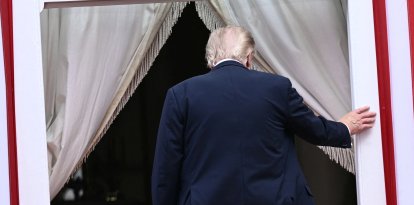
Trump led a White House roundtable discussion on the future of college sports
Among other things, those present discussed the increasing commercialization following the legalization of Name, Image and Likeness (NIL) agreements, legal parameters on whether athletes should be considered employees and the financial imbalance between sports.

Donald Trump at the White House/ Brendan Smialowski.

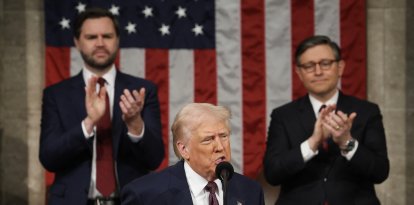
Donald Trump headlined the College Sports Roundtable at the White House. Surrounded by top officials, senators and sports legends, the president discussed the future of college athletics, the importance of protecting women's sports and the challenges of a system that aims for semi-professionalism.
Currently, college athletics faces major challenges for the authorities. For example, the increasing commercialization following the legalization of Name, Image and Likeness (NIL) agreements, the legal parameters on whether athletes should be considered employees, and the financial imbalance between highly profitable sports and the many other university disciplines that depend on that income to subsist.
In this context, the president brought together a number of key players in Washington, D.C., to discuss ideas and explore possible reforms to improve the system.

Just The News
Trump’s favorability ratings with his voting base tops all previous presidents
Just The News/ Amanda Head

Politics
State of the Union guests: The stories behind the citizens Republicans brought to Capitol Hill to put a face to their policies
Emmanuel Alejandro Rondón
Trump began the discussion with the participants. Among them were Nick Saban, former head coach of the University of Alabama; Charlie Baker, former governor of Massachusetts and president of the National Collegiate Athletic Association (NCAA); Pete Bevacqua, director of athletics at the University of Notre Dame; Randy Levine, president of the New York Yankees; Ron DeSantis, governor of Florida; and Condoleezza Rice, former secretary of state and director of the Hoover Institution at Stanford University.
"Federal legislation must allow college athletic programs to set simple common sense rules without endless litigation, and establish a fair Name, Image, and Likeness standard that eliminates the patchwork of conflicting state laws. If Congress does not take action fast, it could destroy college sports, and destroy the colleges that play these sports," the president said.
">.@POTUS hosts a Saving College Sports roundtable: "We're gathered today to discuss an important threat to the integrity and culture of college sports: the inability to set rules on eligibility, transfers, Name, Image, and Likeness... this has grown into a major challenge." pic.twitter.com/4PieRihWAq
— Rapid Response 47 (@RapidResponse47) March 6, 2026
Saban, who has decades of experience coaching young athletes, expanded on the need for clearer rules that are compatible with academic life: "My goal as a coach of my players, of our players, was to help them be more successful in life, to create an atmosphere and environment that would help them in their personal development, with academic support."
"We need to come up with a system... to allow student athletes in all sports, including women's and olympic sports, to enhance their quality of life, while going to college — but still provide opportunity to advance themselves beyond their athletic career. (...) In this current system that we have, that became impossible to do, because people, instead of making decisions about creating value for their future, they were making decisions about how much money could they make at whichever school they could go to or transfer to," he added.
">.@GovRonDeSantis: "I’m thankful that this is going to get done under President Trump’s leadership. This is a bipartisan issue... There is no partisanship about this. We all want our universities and the athletics to succeed." https://t.co/qUUOzKt842 pic.twitter.com/55yLR6W1xA
— Rapid Response 47 (@RapidResponse47) March 6, 2026
In the same vein, Governor DeSantis, who was captain of the baseball team at Yale University, spoke. "We know this is out of whack. We went from a system where you couldn't give a student-athlete anything, they could sell your jersey, you get nothing, to now, quarterback throws for 300 yards and they go see the coach, hey, I need more money,'" he said.
In turn, Randy Levine underscored the quality of the group assembled at the White House and reaffirmed that sports is a problem that needs bipartisan solutions: "Why did we put this group together? Because it's representative of the people who know the best on how to solve this issue. We have college presidents who've been living with this from all over the country. We have some of the finest athletic directors who have been pioneers in this area."
LATEST