Trump Signs Orders to Accelerate Quantum Computing: The U.S. Seeks to Surpass China and Shield Government IT Systems from Cyberattacks
The first of the orders focuses on defense, setting a goal to migrate major federal computer systems to post-quantum cryptography schemes between 2030 and 2031—a transition intended to protect sensitive government data.
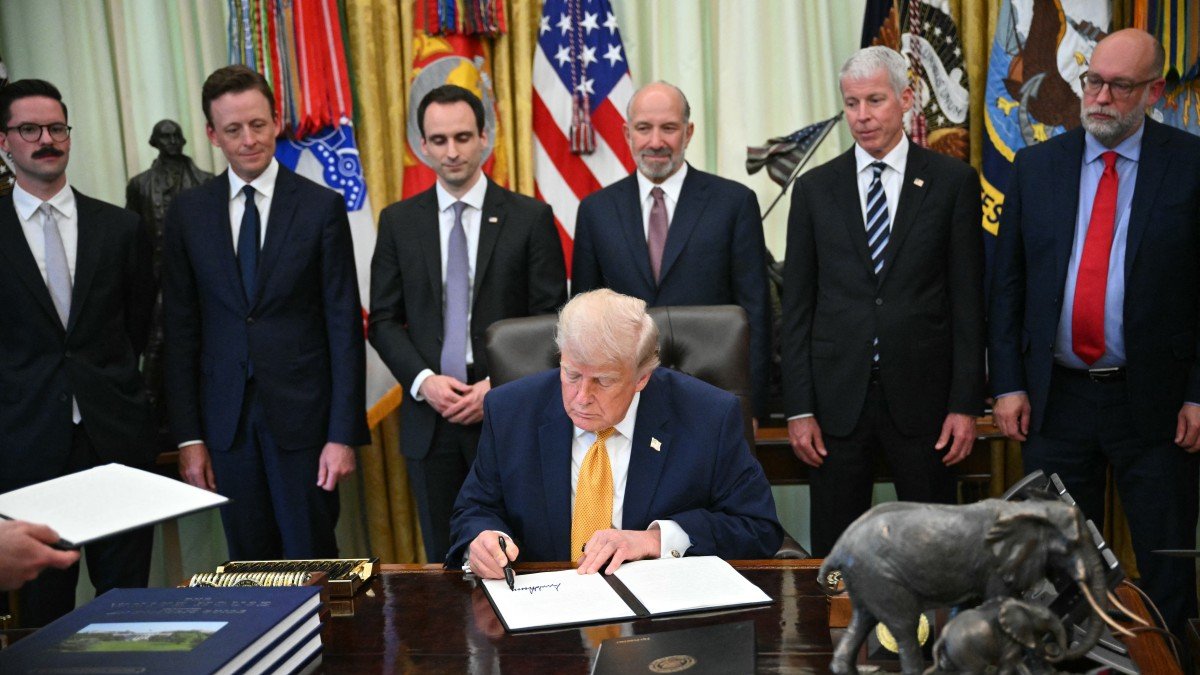
Trump signs an executive order on quantum computing in the Oval Office at the White House

President Donald Trump signed two executive orders on Monday to accelerate the development of a high-performance quantum computer and strengthen the protection of government computer systems against the threats posed by that same technology.
According to the text of the order, the measure aims to consolidate the United States’ advantage in a competition with China that could redefine science and cybersecurity over the next decade.
"The advent of large-scale quantum computers, particularly in the hands of adversaries, will pose a significant threat to widely used cryptographic security systems," the first executive order states. "In light of these threats, the United States must take steps to strengthen cryptographic protections for the Nation's sensitive data, critical infrastructure, and digital economy."
According to Reuters, the White House aims to have this computing capability in place before the end of Trump’s current term. Michael Kratsios, director of the Office of Science and Technology Policy, outlined the measures during a call with reporters and expressed confidence in the planned timeline.
The first of the orders focuses on defense, setting a goal to migrate major federal computer systems to post-quantum cryptography schemes between 2030 and 2031, a transition intended to protect sensitive government data before new machines can breach current encryption systems.


That concern, according to Reuters, is not merely theoretical, since quantum computers process information based on the laws of quantum physics and solve certain problems at a speed far exceeding that of today’s supercomputers. That same power could crack the encryption methods that currently protect governments, banks, and companies, opening the door to dangerous cyberattacks on a massive scale.
For Washington, the offensive aspect of the race is just as important. Mature quantum technology could drive advances in artificial intelligence, materials science, and chemistry—areas in which China has invested heavily in recent years. Last month, the Department of Commerce announced the purchase of $2 billion in equity stakes in nine companies in the sector, including a new initiative by IBM.
The second order, meanwhile, has an international focus, as the package aims to strengthen cooperation with foreign partners on intellectual property protection and supply chain security—an issue that Kratsios directly linked to pressure from rival governments on the U.S. economy.
“We must protect sensitive technologies and work with allies to ensure adversaries cannot use QIST to undermine national security” the order states.
The set of provisions also includes a mandate for federal agencies to develop plans to deploy quantum-enabled sensors and networks over the next five years, extending the focus beyond pure computing to detection and communications applications.
The orders come at a time when the Trump Administration has placed technological supremacy over Beijing as one of its strategic priorities, with the dual goal of harnessing the potential of quantum computing and mitigating the risks that this scientific frontier poses to national security.
LATEST