ANALYSIS
Learn about the woke 'effective altruism' network linked to Anthropic that Dario Amodei wants to oversee artificial intelligence
The personal, professional, and financial ties between METR, Anthropic, and some of its investors have drawn criticism. Detractors argue that an organization connected to the same ideological and business circles cannot act as a fully independent regulator.
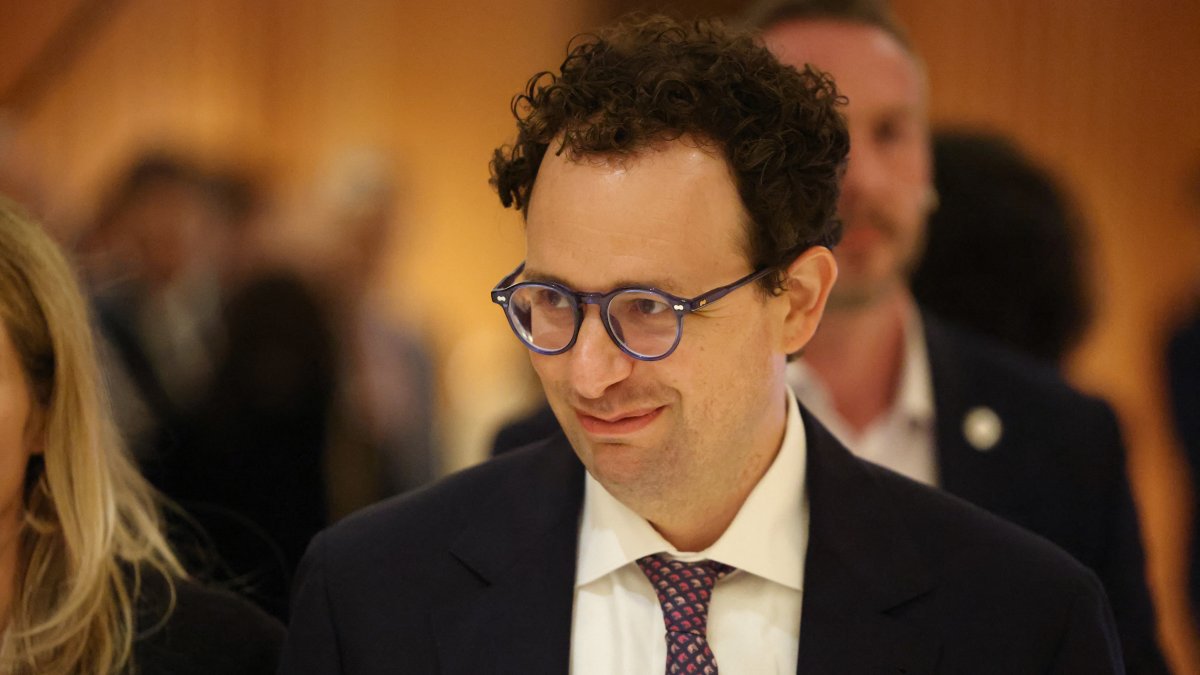
Dario Amodei, CEO of Anthropic

The CEO of Anthropic, Dario Amodei, wants leading artificial intelligence companies to allow permanent access for external evaluators to oversee their systems and reduce the risks associated with the development of advanced models.
According to information revealed by the New York Post (NYP), the proposal appears in his essay "We Must Pace the Frontier," in which he advocates slowing the pace of AI development to allow more time for safety research.
Amodei proposes that independent teams have access similar to that of employees to review training processes, report incidents, and verify whether models meet safety standards.

Politics
Trump labels voices calling for halt to AI as 'very negative forces' and defends US supremacy over China
Carlos Dominguez
The link to 'effective altruism'
The organization Amodei mentions as a potential regulator is Model Evaluation and Threat Research (METR), a nonprofit specializing in studying the capabilities and risks of advanced systems.
METR emerged from the Alignment Research Center (ARC), the lab led by researcher Paul Christiano. Christiano shared an office and worked at OpenAI with Dario Amodei; later, Beth Barnes set up ARC Evals there, the precursor to METR.

ARC is linked to effective altruism (EA): a movement that originated in Oxford and spread to Silicon Valley, which holds that one should donate and design policies based on calculation, not emotion, to maximize good. This philosophy took shape between 2007 and 2011 with the goal of funding the interventions that save the most lives per dollar, according to the criteria of the NGO evaluator GiveWell. Over the past decade, a growing share of funding and talent has shifted toward the existential risk posed by artificial intelligence. Climate change has taken a back seat.
Effective altruism is organized into a network of foundations, research centers, and investors that seeks to influence who audits AI and at what pace it can develop.

Who makes up the team
METR brings together individuals from the same pool of effective altruism advocates, and this group is no stranger to Anthropic.
- Beth Barnes, founder and CEO, left OpenAI and DeepMind, gave a TEDx talk on EA in 2015, and set up ARC Evals under Christiano's leadership.
- Ajeya Cotra, a member of the technical team and Christiano's wife, founded the Effective Altruists at Berkeley and served as a senior analyst at Open Philanthropy, the movement's largest funding organization.
- Hjalmar Wijk, chief scientist, has worked at the Future of Humanity Institute, the Center on Long-Term Risk, and MIRI.
- Megan Kinniment, also from Oxford, has worked at CLR, FHI, and 1DaySooner.
- Pip Arnott studied Human Sciences at Oxford; their METR profile uses the pronouns they/them.
- Jasmine Dhaliwal, a political scientist, was a British diplomat, chief of staff at Open Philanthropy and FutureHouse, and a biosecurity fellow at Johns Hopkins.

Technology
Altman and Musk back Amodei: OpenAI and xAI CEOs call for a slowdown in AI development
Luis Francisco Orozco
Amodei has pledged to donate 80% of his personal wealth, in line with the very concept of effective altruism. His sister Daniela, co-founder of Anthropic, is married to Holden Karnofsky, a driving force behind GiveWell and Open Philanthropy (now Coefficient Giving), the movement's major funding channels.
Also featured on the same map was Sam Bankman-Fried: he was one of the first major investors in Anthropic, the most visible face of EA, and, in the 2021–2022 cycle, the second-largest individual donor to the Democrats, second only to George Soros. His crypto empire collapsed, and he was ultimately convicted of fraud.
What has been documented is not an identity manifesto for every name on the METR list. It is something else: shared ideology, family ties, and an Oxford alumni network.

Criticism of its independence
The personal, professional, and financial ties between METR, Anthropic, and some of their investors have drawn criticism. Detractors argue that an organization connected to the same ideological and business circles cannot act as a fully independent oversight body.
According to the NYP, METR acknowledges its connection to effective altruism, but asserts that its employees hold diverse opinions and are required to disclose potential conflicts of interest. The organization also states that it does not accept funding from AI companies or their executives, and that its funders do not interfere in its research.
"To say you want to be audited by METR's 'independent' people is a complete joke," Perry Metzger, president of Alliance for the Future, a Washington, D.C.-based AI policy group, told the NYP.

Technology
'Our inaction will be unforgivable': Bipartisan letter urges Mike Johnson to suspend legislative recess to regulate AI amid growing global concern
Emmanuel Alejandro Rondón
"If tomorrow, as a major bank, you were to commission your audits from an organization made up entirely of your own former employees and funded by the same investors who invest in you, do you know what the federal authorities would do to you?" he added. "It would be truly medieval."
David Sacks, who served as the White House's AI czar, also joined the criticism. He urged Amodei to "stop pretending that METR is independent when it is intertwined with Anthropic's investors and staff."
The organization announced in August that it had secured funding commitments totaling about $71 million over the previous six months. Furthermore, according to published reports, foundations linked to major tech donors have supported METR or its predecessor organization.

Technology
Republican leaders take a stand on artificial intelligence: They demand security oversight without giving China an advantage
Andrés Ignacio Henríquez
An internal oversight model
Amodei's plan calls for evaluators to have access to offices, credentials, computer equipment, and internal company tools. They could also publish their findings on incidents and risks, with limited exceptions related to confidential or security-sensitive information.
The executive also proposes coordinating security standards among companies in democratic countries and, in the longer term, negotiating international rules on AI development. According to his approach, the goal would not be to halt innovation, but rather to align it with companies' ability to assess and control their risks.

Politics
Trump admin supports OpenAI in lawsuit filed by The New York Times over use of protected content
Williams Perdomo
Political and regulatory concerns
Federal Trade Commission Chairman Andrew Ferguson warned that caution is warranted if companies simultaneously seek new regulations and antitrust exemptions to coordinate their safety policies.
OpenAI supported the general idea of having external evaluators with internal access, although its CEO, Sam Altman, did not specifically mention METR.
LATEST